Camping food should be one of the best parts of a trip outdoors. Instead, it is where most trips quietly fall apart. The worst camping food mistakes are rarely dramatic. They are small decisions made at the supermarket or the night before, and they show up hours later as soggy sandwiches, lukewarm chicken, or a dinner that takes two hours to cook while everyone stands around hungry in the dark.
The problem is not that camp cooking is hard. It rewards planning and punishes improvisation far more than cooking at home does. There is no fridge to open, no tap to rinse a pan under, and no spare burner when the only one you brought runs out of gas.
This guide covers the worst camping food mistakes we see again and again, from food safety errors that can make people ill to planning failures that turn a weekend into expensive takeaway runs. Each mistake comes with a practical fix.
Key takeaways
- Keep cold food below 4°C from the moment you leave home, and treat a warm cooler as a food safety risk, not an inconvenience.
- Plan every meal before you pack, and prep as much as possible at home.
- Cook with the heat you actually have, not the heat you wish you had, and always carry a backup stove or a no-cook meal.
- Pack seasonings, oil, salt and the small tools that turn plain ingredients into a meal worth eating.
- Store every scrap of food securely at night, because wildlife finds camp food fast.
1. Packing Perishables With No Real Cold Chain
The single most dangerous of all the worst camping food mistakes is treating a cooler like a fridge. It is an insulated box that slowly warms up, and once the temperature inside climbs above 4°C, bacteria on meat, dairy and cooked food start multiplying fast. Perishable food should not sit between 4°C and 60°C for more than two hours, and on a hot day that window shrinks to one hour.
The fix starts before you leave. Freeze water bottles as ice blocks: they last far longer than loose ice and do not leave food swimming in meltwater. Pre-chill the cooler overnight, pack cold food straight from the fridge, put the food you need first on top, and keep the lid shut and the cooler in the shade.
What to freeze in advance
Freeze sauces, stews and marinated meat at home so they act as extra ice blocks and thaw into dinner by evening. Seal raw meat in a leak-proof bag, because meat juices dripping onto other food are a fast route to a ruined trip.

2. Bringing Far Too Much Food, or Far Too Little
Overpacking is the most common camping food mistake after the cold chain, and underpacking is the most miserable. Too much food means heavy bags, wasted money and a cooler full of items that spoil before anyone eats them. Too little means hungry campers and a drive to the nearest shop.
The answer is a meal plan, written down, with quantities. Plan every meal for every day, then shop from that list and nothing else. Count portions honestly: a full day of walking needs far more food than a day at a desk. Many of the worst camping mistakes beginners make start with packing by guesswork instead of by a list, and food is where that guesswork costs the most.
3. Cooking Everything Over an Open Flame
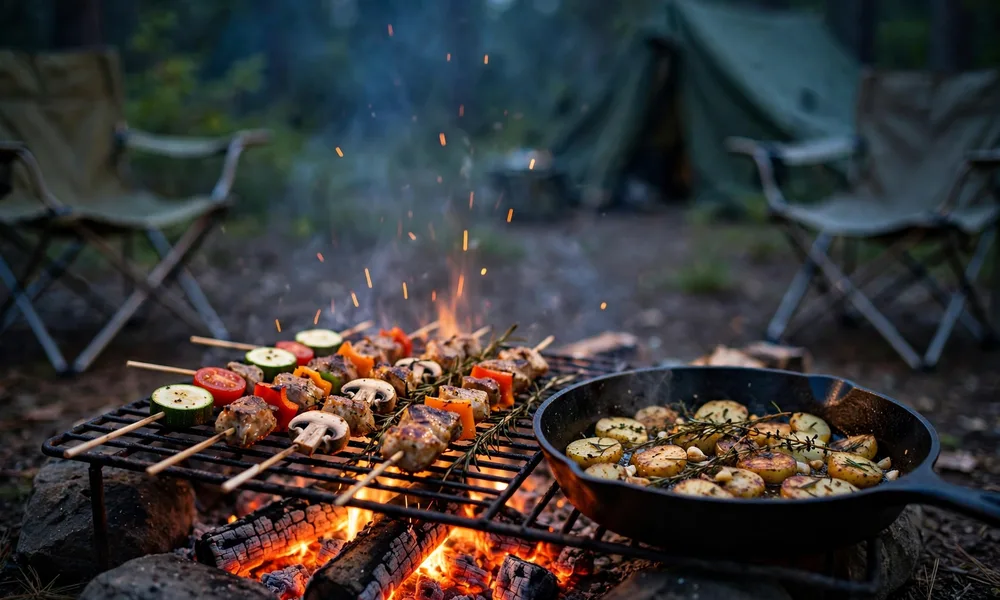
An open fire looks wonderful and cooks terribly if it is your only method. Flames are uneven and hard to control, and raw chicken that is burnt on the edges and pink in the middle is the classic result. Campfire cooking works best for foods that forgive uneven heat, such as foil parcels, skewers, corn on the cob and anything in a cast iron pan set over coals rather than flames.
Wait for the fire to burn down to glowing embers, which give steady, even heat, while tall flames give smoke and scorching. Better still, bring a proper camp stove as your main cooker and treat the fire as a bonus. The gas vs charcoal grills debate applies at camp too: gas gives instant, controllable heat, while wood gives flavour but demands patience and skill.
4. Forgetting the Seasonings, Oil and Basics
Plain pasta with no salt and vegetables with no oil are the meals that make people say camping food is boring. The missing piece is almost always the small stuff: salt, pepper, oil, butter, garlic and a spice blend. These items weigh almost nothing and transform the same ingredients from bland to genuinely good.
Pack a small camp kitchen kit and keep it packed between trips: salt and pepper, cooking oil in a small leak-proof bottle, a spice mix, butter, sugar, coffee or tea, and washing-up liquid. Add a sharp knife, a chopping board, tongs, a spatula, a can opener and a lighter.
5. Planning Meals That Need a Full Kitchen
Recipes that need three pans and an oven are not camp recipes, no matter how good they taste at home. The worst camping food mistakes often start with ambition: a stew that needs four hours, a dish with ten ingredients, or a meal that produces a mountain of washing up when water is rationed.
Choose meals with five or fewer ingredients, one pot, and minimal chopping at the campsite. One-pot pasta, foil-packet chicken and vegetables, pre-made chilli, breakfast wraps, and noodle soups are camp classics for a reason. Do the chopping and measuring at home, and pack ingredients in labelled bags in the order you will use them.
6. Ignoring Food Safety at the Campsite
Food safety matters more outdoors, not less, because there is no running water and no clean surface to fall back on. Hands that have handled raw meat or firewood need washing before they touch food, so carry water and soap to the cooking area.
Use separate boards and knives for raw meat and for everything else, or wash them thoroughly between uses. Cook meat until it is steaming hot all the way through, and never partly cook meat at home with the intention of finishing it at camp. Keep hand sanitiser and paper towels in the cook kit. Food poisoning at a campsite, miles from a pharmacy, is a trip-ender.
7. Relying on One Stove, One Pan and No Backup
A single point of failure is a terrible idea in the woods. If your only stove runs out of gas, if the igniter fails, or if your only pan is too small for the group, dinner is cancelled. Experienced campers almost never make this mistake, because at home there is always another burner and another pan.
Carry a second heat source, even a small one. A second gas canister, a backup burner, or a set of no-cook meals for one night covers most failures. Test your stove at home before you leave, including the igniter and the gas connection. The worst camping gear choices for beginners almost always include a stove bought on price alone and never tested at home.
8. Leaving Food Out for Wildlife
Food left on a picnic table overnight and coolers left open are an open invitation to raccoons, mice, birds and bears. Once wildlife learns a campsite has food, it keeps coming back.
Store all food, rubbish and anything scented in a sealed container, a car boot, or a bear canister where they are required. Clean the cooking area after every meal, never eat in your tent, and double-bag rubbish.
9. Skipping Breakfast and Running on Snacks
It is tempting to skip breakfast, grab a biscuit and get moving. By late morning the whole group is tired and hungry, and by lunch the plan has unravelled. Camping is physical work, and snacks alone do not replace a real meal.
Make breakfast the easiest meal of the day, not the one you skip. Oats with dried fruit, pancakes from a pre-mixed batter, eggs and toast, or porridge with honey all take ten minutes. Pack proper snacks too, but treat them as fuel between meals, not as meals: nuts, dried fruit, cheese, crackers, fruit and energy bars.

10. Having No Plan for Rain, Wind or Fire Bans
Weather is the variable that breaks the most meal plans. A menu built entirely around a campfire fails the moment it rains or a fire ban is announced. Campers who only have one way to cook end up eating cold snacks in the rain while their dinner plan sits unused.
Plan for the weather you might get, not the weather you hope for. Keep at least one meal per day that needs no cooking at all, such as wraps, sandwiches or cured meats with bread and cheese. Carry a wind shield for your stove, and never use a stove inside a tent.
Quick Comparison: The Mistake and the Fix
| Mistake | What goes wrong | The simple fix |
|---|---|---|
| No cold chain | Meat and dairy warm into the danger zone | Frozen bottles, pre-chilled cooler, thermometer |
| No meal plan | Too much waste or too little food | Written plan with portions for every meal |
| Only open-flame cooking | Burnt outside, raw inside | Cook on embers, bring a gas stove |
| No seasonings or oil | Bland meals nobody enjoys | Keep a packed camp spice kit |
| Over-ambitious recipes | Hours of cooking, piles of washing up | One pot, five ingredients, prep at home |
| Poor food hygiene | Cross-contamination and illness | Separate boards, wash hands, cook through |
| One stove, no backup | Dinner cancelled by a dead stove | Spare gas, second burner, no-cook meal |
| Food left out overnight | Wildlife raids the camp | Sealed storage, clean site, no food in tents |
Camping Food Checklist
- ☐ Cooler pre-chilled, frozen water bottles packed, thermometer inside
- ☐ Written meal plan with portions for every breakfast, lunch and dinner
- ☐ Seasonings, oil, salt and a sharp knife in a packed camp kitchen kit
- ☐ Stove tested at home, spare gas canister and a no-cook backup meal
- ☐ Separate chopping board for raw meat, soap, sanitiser and paper towels
- ☐ Sealed food storage and rubbish bags for every night, nothing left out
Frequently Asked Questions
How long does food last in a cooler while camping?
With frozen water bottles, a pre-chilled cooler and the lid kept shut, a good cooler keeps food below 4°C for two to three days. Check the temperature with a thermometer, and eat perishable food earliest in the trip.
What is the safest meat to take camping?
Pre-cooked and cured meats are the safest choices. If you take raw meat, keep it frozen until the day you cook it, seal it in leak-proof bags, store it at the bottom of the cooler, and cook it thoroughly the same day it thaws.
Can you cook over a campfire without a grill?
Yes. A cast iron pan set on embers, foil parcels in hot coals, and skewers over the heat all work without a grill. Holding food directly over tall flames scorches the outside while the inside stays raw.
How much water do you need for camp cooking?
Plan on at least one litre per person per day for cooking and washing up, on top of drinking water. Bring more than you think you need.
What should you do if your stove breaks at camp?
Switch to your no-cook backup meal for that night, then cook on the campfire with a pan over embers if a fire is allowed. This is exactly why a backup meal and spare gas belong on every packing list.
Is it safe to keep food in your tent?
No. Smells attract insects, mice and larger animals to where you sleep. Store food in a sealed container, in a car, or in a bear canister, well away from the sleeping area.
The Bottom Line
The worst camping food mistakes all share the same root cause: treating camp cooking like home cooking. Keep your food cold, plan every meal, prep at home, pack your seasonings and your backup plan, and store everything securely at night.