
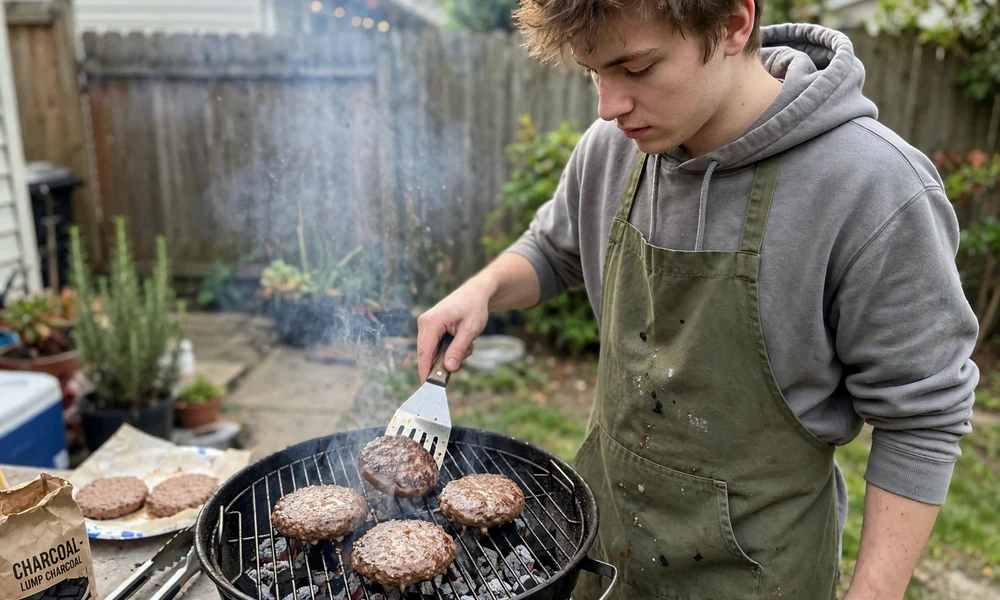
A charcoal grill for a beginner has one job: to make a first cook simple, forgiving and safe, while the cook learns how fire behaves. The worst charcoal grills for beginners of 2026 cannot do it. Their vents stick or do nothing at all, their ash goes everywhere except the tray, and their cooking area is so small that a beginner cannot set up the hot and cool zones that every guide talks about. The photograph shows a relaxed cook turning burgers over a glowing grill. What arrives is a grill that will not light, will not hold heat, and will not clean up afterwards. A beginner needs a grill that forgives mistakes, and a bad one punishes every single one.
What Makes a Charcoal Grill Bad for Beginners
The first thing to understand about a beginner and charcoal is that the beginner is learning two things at once: how to cook, and how to manage a fire. A good beginner grill makes the fire part easy, with vents that move smoothly, a lid that fits, and a grate at the right height above the coals. A bad grill makes the fire part hard, with vents that stick, a lid that gaps, and a grate so close to the coals that everything burns. The beginner blames their own cooking, when the grill was the problem all along.
The second problem is that a beginner needs room to make mistakes safely. A good grill has space for a hot zone and a cool zone, so food can be moved away from a flare-up instead of burning. A bad grill is so small that the whole grate is one hot zone, and a flare-up means the food is ruined. A grill that gives a beginner nowhere to move the food is not a beginner grill. It is a trap, and it earns its place among the worst charcoal grills for beginners of 2026. The test is simple: light it, cook on it, and see whether you can move food away from the fire. If you cannot, the grill is too small to learn on.
Vents That Stick or Do Nothing
Vents are how a charcoal grill is controlled, and the worst vents fail in the most frustrating way. Some stick shut, so the fire starves and dies. Some stick open, so the fire roars and cannot be tamed. Others move freely but do nothing, because they are too small, badly placed, or blocked by ash. A beginner who cannot control the vents cannot control the grill, and a grill that cannot be controlled is a grill that cooks by luck. The first cook is too hot, the second is too cold, and the third is a guess.
The test takes a minute. Move every vent through its full range with one hand. A good vent moves smoothly and stays where you put it. A bad vent sticks, wobbles, or falls shut on its own. Then light the grill and try to bring the temperature down by closing the vents halfway. If nothing changes, the vents are decorative, and the grill has no temperature control at all. If you want to know what a grill that controls properly looks like, read our guide to the best charcoal grills and notice how the winners are all judged on their vents first. The worst grills are the ones where the vents do nothing, and a beginner always finds them out.
Ash That Goes Everywhere
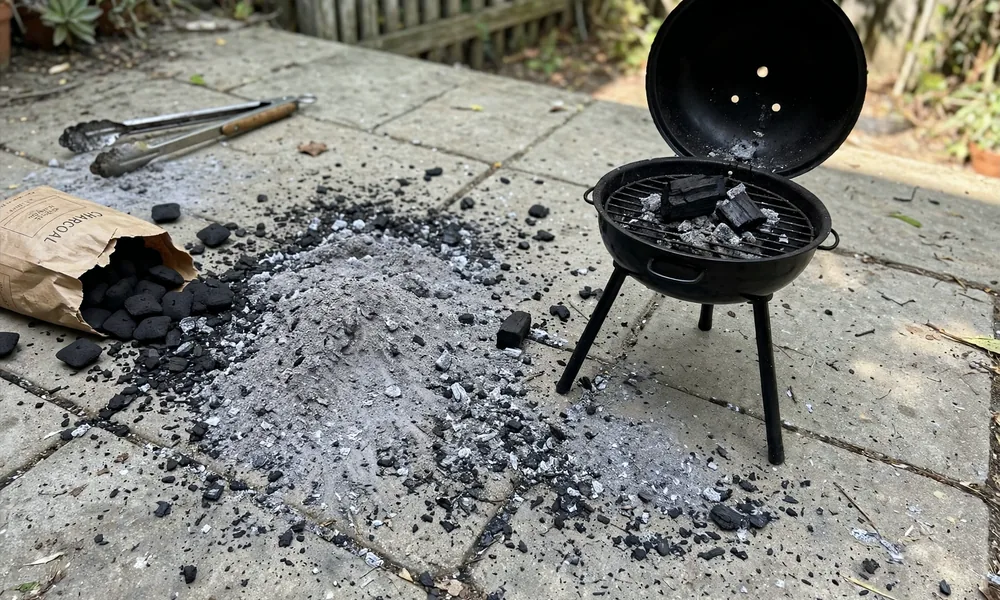
Ash is the part of charcoal grilling that nobody photographs, and the worst grills make it a misery. Some have no ash catcher at all, so ash falls straight onto the patio and blows across the garden. Others have a tray so small that it overflows after one cook, or a tray that is fixed in place and cannot be removed without taking the grill apart. A few have a tray that looks fine but is blocked by the legs, so ash builds up under the fire, chokes it, and the temperature crashes halfway through cooking.
The test is to empty the ash after a cook and see how long it takes. A good grill has a large tray or catcher that slides out in seconds and holds a whole cook’s worth of ash. A bad one takes ten minutes, a brush, and a dustpan, and still leaves ash on the patio. Ash matters more than most beginners think, because ash chokes the fire, and a choked fire is a cold fire. A grill that cannot be cleaned easily will not be cleaned often, and a grill that is not cleaned will cook worse every time. If the ash system is an afterthought, the grill was designed by someone who never cleaned one.
Grills Too Small to Learn On
Size is the fault that a beginner feels most, because a small grill gives a beginner nowhere to hide. The worst beginner grills are tiny kettles barely wider than a dinner plate, sold as perfect for a first grill. They are not. A grill that small has no cool zone, so a flare-up means the food burns. It has no room for a chimney starter, so lighting it is a struggle. It has no space for more than two burgers, so cooking for a family means cooking in shifts, with the first burgers cold by the time the last ones are done.
The test is to count the burgers the grill can hold with a cool zone left over. A good beginner grill holds four burgers on the hot side and leaves room on the cool side to move them. A bad one holds two burgers and nothing else. A beginner who has to cook in shifts is a beginner who will give up, and a grill that makes a beginner give up is a grill that has failed. The right size for a first grill is a medium kettle, big enough for a hot zone and a cool zone, small enough to move and store. If the grill is barely wider than a plate, it is a toy, not a grill, and it will teach a beginner nothing except frustration.
Lids and Grates That Fight You
A lid that does not fit and a grate that does not sit right are faults that a beginner feels on the first cook. The worst lids gap at the rim, so heat and smoke escape and the temperature cannot be held. Some lids have a handle that gets hot, so the beginner burns a hand lifting it. Others have no hook or holder, so the lid has to be put on the ground, where it picks up dirt and grass. The worst grates are thin wire that sags under food, rusts after a few cooks, and lets small items fall through into the coals.
The test is to close the lid and look at the seam. A good lid sits flat all the way around, with no gap to let heat out. A bad lid rocks, gaps, or needs a push to close. Then look at the grate. A good grate is heavy, with bars close enough together to hold a sausage. A bad grate is thin wire with wide gaps, and it will sag and rust within a season. A lid that gaps and a grate that sags are not small faults. They are the faults that decide whether the grill holds heat and holds food, and a grill that does neither is not a grill at all.
Grills That Rust Before You Learn
Rust is the fault that ends a beginner grill early, and it ends it fast. The worst beginner grills are made of thin steel with a coat of paint that burns off the bowl on the first hot cook. Within a season the bowl is pitted, the legs are rusted at the joints, and the vents have seized shut. Some grills rust from the inside out, so the outside looks fine while the bowl corrodes, and the owner only discovers it when the bottom falls out during a cook.
The materials that last are thick steel, porcelain enamel, and heavy cast iron. They cost more, but they survive heat after heat without a mark. When you look at a grill, check the bowl first, because that is where the heat and the rust start. If the metal feels thin, if the paint is already chipped, or if the legs are bare steel, the grill will rust. If you want to know what a grill built to last looks like, read our guide to the best grills and notice how the winners are all thick, coated and heavy. A grill that rusts in a season is a grill you will replace in a year, and the lessons you learned on it will be lessons in frustration.
How to Spot a Bad Beginner Grill Before You Buy It
The best time to spot a bad charcoal grill is in the shop, before any money changes hands. Move every vent through its full range. If it sticks or does nothing, the grill has no temperature control. Look at the ash system. If there is no catcher, or the tray is tiny and fixed, cleaning will be a misery. Count the burgers the grate can hold with a cool zone left over. If it holds two and nothing else, it is too small to learn on. Close the lid and look at the seam. If it gaps, heat will escape. Pick up the grate. If it feels light and flimsy, it will sag and rust.
Then think about the cooks you will actually do. A grill that cannot hold heat, cannot be cleaned, and cannot fit a family meal is not a beginner grill. It is a toy that burns charcoal. The right grill is a medium kettle with smooth vents, a big ash catcher, a heavy grate, and a lid that fits. Everything else is a lesson in frustration. If you want to see how charcoal compares with other grills, our guide to the best vs worst grills will help you judge the whole category. Get the first grill right, and charcoal becomes the best cooking you do all summer. Get it wrong, and the grill will be rusting in the corner by next spring, and the beginner will have given up.

The Verdict on the Worst Charcoal Grills for Beginners
The worst charcoal grills for beginners of 2026 all fail in the same few ways. Their vents stick, their ash goes everywhere, they are too small to learn on, or they rust before the beginner has learned anything. They look fine in a photograph and fail over a real fire, and the beginner is the one who pays for it, with burnt food, a cold grill, and a patio full of ash. A grill that cannot be controlled, cannot be cleaned, and cannot fit a family meal is not a beginner grill. It is a toy that burns charcoal, and charcoal deserves better. The good news is that the faults are easy to spot before you buy: move the vents, check the ash tray, count the burgers, and close the lid. A grill that passes those four tests will teach a beginner to love charcoal. A grill that fails even one of them will be rusting in the corner by next spring.


