A diamond painting kit has one job: to let a maker stick tiny resin drills onto a coded canvas and end up with a picture that sparkles. The worst diamond painting kits of 2026 fail at it in ways that leave a maker with drills that do not match, a canvas that will not hold them, or a picture that looks nothing like the box. They use dull drills, weak glue, and symbols too small to read. People buy them hoping for a relaxing craft that ends in a picture worth framing. What they get is a kit that frustrates, a kit that falls apart, or a kit that ends up rolled up in a cupboard. A kit that is bought for relaxation should be judged on a quiet evening, not on the first ten minutes, because the first ten minutes are always the easiest.

Drills That Do Not Match the Chart
A diamond painting kit lives or dies on its drills, and the worst kits get them wrong. The drills are the wrong colour for the symbol on the chart, the bags are mislabelled, or there are not enough drills to finish the picture, so a maker runs out of the most-used colour halfway through. Some kits include drills in the wrong shape, square drills for a round-drill canvas, so they do not sit together and leave gaps. A picture that cannot be finished because the drills ran out is a craft that ends in frustration. A drill that is the wrong colour will stand out on the finished picture, and a picture with the wrong colours is a picture that can never be fixed.
A good kit counts its drills carefully and includes extras of every colour, because a few will always be lost. The bags should be labelled clearly with the symbol they match, and the chart should be printed large enough to read without squinting. Check the drill count before you start, and sort the drills into a tray or small pots so a spill does not mix the colours. If the drills do not match the chart on the first section, stop and contact the seller, because the rest of the picture will be wrong too. A drill that is lost under the table will be found by a bare foot, so a kit with a tray is also a kit that keeps the floor safer.
Canvas Glue That Gives Up
The canvas must hold every drill firmly, and the worst kits use glue that gives up. The adhesive is too weak, so drills fall off when the canvas is moved, or it is patchy, so whole sections will not hold a drill at all. Some canvases arrive with the glue dried out, because the protective film was loose in transit, and no drill will stick to a dry canvas. A picture that sheds its drills every time it is touched is a picture that will never be finished, let alone framed. A canvas that sheds drills will shed them at the worst moment, usually when the picture is moved to be shown to someone.
Test the glue on a small corner before you start: press a few drills onto the canvas and lift it gently. A good canvas holds them firmly, while a bad one lets them drop off. Keep the protective film on the sections you are not working on, and work in small areas so the glue does not dry out. If the canvas is dry on arrival, the kit is faulty, and no amount of careful work will make the drills stick. A canvas that holds its drills is the foundation of the whole craft. A canvas that holds its drills firmly will also hold them after framing, while a weak canvas will shed drills behind the glass.
Symbols Too Small to Read
A diamond painting canvas is covered in tiny symbols, and the worst kits print them too small to read. The symbols blur together, two similar symbols look identical, and a maker has to hold a magnifier over the canvas for hours, which turns a relaxing craft into an eye strain. The problem is worst on large canvases with many colours, where the symbols are smallest and the differences between them are hardest to see. A kit that cannot be read cannot be finished, however good the drills are. A symbol that cannot be told apart from its neighbour will be placed wrongly, and a wrongly placed drill is a mistake that shows on the finished picture.
Look for a canvas with symbols printed clearly and large enough to read at arm’s length, with a chart that lists every symbol and its drill colour. A light pad underneath the canvas helps a lot, and many good kits include one or suggest it. If the symbols are printed in pale ink on a busy background, the canvas will be hard to read no matter how good the light is. A readable canvas is a relaxing canvas, and a canvas that strains the eyes is a canvas that gets abandoned. For a wider look at kits that respect the maker, our guide to the best craft kits of 2026 covers the kits that keep their promise, from papercraft to candle-making. A light pad is the cheapest upgrade a diamond painter can buy, because it turns a squinting chore into a relaxing evening.
Trays and Pens That Do Not Work
A diamond painting kit needs a tray that lines the drills up and a pen that picks them up, and the worst kits include tools that do neither. The tray is too shallow, so the drills spill everywhere, or its grooves are too wide, so the drills will not line up. The pen does not hold its wax, so it cannot pick up a drill, or the wax is so hard it will not take a drill at all. A maker who spends more time fighting the tools than placing drills will give up long before the picture is done. A tray that is too shallow will spill drills across the table, and spilled drills take longer to sort than the picture takes to make.
Good tools are simple and they work: a tray with grooves that match the drill size, a pen that holds its wax, and enough wax to last the whole picture. Test the pen on a few drills before you start, and if it will not pick one up, replace the wax or the pen. A spare pen and extra wax are worth having, because a pen that stops working halfway through a picture stops the whole craft. A kit whose tools work is a kit that lets the maker focus on the picture, which is the whole point. A pen that stops working halfway through a picture stops the whole craft, so a spare pen is worth more than a fancy one.
Canvases That Will Not Lie Flat
A diamond painting canvas must lie flat while you work, and the worst ones will not. They arrive rolled tight in a tube, and the creases never come out, so the canvas curls up at the corners and the drills slide off the raised edges. Some canvases are printed on thin material that wrinkles under the weight of the drills, or they are cut crooked, so the picture is never square. A canvas that will not lie flat is a canvas that fights the maker at every step. A canvas that curls at the corners will also lift the drills at the edges, so the border of the picture is the first part to fail.
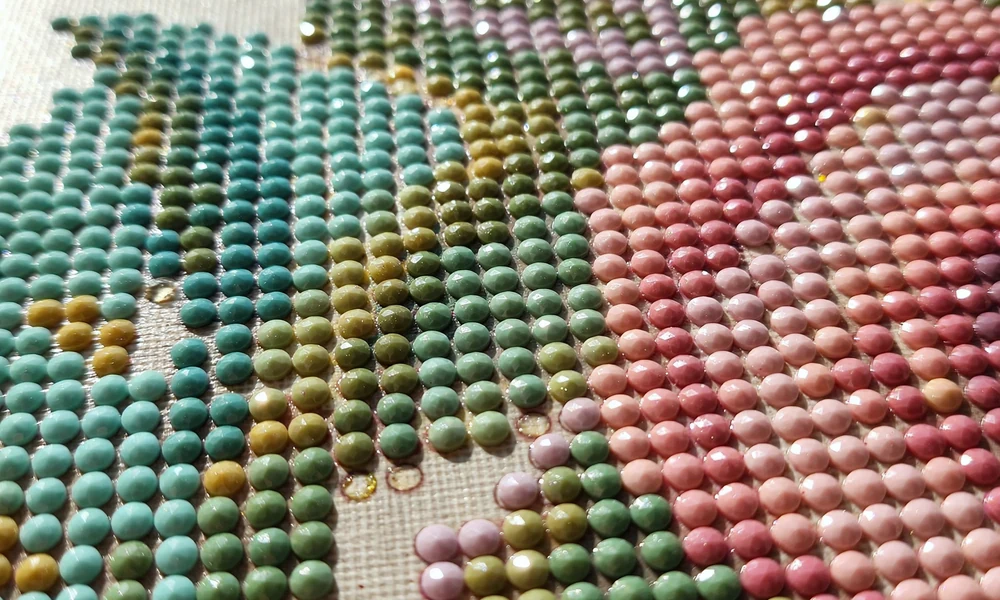
A good kit ships its canvas flat, or rolled loosely with a protective tube, and the canvas should flatten within a day under a few books. If the creases are deep and will not come out, the canvas is faulty, and the picture will never sit right. Work on a flat, hard surface, and tape the corners down if they lift. A flat canvas is the simplest requirement of the craft, and a kit that cannot meet it is a kit that was packed without care.
Pictures That Look Nothing Like the Box
A diamond painting kit should produce a picture that looks like the one on the box, and the worst ones do not. The image is too small for the drill size, so the picture is blocky and unrecognisable, or the colours are wrong, so a portrait comes out with a green face and a purple sky. Some kits use a low-resolution image stretched to fit a big canvas, so the result is blurry even when every drill is placed correctly. A maker who spends forty hours on a picture that looks nothing like the box will not buy another kit. A picture that is too detailed for its canvas will look blocky from across the room, and a blocky picture is not one worth framing.
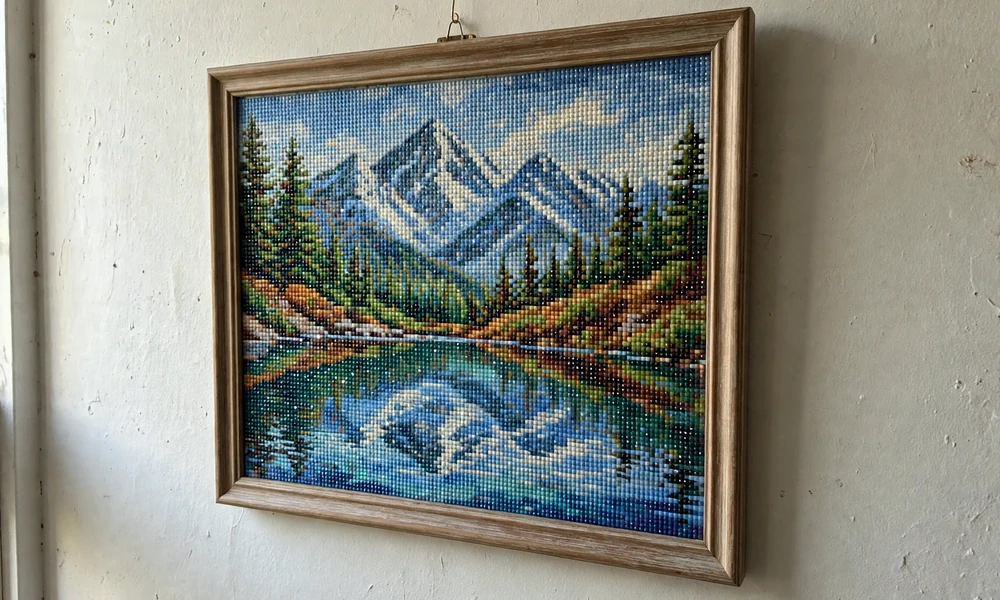
Check the canvas size against the image before you buy: a detailed picture needs a large canvas, and a small canvas can only carry a simple design. A good kit shows an honest photograph of a finished piece, not a computer mock-up, and the drill count matches the detail in the image. If the picture on the box looks too detailed for the canvas size, it probably is. A picture that looks like the box is a picture worth framing, and a picture that does not is forty hours wasted. A large canvas takes weeks to finish, so a beginner who starts too big will run out of patience long before they run out of drills.
What to Buy Instead
The diamond painting kits worth buying share a short list of features, and none of them is expensive on its own. Drills that match the chart, with extras of every colour. A canvas with strong, even glue that lies flat and has symbols large enough to read. A tray and pen that work, and a picture that suits the canvas size. If a kit fails any one of those checks, keep looking.
Fit matters as much as build, and the kit should suit the maker in front of you rather than the maker in the photograph. A beginner should start with a small canvas, few colours, and round drills, which are more forgiving than square ones. An experienced maker can take on a large canvas with many colours, but only if the symbols are clear and the drills are plentiful. Work in small sections and keep the film on the rest. If you want the rest of the craft table covered too, our guide to the best art supplies of 2026 covers the paints, papers and tools that make a craft table complete.
The Bottom Line
The worst diamond painting kits of 2026 share a pattern: drills that do not match the chart, canvas glue that gives up, symbols too small to read, trays and pens that do not work, canvases that will not lie flat, and pictures that look nothing like the box. Avoid those six failures and you avoid almost every diamond-painting regret. Test the glue on a corner, check the symbols are readable, and start with a small canvas. Do that, and the kit you buy will be the one that ends with a picture worth framing. And if you need the brushes for the rest of your craft work, our guide to the best paint brushes of 2026 covers the brushes that hold a point and do not shed.