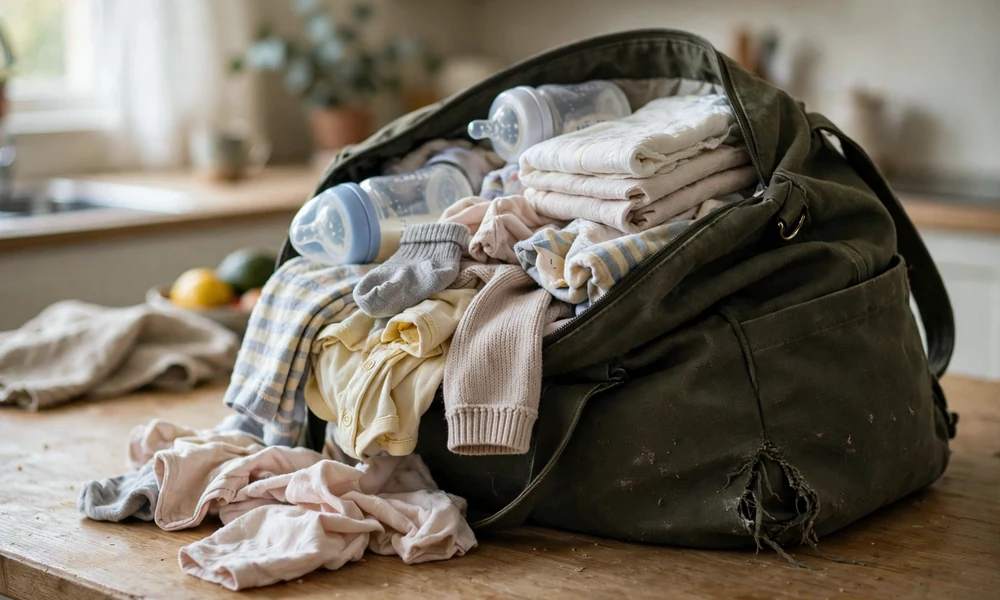
A diaper bag for one baby is already a test of organisation. A diaper bag for twins is a test of engineering, because it has to carry double the nappies, double the bottles, double the changes of clothes, and still close properly, still hang on a pushchair, and still let a parent find anything with one hand while holding a baby in the other. The worst diaper bags for twins of 2026 fail at the first of these jobs: they burst at the seams, swallow nothing, and dig into the shoulder of the person carrying them. A parent of twins deserves a bag that works as hard as they do, not one that gives up before lunchtime.
What Makes a Twin Diaper Bag Bad
A twin diaper bag has one job above all others: it must hold everything two babies need, and keep it organised enough to find in a hurry. A good bag has a pocket for every category, a wide opening that stays open while you reach inside, and a shape that holds its own when it is set down. A bad bag is a single dark cavern where everything sinks to the bottom, so a parent has to empty half the bag to find a dummy. The worst bags look big in the photograph and turn out to be mostly padding and dead space, with pockets that are too small for a bottle and too shallow for a folded change of clothes.
The second problem is the weight. A bag for twins is heavy when it is full, and a bad bag makes that weight worse. Thin straps cut into the shoulder, a narrow handle digs into the hand, and a bag with no weight distribution pulls to one side until the parent is walking lopsided. Some bags have straps that slip off the shoulder constantly, so the parent is always hitching the bag back up with a baby in one arm. A bag that hurts to carry will be left at home, and a bag left at home is no use at all. Comfort is not a luxury in a twin bag; it is the difference between a bag that gets used and a bag that gathers dust.
The Main Types of Twin Diaper Bag, and Where They Go Wrong
Backpack bags are the most popular style for twins, because they leave both hands free, and they fail in the most predictable ways. A good backpack has wide, padded straps, a chest strap to spread the load, and a back panel that does not turn into a sweaty slab. A bad one has thin straps that cut in after ten minutes, a back panel with no ventilation, and a shape that pulls backwards so the parent leans forward to compensate. The worst backpacks have a top opening that is too narrow, so a parent has to fight the bag to get a bottle out, and a front pocket that is too small for anything except a phone.
Tote and messenger bags suit parents who prefer one shoulder, and they fail differently. A good tote has a long, adjustable strap, a reinforced base, and a shape that stays upright when it is set down. A bad one has a strap that is too short to wear across the body, so the bag bangs against the hip with every step, and a base that collapses, so the bag tips over and spills its contents the moment it is put down. Messenger bags for twins are the worst offenders, because they concentrate all the weight on one shoulder, and a parent carrying double kit on one shoulder will feel it by the end of the first outing. For more on the single-baby bags these designs are based on, our guide to the best diaper bags of 2026 covers the features that matter before the load is doubled.

The Bag That Bursts: Worst for Seams and Zips
A burst seam is the worst failure a twin diaper bag can have, because it happens at the worst moment and it cannot be fixed on the go. A good bag is stitched to carry its rated load, with reinforced seams at the base and the straps, and a zip that runs smoothly when the bag is full. A bad bag is stitched for looks, with single stitching at the stress points and a zip that jams the moment the bag is packed properly. The seam goes first, usually at the bottom corner, and the contents start to escape. A parent who discovers a burst seam at the park has no way to fix it, and the bag is finished.
The zip is just as important as the seam. A good zip is chunky, runs the full width of the bag, and opens wide enough to see inside. A bad zip is small, flimsy, and catches on the lining every time it is pulled. Some zips are placed so that the bag cannot be opened fully, which turns the bag into a dark hole with a small mouth. Others are placed on a curve, so they wear out quickly and split. Test the zip in the shop with the bag full, because a zip that works on an empty bag and fails on a full one is a zip that will fail on the first real outing. A twin bag is always full, and it has to be built for that.
Pockets That Do Not Work
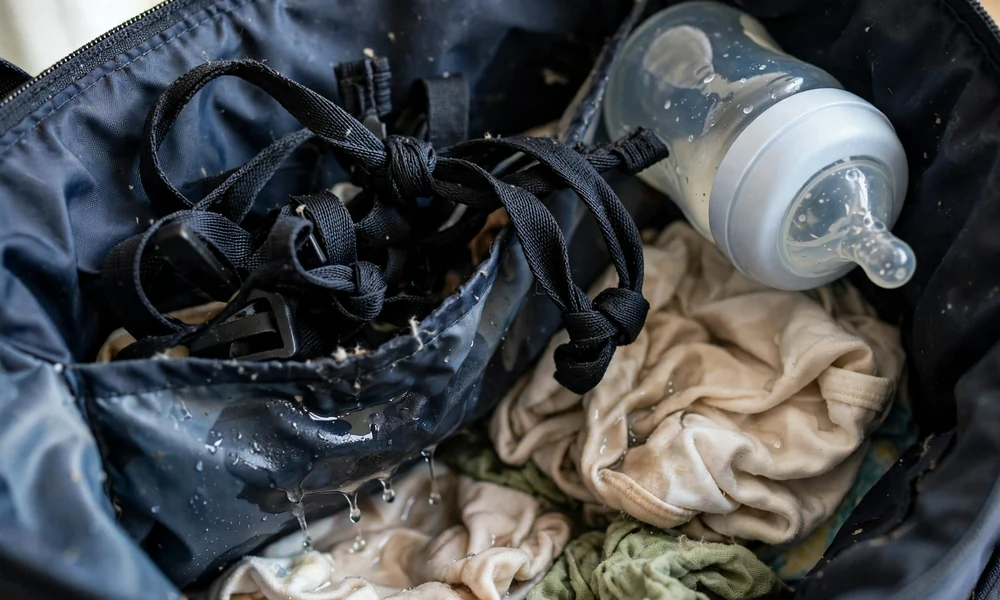
Pockets are where a twin bag earns its keep, and the bad ones get them wrong in every direction. A good bag has insulated bottle pockets that actually keep a bottle warm, a wet pocket that seals properly, and a pocket for wipes that can be reached without opening the whole bag. A bad bag has bottle pockets that are too narrow for a standard bottle, so the bottle sticks out of the top and tips over. Its wet pocket is a thin mesh that leaks into the rest of the bag, and its wipes pocket is a slit in the side that lets the wipes dry out. Some bags have a dozen pockets and none of them fit anything useful, which is worse than having three pockets that work.
The layout matters as much as the count. A pocket on the outside is useful only if it can be reached while the bag is hanging on a pushchair, and a pocket on the inside is useful only if it can be found without emptying the bag. The best twin bags put the things a parent needs in a hurry, wipes, a dummy, a bottle, on the outside, and the things that can wait, spare clothes, nappies, a blanket, on the inside. The worst bags hide everything equally, so every search becomes a rummage. Pack the bag the way you would for a real outing before you buy it, and if you cannot find the wipes in ten seconds, the pockets are in the wrong places.
Pushchair Clips and the Tipping Problem
A twin diaper bag spends most of its life hanging on a pushchair, and the bad ones forget that. A good bag has strong clips that fit a double pushchair handlebar, hold the weight without slipping, and unclip with one hand. A bad bag has clips that are too small for a thick handlebar, so they pop off the moment the bag is loaded, or clips made of thin plastic that snap under the weight. Some bags have no clips at all, just a strap that is supposed to loop over the handle, and the strap slips off at the first bump. A bag that falls off a pushchair onto a pavement is a bag that has failed its most basic job.
The tipping problem is the other half of the same failure. A heavy bag hung on a pushchair changes the balance of the whole thing, and a bag that hangs too high or too far back can tip a double pushchair backwards when the babies are lifted out. The best bags hang low and close to the frame, and the worst hang high and swing. Some pushchairs have a weight limit for handlebar bags, and a twin bag that is full can exceed it on its own. Check the clips, check the balance, and check the pushchair manual before you buy. A bag that tips the pushchair is not just inconvenient, it is dangerous, and no amount of storage space makes up for that.
How to Spot a Bad One Before You Buy
Pack the bag before you buy it, with everything two babies need for a day out: nappies for two, bottles for two, two changes of clothes, wipes, a blanket, and a dummy each. If it does not all fit with the zip closed, it is too small, whatever the label claims. Lift it by the straps and walk around the shop: if the straps cut in, if the bag pulls to one side, or if it slips off your shoulder, it will be worse on a real outing. Hang it on a pushchair if the shop has one, and check that the clips hold and the balance is right.
Check the seams, the zips, and the pockets with your hands, not just your eyes. Pull gently at the base seams, run the zip three times with the bag full, and try to reach the wipes pocket without opening the main compartment. If the bag has a wet pocket, pour a little water into it and check that nothing leaks through. A twin bag is used every day, often twice a day, and the difference between a good one and a bad one is the difference between an outing that works and an outing that falls apart. For the rest of the twin kit, our guide to the best strollers of 2026 covers the pushchairs these bags hang from, and our guide to the best baby wipes of 2026 covers the wipes that have to be reachable in seconds. Buy the bag that holds everything, stays comfortable, and keeps its seams, and walk past the one that only looks roomy in the photograph.
The Verdict
The worst diaper bags for twins of 2026 are the ones that burst at the seams, hide everything in one dark space, and dig into the shoulder of the person carrying them. The best are the ones you stop noticing, because everything has a pocket, the straps spread the load, and the bag hangs safely on the pushchair. Pack a bag properly before you buy it, and judge it on a week of real outings. A bag that survives a year of twin outings has paid for itself many times over, whatever it cost on the day it was bought. A good twin bag is used every day, and the difference between a good one and a bad one is the difference between an outing that runs smoothly and one that unravels before lunchtime.