
Full-Length Mirrors That Make Getting Dressed Easier in 2026
Full-length mirrors that make getting dressed easier in 2026 do one job well: they show the whole outfit, head to toe, in honest light, before you leave. A good one catches the hem, the shoes, the way a jacket sits, and the colour of a top in daylight. A bad one shows a wavy reflection, cuts you off at the knees, or hangs in a dim corner where everything looks grey. This guide is about the dressing mirror, not brightening a hallway: how to pick one that makes mornings quicker and calmer.
A useful mirror differs from a decorative one in four ways: height, glass, light, and position. Get those right and the mirror becomes part of getting dressed rather than an afterthought. Get them wrong and you will keep finding problems only after leaving the house, when it is too late.
Key Takeaways
- A dressing mirror should be at least 150 centimetres tall, showing most people head to toe without stepping back.
- Flat, distortion-free glass matters more than the frame: stand at an angle and check that straight lines stay straight.
- Place the mirror where daylight falls on you, not on the glass, so colours look true and the reflection stays clear.
- Leaning mirrors suit renters and bedrooms; wall-mounted mirrors suit small dressing corners and homes with children or pets.
- Hang or lean the mirror near the wardrobe, with space to step back two paces, so the full outfit fits in the frame.

Why a Full-Length Mirror Changes Getting Dressed
Getting dressed is a series of small judgements: does this jacket go with these trousers, is the hem the right length, do the shoes work, is the shirt tucked or untucked? A waist-up mirror answers none of them. You end up guessing or asking someone else. A full-length mirror answers all of them in one glance, while you still have time to change.
It also changes how you shop. When you can see the whole outfit at home, you learn what actually suits you: which lengths flatter you, which colours wash you out, which combinations you reach for again and again. Clothes that looked fine on a shop rail reveal themselves quickly at home, and the pieces that work earn their place.
There is a practical point too. A mirror near the wardrobe saves the daily shuffle between bedroom and bathroom, and stops last-minute discoveries of stains, creases, or mismatched shoes. Ten seconds before a good mirror beats ten minutes of doubt later.
The Main Types of Full-Length Mirror
Leaning Floor Mirrors
The leaning mirror is the classic dressing mirror: a tall mirror, usually 150 to 180 centimetres, that rests against the wall at a slight angle. It needs no drilling, so it suits renters, and it moves easily when the room changes. The trade-off is safety: it is heavy and can topple, so it needs a wall anchor at the top, especially with children or pets.
Wall-Mounted Mirrors
A wall-mounted mirror is fixed flat to the wall, so it takes up no floor space and cannot be knocked over. It suits small bedrooms and dressing corners, and is safest where children play. Hung with its centre at eye level, around 145 to 155 centimetres from the floor, it gives a true, straight-on reflection. The cost is commitment: you must drill and be sure of the position, since moving it means patching holes.
Over-the-Door Mirrors
An over-the-door mirror hangs from hooks on a bedroom or wardrobe door, the cheapest way to get a full-length reflection in a small room. It needs no tools, no drilling, and no floor space, and it can move from room to room in seconds. The compromise is stability: door mirrors are narrower and lighter, and can swing or rattle when the door moves.
Freestanding Cheval Mirrors
A cheval mirror stands in its own frame, often with feet and a pivot so the glass tilts. It is the traditional dressing-room mirror, suiting a dedicated dressing corner or large bedroom. The tilt angles the reflection, helping with hems and shoes. The drawback is footprint: it takes more floor space than a leaning mirror, needs a level floor, and a good one is not cheap.
Light-Up and LED Mirrors
Light-up mirrors have built-in lighting around the frame, and they promise a clear view at any hour. In a dark bedroom or windowless dressing area, they genuinely help: even, front-facing light flattens shadows and shows the outfit as it will look indoors. Be careful, though: cheap LEDs can cast a cold, blue light that makes colours look wrong. Prefer adjustable warmth over one harsh setting; a mirror with good daylight beside it beats a lit mirror in a dark corner. For close-up work such as makeup, a dedicated vanity mirror beats a full-length mirror with lights.

Comparison Table
| Type | Best For | Space Needed | Drawbacks |
|---|---|---|---|
| Leaning floor mirror | Renters, bedrooms | Floor space in front | Needs a wall anchor |
| Wall-mounted mirror | Small rooms, families | Wall space only | Needs drilling, fixed position |
| Over-the-door mirror | Tight budgets, small rooms | None | Narrow, can swing |
| Freestanding cheval | Dressing corners | Largest footprint | Heavy, expensive |
| Light-up LED mirror | Dark bedrooms | Wall or floor space | Light colour can mislead |
What to Look For Before You Buy
Start with height. A 150-centimetre mirror suits most people for a head-to-toe view; 160 to 180 is better if you are tall or want to see shoes without stepping back. Width matters too: 40 to 50 centimetres suits one person, while 60 or more gives a comfortable view of the whole outfit.
Then check the glass. Good glass is flat, with a true reflection and no green tint at the edges. Stand before it, move to the side, and watch straight lines — a door frame, a skirting board — in the reflection. If they bend, the glass is poor. Thicker glass, around 4 to 5 millimetres, is usually flatter and more durable.
Next, look at the frame and backing. A solid wood or metal frame protects the edges and suits daily use; thin plastic can flex and crack. The backing should be sealed against damp, and the fixings rated for the mirror’s weight. A failing fixing is dangerous, so never trust a single small nail for a large mirror.
Finally, think about the finish. A thin frame maximises reflection and suits a modern room; a wide frame suits a traditional room but eats into the mirror. Match the frame to something else in the room — the wardrobe handles, the bed frame, the lamp — and it will look like it belongs.
Light and Colour: Seeing Your Outfit Truly
Light is what makes a dressing mirror useful or useless. The best light is daylight falling on you, with the mirror beside a window rather than facing it. If it faces the window directly, it glares; stand between window and mirror and you are lit evenly, colours true.
Colour is the reason this matters. Navy and black look identical in dim light, and a top that seems cream under a warm bulb can look white in daylight. Check the outfit in the light you will be seen in: daylight by day, warm light in the evening. If the bedroom is dark in the morning, a mirror near the brightest window will save you from surprises.
Keep the glass clean. Fingerprints, dust, and hairspray haze dull the reflection and muddy colours. A wipe with a damp microfibre cloth once a week takes less than a minute. Avoid ammonia cleaner on delicate backings, and never spray near the frame, where cleaner can seep behind the edge.
Where to Put a Full-Length Mirror
The best spot is near the wardrobe, where getting dressed happens. A hallway mirror is useful for a last check, but no substitute for one beside the clothes: by the hallway you have decided, and changing means walking back. Put the mirror where the decision is made.
Leave room to step back. You need about two paces between you and the mirror, so do not squeeze it into a corner you cannot stand in front of. An empty stretch of floor, a clear wall, and a little daylight beat an elaborate frame. In a small bedroom, a wall-mounted mirror on the wardrobe wall, or an over-the-door mirror on the wardrobe door, keeps the routine in one place.
Think about what the mirror reflects. A mirror showing a tidy bed and calm wall makes the morning feel calm; one showing laundry and an open wardrobe does the opposite. Angle it toward the best view in the room, and keep the space in front of it clear. Our guide to wardrobes that hold more without eating the room covers keeping the dressing area tidy, so the mirror reflects something pleasant.
The 30-Second Outfit Check
A good mirror earns its place if you use it the same way every morning. Stand two paces back, look from the shoes up, and check four things: hem length, fit at shoulders and waist, shoes against the outfit, and colour in daylight. Turn sideways once for the profile, then step closer for buttons, collar, and marks. Thirty seconds daily catches nearly every mistake a full-length mirror exists to catch.
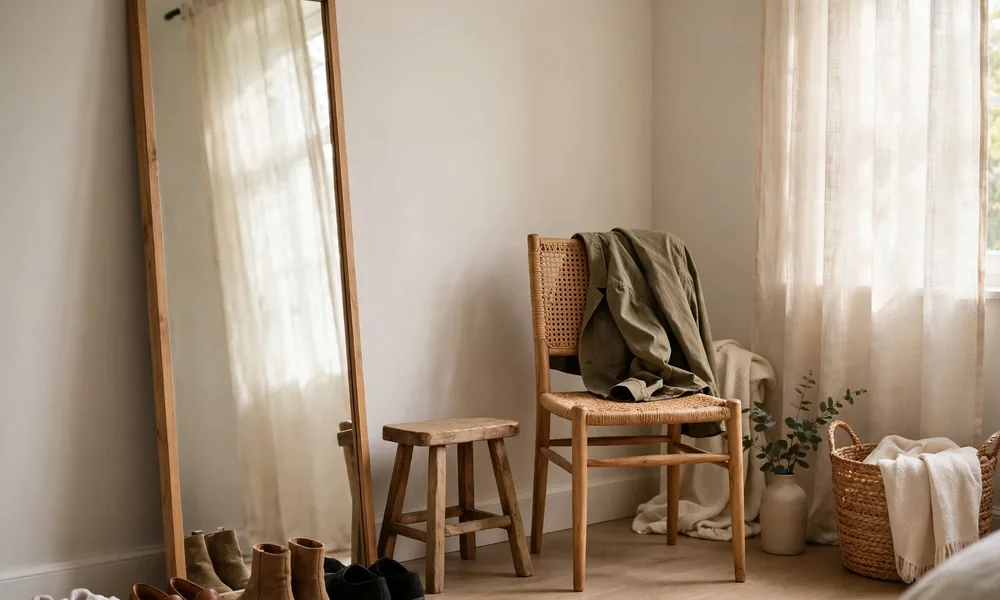
Checklist: Buying a Full-Length Mirror in 2026
- Choose at least 150 centimetres tall, so the mirror shows you from head to toe.
- Check the glass for distortion: straight lines in the reflection should stay straight.
- Place it near the wardrobe, with two paces of clear floor to step back.
- Put daylight on you, not on the glass, so colours read true.
- Anchor leaning mirrors to the wall, and use fixings rated for the mirror’s weight.
- Keep the glass clean with a damp microfibre cloth, and check the frame yearly.
Frequently Asked Questions
How tall should a full-length mirror be?
At least 150 centimetres for most people; 160 to 180 if you are tall or want to see your shoes without stepping back. It should show your head and shoes together when you stand two paces away.
Is a leaning mirror or a wall-mounted mirror better for getting dressed?
Both work well. A leaning mirror needs no drilling and can be moved, but it must be anchored to the wall for safety. A wall-mounted mirror takes no floor space and cannot topple, but its position is fixed, so measure before drilling.
Why does my outfit look different in the mirror than outside?
Light changes colour. Warm indoor bulbs make colours look warmer and softer, while daylight is cooler and sharper. Navy and black are the classic confusion in dim light. Check it in daylight, or in light like where you will spend the day.
Can a full-length mirror make a small bedroom feel bigger?
Yes, a large mirror reflects light and the room behind you, which can make a bedroom feel more open. That is a bonus, though: choose first for dressing, and treat the space as a welcome extra. Our guide to the best mirrors for small rooms covers the room-brightening side in detail.
How do I keep a full-length mirror safe with children or pets?
Anchor a leaning mirror to the wall with an anti-tip fixing, or choose a wall-mounted mirror instead. Keep the base clear, check the anchor every few months, and level a freestanding mirror so it cannot rock.
Do I need a light-up mirror for getting dressed?
Only if your dressing area is dark. Good daylight beside the mirror beats built-in lighting, and cheap LEDs can make colours look wrong. If you buy one, choose adjustable warmth, and test it with navy and black side by side first.
The Bottom Line
Full-length mirrors that make getting dressed easier in 2026 are tall, true-glass ones near the wardrobe in good daylight: a leaning mirror anchored safely for renters, a wall-mounted mirror for small rooms and families, or a cheval mirror for a dressing corner. Check the glass, leave two paces, and keep it clean.


