A lemon squeezer is a small tool with one job, and yet the difference between a good one and a bad one is easy to taste. A good lemon squeezer gets every last drop out of the fruit with a single squeeze, leaving the seeds behind. The best lemon squeezer in 2026 matches how you cook: a hand press for a quick squeeze, a lever press for a whole jug, or a reamer for control.
It is worth choosing carefully, because lemons are not cheap and a squeezer is a tool you will reach for several times a week. Dressings, marinades, drinks, baking, and cleaning all start with lemon juice, and a squeezer that wastes juice wastes money as well as effort. This guide compares the types, explains what actually affects how much juice you get, and shows how to pick a squeezer that will last for years rather than months.
Key takeaways
- A stainless steel hand press is the best all-round lemon squeezer for most kitchens: fast, strong, and easy to clean.
- A lever press extracts the most juice with the least effort, and it is the best choice if you squeeze lemons often or in quantity.
- Roll the lemon firmly on the worktop and bring it to room temperature before squeezing to get noticeably more juice.
- Cut the lemon across its middle, not lengthways, so the squeezer can press the flesh evenly.
- Choose stainless steel or sturdy cast metal over thin plastic, which flexes and cracks under pressure.
- Rinse the squeezer straight after use; dried lemon pulp is the main reason squeezers become hard to clean.
Why a good squeezer matters
A lemon holds more juice than most people get out of it. Squeezing by hand leaves a surprising amount behind in the flesh, and lets seeds slip into the dish. A proper squeezer presses the flesh evenly against a ridged bowl, forcing juice through small holes while seeds stay behind.
The types of lemon squeezer
Most lemon squeezers fall into four types, and each suits a different way of cooking. The hand press, sometimes called a bowl press, is the familiar two-handled tool with a cupped bowl and a ridged press. You place half a lemon cut-side down in the bowl, close the handles, and the juice runs out through holes in the base. It is fast, it catches seeds, and it works for limes as well as lemons. For most kitchens, this is the best place to start.
The lever press, or countertop press, is a larger tool with a long handle that uses leverage to crush the fruit. It extracts the most juice of any manual squeezer, with far less hand strength, which makes it ideal for anyone with a weak grip or who squeezes several lemons at once.
The reamer
A reamer is a ridged cone, usually wood or plastic, that you twist into the cut half of a lemon. It gives you complete control over how much juice you extract, and it is the best choice when you need only a teaspoon or two for a dressing or a sauce. It is also the cheapest and smallest option. Its weakness is mess: juice runs down your hands and seeds end up in the bowl, so it is slower and less tidy than a press for larger amounts.
Electric citrus juicers
An electric citrus juicer uses a spinning cone to extract juice at the push of a button. It is the fastest option for large quantities, and it suits a household that juices citrus every morning. For a single lemon, though, it is more tool than you need. If you juice oranges and grapefruits too, our guide to the best juicers covers larger machines for the whole citrus family.

What affects how much juice you get
The squeezer is only half the story. How you prepare the lemon matters just as much. A cold lemon straight from the fridge gives less juice than one at room temperature, because cold juice is thicker and the flesh is firmer. Leave lemons on the counter for an hour before you use them, or roll them in warm water for a few minutes if you are in a hurry.
Rolling is the oldest trick in the book, and it works. Place the lemon on the worktop, press down firmly with your palm, and roll it back and forth for ten seconds. This breaks down the membranes inside the fruit and releases juice that would otherwise stay trapped. A rolled lemon can yield noticeably more juice than an unrolled one, whatever squeezer you use. It costs nothing and takes seconds, so it is worth doing every time.
How you cut the lemon matters too. Cut it across the middle, through the equator, so each half has a flat face and a rounded back that fits the squeezer bowl. Cutting lengthways leaves a shape the press cannot grip evenly, and you will get less juice and more mess. Always place the cut side down in a hand press, so the juice is forced through the holes rather than squirting upward.
Materials and build quality
Stainless steel is the best material for a lemon squeezer. It does not react with acidic juice, it does not stain or absorb smells, and it is strong enough to press a lemon fully without flexing. A good one feels heavy for its size, with a smooth hinge and a bowl deep enough for a large lemon half.
Cast aluminium and cast zinc alloy are common alternatives, and a well-made one can last for years. They are lighter and often cheaper, but they need a good coating, because bare aluminium can react with lemon juice and leave a metallic taste.
Comparing the main types
| Type | Juice yield | Effort | Best for |
|---|---|---|---|
| Hand press | High | Moderate | Everyday cooking, one or two lemons |
| Lever press | Highest | Low | Frequent use, large quantities |
| Reamer | Medium | Moderate | Small amounts, precise control |
| Electric juicer | High | Very low | Daily juicing, whole citrus family |
| Squeezing by hand | Low | High | No tool available |
The trade-offs are clear. A hand press is the best balance of yield, effort, and convenience for most people, while a lever press wins on yield and ease if you have the space. Size matters too: a lemon squeezer also handles limes, but it will struggle with a large orange.

Using a lemon squeezer well
Good technique turns a decent squeezer into a great one. Start with a room-temperature lemon, roll it firmly, and cut it across the middle. Place the half cut-side down in the bowl, close the handles slowly at first, then press firmly and hold for a second so the last juice runs out. If you press too fast, juice can spray sideways; a slow, steady squeeze keeps it in the jug.
One habit that saves trouble is to squeeze over a jug or a measuring cup rather than directly into the dish. That way you can see how much juice you have, you can fish out any seeds that slip through, and you can add the juice gradually to taste. A dressing with too much lemon is hard to fix, while one with too little is easy to adjust.
Cleaning and storage
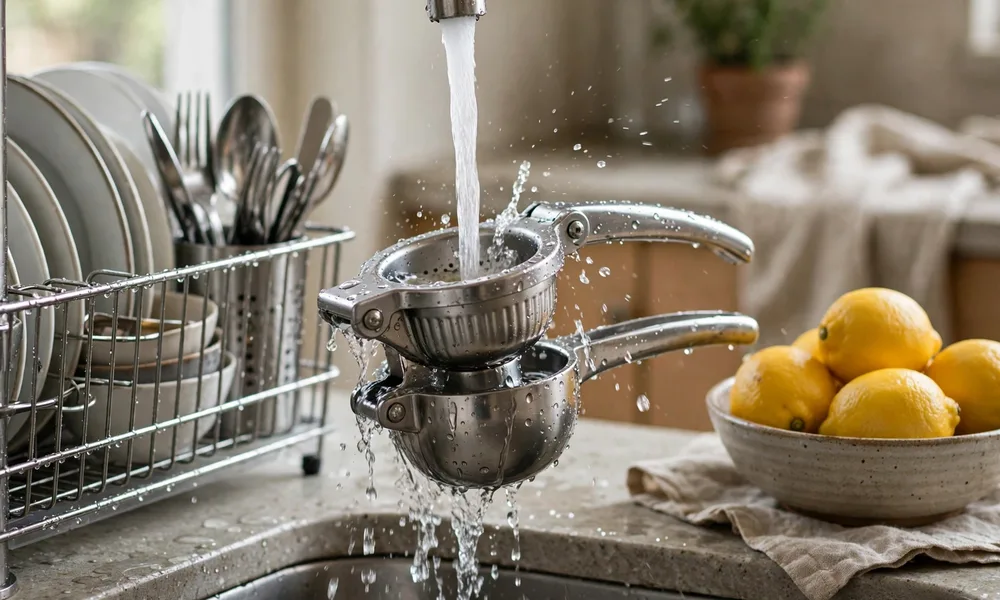
Cleaning is where many squeezers fail, not because they are hard to clean, but because people leave them until the pulp dries. Lemon pulp dries into a hard film that clogs the holes and stiffens the hinge, and once it is dry it takes scrubbing to remove. Rinse the squeezer under the tap straight after use, while the pulp is still wet, and it will come clean in seconds. A quick brush around the holes keeps them clear.
What else belongs in a citrus-friendly kitchen
A lemon squeezer works best alongside a few other simple tools. A sharp knife makes a clean cut across the lemon, and a sturdy chopping board gives you a stable surface for rolling and cutting. Our guide to the best cutting boards covers boards that stay put and survive daily use.
If you use lemon juice in smoothies and drinks as well as in cooking, a blender can be a useful partner: it lets you use the whole fruit, zest and all. Our guide to the best blenders covers machines that handle citrus well. But for the everyday job, nothing beats a simple hand press.
Checklist: choosing a lemon squeezer
- Pick a stainless steel hand press for everyday use, or a lever press if you squeeze lemons often or in quantity.
- Check that the bowl fits a large lemon half and the handles fit your hand comfortably.
- Choose a sturdy hinge with no wobble, and avoid thin plastic that flexes under pressure.
- Make sure the holes are small enough to catch seeds but large enough to let juice flow freely.
- Look for a squeezer that rinses clean easily, with no hidden corners where pulp can dry.
- Test it if you can: one firm squeeze should empty a lemon half with no spraying and no seeds in the juice.
Frequently asked questions
Which lemon squeezer gets the most juice out?
A lever press extracts the most juice, because its long handle multiplies your force and crushes the fruit evenly. A good stainless steel hand press comes close, and it is faster and easier to store.
Should I buy a hand press or a reamer?
Buy a hand press if you can only have one. It is faster, tidier, and catches seeds, and it works for limes too. A reamer is a useful second tool for small amounts, when you need a teaspoon of juice and do not want to wash a press.
Why does my squeezer leave so much juice in the lemon?
The most common reasons are a cold lemon, no rolling beforehand, and cutting the lemon lengthways instead of across the middle. Bring the lemon to room temperature, roll it firmly for ten seconds, cut it across the equator, and press slowly.
Can I put a lemon squeezer in the dishwasher?
Most stainless steel and cast metal squeezers are dishwasher-safe, and the top rack is the safest place for them. Hand washing is gentler on the hinge and the finish. Wooden reamers should always be washed by hand and dried promptly.
Do lemon squeezers work for limes and oranges?
Yes, a lemon-sized hand press works well for limes, which are smaller and softer. Oranges need a larger squeezer, because a lemon press cannot hold an orange half properly. If you squeeze oranges often, buy the larger size.
How do I stop seeds getting into the juice?
Use a hand press or lever press, which traps seeds in the bowl while the juice runs through the holes. Squeeze over a jug rather than directly into the dish, so you can remove any seeds that slip through before they reach the food.
The bottom line
The lemon squeezer that gets every last drop in 2026 is a stainless steel hand press for most kitchens, and a lever press if you squeeze citrus often or in quantity. Bring the lemon to room temperature, roll it, cut it across the middle, and press slowly over a jug. Rinse the squeezer straight after use. Do those few things, and one lemon will give you noticeably more juice, with no seeds, no spray, and no wasted fruit — and the same care keeps the tool itself in good shape for years.