
The paperback vs audiobooks for commuting question arrives every morning, usually on the platform: one hand holds a book with pages you can fold and mark, the other holds a phone and earbuds carrying a whole library. Both promise to turn dead travel time into something worth keeping, yet they ask very different things of you.
A thirty- or forty-five-minute journey, taken twice a day, adds up to hundreds of hours a year, enough to finish dozens of books. The format you choose shapes not only how many you finish but how much stays with you when you step off the train.
This comparison looks at paperbacks and audiobooks the way a commuter actually uses them: on crowded trains, on buses that stop every two minutes, and on walks between stations. We weigh focus, comfort, cost, and convenience, and finish with a clear answer for each journey.
Key takeaways
- Paperbacks win for deep focus and remembering detail, especially on seated train and bus journeys.
- Audiobooks win for hands-free travel: walking, standing on packed carriages, and changing trains.
- Most commuters finish more books with audiobooks, but remember more from a paperback.
- The cheapest habit is a mix: library paperbacks for the seat, audiobooks for when your hands are busy.
- Your commute type matters more than the format, so match the book to the journey.
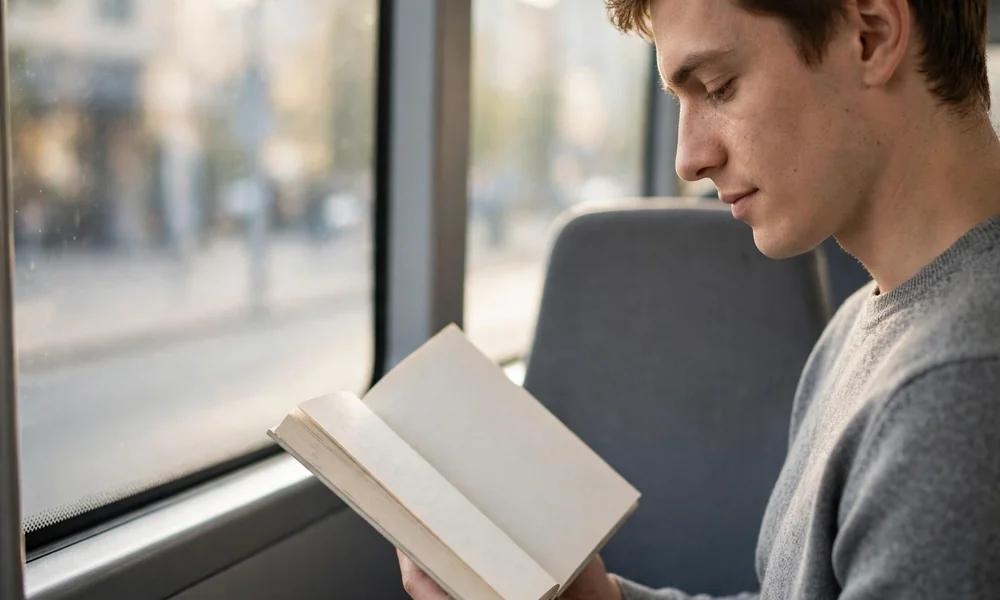
The Commute Is a Reading Habit in Disguise
A commute is rarely anyone’s favourite part of the day, yet it is one of the most reliable reading windows most adults have. Unlike an evening at home, where chores and screens compete for attention, a train carriage gives you a fixed block of time with little else to do.
The habit works because it attaches to something you already do. You simply open a book or press play when you sit down, and over weeks that routine compounds into five hours a week, enough for a novel every ten days.
Why the Journey Shapes the Format
Not all commutes are alike. A forty-minute train with a reserved seat is a reading room on wheels, while a twenty-minute bus through city traffic is a test of patience. The strongest commuter readers are flexible: paperback with a seat, audiobook when walking or standing.
What Paperbacks Do Best on the Move
A paperback asks for your full attention, and on a seated commute that is its greatest strength. With a physical book there is nothing to tap, swipe, or check: no notifications, no battery warnings, and no temptation to jump to another app. That simplicity helps many readers stay with a difficult chapter instead of drifting away.
Paperbacks also make it easy to go back. If a character’s name slips your mind or a plot twist depends on something from three chapters ago, you can flip back in seconds. That matters for dense novels and books where details build on each other.
Focus Without a Screen
One quiet advantage of a paperback is that it keeps your eyes off a screen for part of the day, a real break after eight hours looking at a monitor. A printed page does not glow or refresh, and it never interrupts with a message from work. The cost is practical: a paperback needs light, space, and two free hands, which a packed standing commute rarely offers. For a closer look at how screen-based reading compares with listening, see our guide to how digital reading compares with listening.
The Joy of a Book You Can Hold
Paperbacks are easy to share. You can lend one to a colleague, leave one on a seat for the next passenger, or pick one up second-hand for very little money. They need no subscription or account. The trade-off is bulk: a thick paperback adds weight to a bag already carrying a laptop and a lunchbox.
What Audiobooks Do Best on the Move
Audiobooks turn the parts of a commute that paperbacks cannot reach into reading time. The walk to the station, the wait on the platform, the standing-room-only carriage, and the final stretch to the office all become chapters. For commuters who move between modes of transport, that flexibility is listening’s biggest advantage.
The format is also forgiving of tired eyes. After a long day, many people find that their concentration for print fades, yet they can still follow a well-narrated story with ease. A good narrator does much of the work for you, and memoirs read by their authors are a particular pleasure. Our comparison of tablets and e-readers for travel reading shows how other screens handle the same problem.
Listening Fits the Gaps Between Seats
The strongest case for audiobooks is the standing commute. When there is no seat, no table, and barely room to breathe, a paperback is nearly useless, yet an audiobook works exactly as well as anywhere else. The same is true of the walk to the office, a stretch print readers simply lose.
The Narrator Makes or Breaks It
With audiobooks, the narrator is half the book. A skilled narrator can lift an average story into something memorable, while a flat voice can make a great novel feel like a chore. Most apps let you sample the first few minutes before committing, and experienced listeners check the narrator’s name before the plot. Speed controls help too: many commuters listen at one and a quarter times normal speed, turning a ten-hour audiobook into an eight-hour one.

Head-to-Head Comparison
Side by side, the two formats trade wins across the things commuters care about. Neither dominates every category, which is why the honest answer is not a winner but a balance.
| Factor | Paperback | Audiobook |
|---|---|---|
| Focus and retention | Excellent for detail and complex plots | Good, but easier to drift and miss passages |
| Hands-free travel | Poor when standing or walking | Excellent on any part of the journey |
| Cost per book | Low second-hand or borrowed from a library | Higher per title, cheaper with a subscription |
| Ease of revisiting | Instant page flipping and marking | Rewinding is slower and less precise |
| Carrying weight | One book at a time, added bulk | Whole library on a phone you already carry |
| Eye strain | None from screens, needs good light | None at all, works in the dark |
The pattern is clear. Paperbacks lead where attention and memory matter, while audiobooks lead where movement and convenience matter. Your commute decides which strengths you need more often, and the answer changes with the season, the route, and the book.
Retention, Focus and Enjoyment
The question readers ask most often is whether they remember audiobooks as well as books they read with their eyes. For a light novel or a memoir, most people retain just as much from listening. For a dense history or a novel with a large cast, print usually wins, because the reader can pause, reread, and check back without losing their place.
Focus is the real difference. Reading a paperback is an active choice that shuts out the world, while listening is easier to do on autopilot. Commuters often arrive at their stop realising they have no idea what happened in the last chapter, a sign that listening needs more deliberate attention on a noisy route.
How to Remember More of What You Hear
If you love audiobooks but worry about forgetting them, a few small habits help. Slow the speed back to normal for complex passages, rewind when your mind wanders, and pause at chapter breaks to let the story settle. Some listeners keep a note on their phone with key characters’ names, which removes the most common confusion in a long novel.
The Practical Stuff: Cost, Weight and Battery
Cost is where the two formats diverge most sharply. A paperback bought second-hand or borrowed from a library can cost almost nothing, and one book can be read and passed on many times. Audiobooks are usually more expensive per title, and subscriptions still add a monthly bill to a habit that print can serve for free. Libraries help too, since many now lend audiobooks alongside print.
Weight is the opposite story. A phone already in your pocket holds hundreds of audiobooks, while a paperback adds bulk and forces you to choose one book at a time. The comparison of e-readers and paperback books covers the middle ground, where a single light device holds many titles without giving up print entirely.
Battery is the audiobook’s hidden weakness. A phone that runs out of charge leaves you with nothing to read, while a paperback never runs flat. Commuters who rely on listening learn to keep a charger at work and to download books the night before. Above all, keep the next book ready before the current one ends, because the habit breaks most often in the gap between books.

Which Format Wins for Your Commute?
There is no single winner, because there is no single commute. The right choice depends on how you travel, how long you travel, and what kind of books you love. Use the checklist to match the format to your journey.
- Seated train over thirty minutes: choose a paperback for focus and depth.
- Standing room or a crowded bus: choose an audiobook and keep your hands free.
- Walking between stations: choose an audiobook, since print is impossible on foot.
- Dense non-fiction or a complex novel: choose a paperback so you can flip back.
- A light novel, memoir, or comedy: choose an audiobook and let a good narrator carry it.
- A tight budget: use the library for both, and buy only books you will read twice.
Many commuters end up with a simple rule: paperback for the seat, audiobook for the rest. That respects what each format does best, and turns the whole journey into reading time instead of only the seated half.
Frequently Asked Questions
Are audiobooks as good as reading for your brain?
For most fiction and memoirs, listening builds the same understanding. For dense or technical material, print usually supports better recall, because you can pause and reread. Use both, matching the format to the difficulty of the book.
How many books can I finish on a typical commute?
A commuter travelling an hour a day can finish two to four books a month. Audiobooks often lead to a higher count because they fill the walking and standing parts of the journey, while paperbacks lead to deeper recall.
Do audiobooks count as reading?
Yes, in every way that matters. You follow the same story, meet the same characters, and learn the same ideas. The experience is different, and some books suit one format better than the other, but finishing an audiobook is finishing a book.
What is the best way to listen on a noisy train?
Good earbuds with noise cancellation make the biggest difference, followed by downloading the book before you leave home so a weak signal never interrupts it. Keep the volume moderate, pick a narrator with a clear voice, and rewind when an announcement pulls your attention away.
Is it cheaper to read paperbacks or listen to audiobooks?
Paperbacks are usually cheaper, especially borrowed from a library or bought second-hand. Audiobooks cost more per title, though subscriptions and library lending close the gap. Library loans in both formats are the lowest-cost way to read every day.
Can I switch between a paperback and an audiobook of the same book?
Yes, and many commuters do exactly that. Read the paperback when you have a seat, then pick up the audiobook from roughly the same point when you start walking. It takes a minute to find your place, but the story stays continuous, and you get both formats’ strengths.
The Bottom Line
Paperbacks win the seated commute, audiobooks win the moving one, and the best reading habit uses both. Choose the paperback when you have a seat, good light, and a book worth full attention. Choose the audiobook when standing, walking, or too tired to focus on a page. Match the format to the journey, and your commute becomes the best-reading part of your day.


