A baby activity center is one of those purchases that looks simple in the shop and turns out to matter a great deal at home. It is the place where a baby who can hold their head up, but cannot yet walk, spends happy minutes reaching, spinning, pressing and bouncing while a parent finally gets both hands free. The best baby activity centers of 2026 do that job without fuss: they are stable, easy to clean, interesting enough to hold a baby’s attention for a short session, and gentle enough that a baby can use them safely. The worst ones wobble, bore a baby within days, trap crumbs in every seam, or push a baby into a posture that is not right for their age.
What Is a Baby Activity Center?
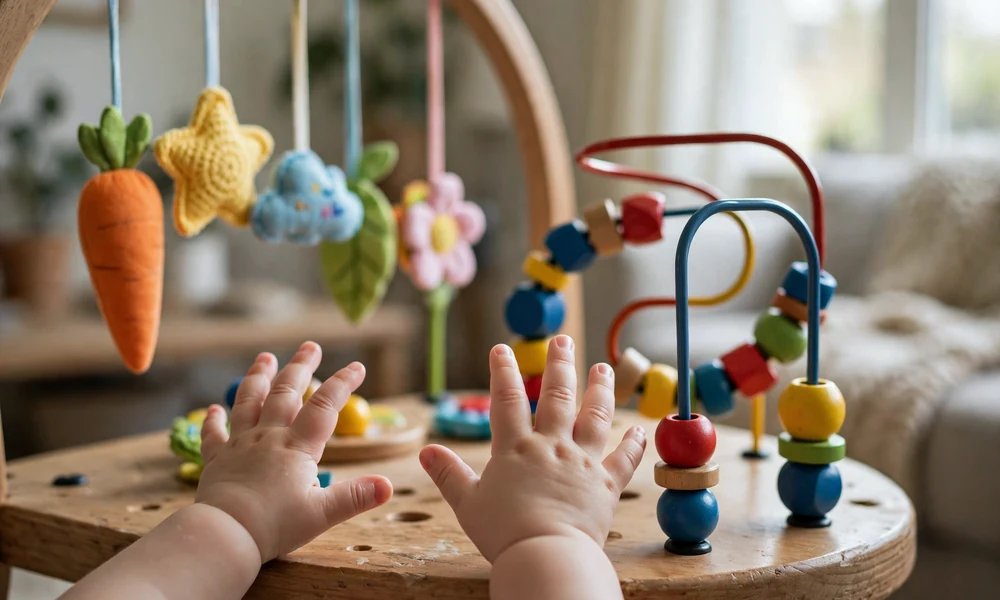
A baby activity center is a stationary play station with a seat in the middle and toys arranged around it. Most designs fall into two broad families. The first is the sit-in center, sometimes called a jumper or an exersaucer-style center, where the baby sits in a padded fabric seat surrounded by a tray of toys and can bounce, spin or rock gently. The second is the activity table or floor center, which a baby uses standing with support, or sitting on the floor, pushing buttons, turning gears and sliding beads. Both types are built around the same idea: a contained, upright play space that lets a baby practise reaching, grasping, looking and listening while staying in one safe spot.
Activity centers are not walkers, and they should not be confused with them. A walker moves across the floor and carries a baby into places they should not go. An activity center stays put. That fixed base is the whole point, and it is also the first thing to check. A good center has a wide, heavy base that does not tip when a baby leans hard to one side, and feet or a frame that grips the floor rather than sliding across it. If you can rock the display model with one hand, walk away. Your baby will be stronger, more determined and less careful than you are.
Age matters more than almost anything else with this purchase. Most sit-in centers are designed for babies who can hold their head up steadily and sit with support, usually from around four to six months, and most are outgrown somewhere between twelve and eighteen months, or when a baby can climb out, walk unaided or exceeds the weight limit. Activity tables last longer, because a baby can use them sitting, kneeling and then standing, and many convert into a small table for a toddler. Check the maker’s stated age and weight limits before you buy, and take them seriously rather than treating them as a rough guide.
How to Choose: The Six Things That Matter Most
Start with stability and the seat. The base should be wide and the whole unit should feel planted. The seat should hold a baby upright without letting them slump to one side, with a padded ring that supports the hips and a fabric sling that can be removed and washed. A seat that is too deep leaves a small baby swimming in it, while a seat that is too shallow lets a bigger baby tip forward onto the tray. Some centers offer a height adjustment with two or three positions, and that is worth having, because a baby grows fast and a seat that was right in March will be wrong by June. The baby’s feet should rest flat or bounce lightly on the base or the floor, never dangle, and never be forced onto tiptoe.
Next, look at the toys themselves, because they are what your baby will actually use. The best trays mix textures and actions: something to spin, something to slide, something to press that makes a sound, something soft to chew and something bright to look at. Variety matters more than quantity. A tray crowded with twenty tiny toys is worse than a tray with six good ones, because the crowded tray is harder to clean and harder for a baby to explore. Removable toys are a bonus, since you can take them off, wash them and swap them for something new when your baby gets bored. Check that every toy is firmly fixed or, if it comes off, too large to be a choking risk, with no small parts, loose strings or sharp edges.
Cleaning is the test most parents forget until the first spill. Babies drool, spit up, drop food and chew everything within reach, so an activity center that cannot be cleaned will become unpleasant within a week. Look for a smooth plastic tray that wipes clean, a seat fabric that comes off and goes in the washing machine, and as few narrow seams and hidden corners as possible. If you can, take the seat off in the shop or check the instructions online first. A seat that needs tools to remove will be removed far less often than one that unclips in seconds.
Size and storage come fifth, and they matter more in a small home than any toy ever will. Measure the space where the center will live, including the doorway it has to pass through, because some centers are surprisingly wide. A foldable frame or a removable tray helps a great deal, and it is the difference between a center that lives in the living room and one that lives in a cupboard, forgotten. Our guide to the best baby play mats of 2026 is useful here too, because a good mat underneath the center protects the floor, softens the space and gives your baby somewhere comfortable to play when they come out of the seat.
The Main Types, and Who Each Suits
The classic sit-in jumper center suits babies from around six months who love to bounce. The seat is suspended in a frame, the baby pushes off the base with their feet, and the toys sit all around the tray. Babies who are active and strong tend to love these, but sessions should be short, because bouncing is tiring and a baby who is tired stops enjoying it. A stationary activity center without the bouncing spring suits a calmer baby, or a smaller room, because it takes up less space and the baby can spin the seat to reach different toys without the whole unit moving.
Activity tables suit babies who are already pulling up or cruising, and they last the longest of all the types. A baby can use one sitting on the floor, kneeling at it, and then standing at it, and many models convert into a low table with chairs or a drawing surface for a toddler. They are also the easiest to share, because two children can stand at opposite sides. The trade-off is that a table does not contain a baby the way a sit-in center does, so it suits a baby who is already mobile and a parent who is nearby, rather than a younger baby who needs to be kept in one place.
Safety First: How to Use an Activity Center Well
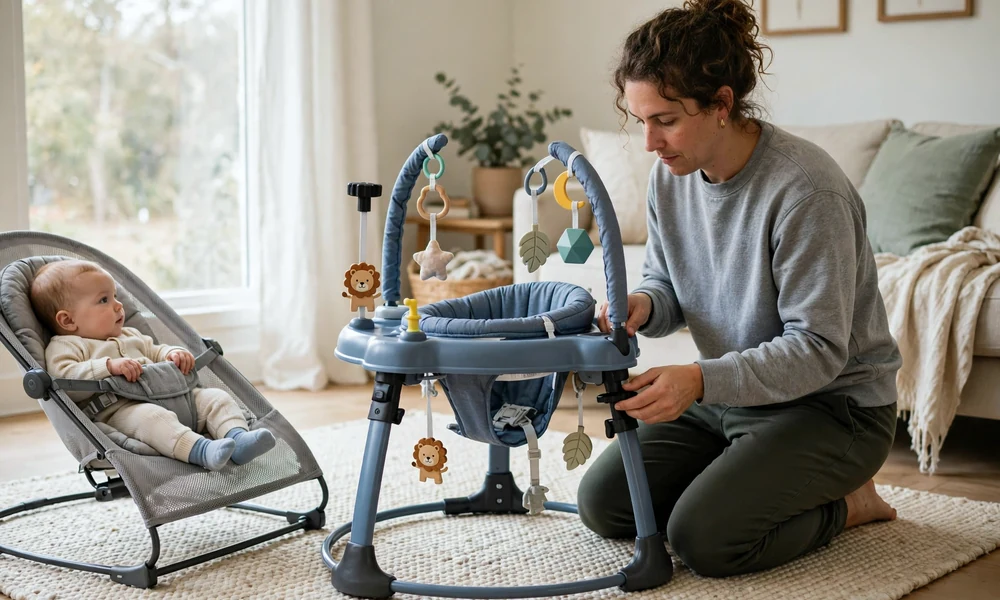
An activity center is a supervised play space, not a place to leave a baby alone. Stay in the same room, within reach, and check on your baby often, even if they seem perfectly happy. Keep the center on a flat floor, away from stairs, heaters, cords, table edges and anything a baby could pull down. Never put an activity center on a table, a bed or a raised surface, and never use it near water. Keep sessions short, around fifteen to twenty minutes at a time, and take your baby out as soon as they look tired, frustrated or uncomfortable. Short, happy sessions are far better than one long session that ends in tears.
Never use an activity center for sleep. A baby who falls asleep in the seat should be moved to a flat, firm sleep surface on their back, such as a cot or a bassinet, as soon as you notice. The upright, padded seat is a play position, not a sleep position, and a sleeping baby can slump in a way that makes breathing harder. The same rule applies to any seat that holds a baby upright, including the best baby bouncers of 2026. If you are unsure about when your baby is ready for an activity center, or how long they should spend in one, ask your paediatrician or health visitor, who can advise based on your baby’s development rather than a general age label. For rest and quieter moments between play sessions, our guide to the best baby swings of 2026 covers the gentler options.
Before every use, give the center a quick check. Make sure the frame is locked, the seat is secure, the toys are firmly attached and there are no loose screws, torn fabric or cracked plastic. Wash the toys and the seat regularly, following the maker’s instructions, and stop using the center if any part is damaged. Check the weight limit as your baby grows, and retire the center when your baby can climb out of it, walk away from it unaided or push it across the floor. A baby who can escape from the center is a baby who no longer needs to be contained by it.
What to Avoid
The worst baby activity centers share a few clear warning signs. The base is narrow or light, so the whole unit tips when a baby leans. The seat is too deep or too shallow, so the baby slumps or strains. The toys are all the same, usually small plastic buttons that play the same tune, so the baby loses interest within days. The fabric cannot be removed, so it stains and smells within a week. The frame is hard to fold, the battery door opens without a screwdriver, or the instructions are vague about age and weight limits. Any one of these is a reason to choose a different model, and two of them together are a reason to put it back on the shelf.

Be wary of a center that promises to teach your baby to walk, talk or read sooner. No activity center can do that, and the claim is a sign that the maker is selling a promise rather than a product. What a good center does is simpler and more honest: it gives a baby interesting things to reach for, in a safe place, for a short time, while a parent stays close. The learning that happens is ordinary and valuable, which is reaching, grasping, turning, listening and looking, and it does not need a screen, a lesson plan or a loud sales claim to be worthwhile.
The Verdict
The best baby activity center for your family is the one that fits your baby today, fits your home, and can be cleaned without a struggle. Choose a wide, stable base, a seat that holds your baby upright at the right height, a small set of varied toys that can be washed or swapped, quiet sounds with a real off switch, and a frame that folds or stores easily. Keep sessions short, stay in the room, and move a sleeping baby to a proper bed. Get those basics right and the center will earn its place in the living room, giving your baby happy, busy minutes of play and giving you a little breathing room at the same time.