A baby swing is one of those nursery buys that sounds simple until you start shopping. Every model promises the same gentle motion, the same soothing sounds and the same happy baby, yet the swings themselves are very different. Some are large electric models that plug into the wall and swing for hours. Some are small portable frames that fold flat for a visit to grandparents. Some are really bouncers with a motor added on. The best baby swings of 2026 get the basics right first: a steady frame, a secure harness, a comfortable seat and a motion that calms a baby without jolting them, and then add the extras that make daily life easier.
What a Baby Swing Is For
A baby swing is a supervised place for a baby to sit and be soothed for a short while. It is not a bed, not a place to leave a baby alone, and not a substitute for being held. Used well, it gives a parent a free pair of hands for ten or twenty minutes: time to make a bottle, eat lunch, or fold laundry while the baby is close by, in sight, and gently moving. That is the whole job, and a swing that does it calmly is worth far more than one with twenty songs and a flashing light show.
How to Choose: What Matters Most
Start with stability. A baby swing should sit flat on the floor with a wide base, and it should not rock, slide or tip when you press gently on one side. Put it on a hard floor, not on a bed, a sofa or a raised surface, and make sure there is clear space around it so it cannot hit a wall or a table as it moves. A wide-legged frame takes up more room, but that width is what keeps it steady when a baby wriggles, and a swing that feels flimsy in the shop will not feel safer at home.
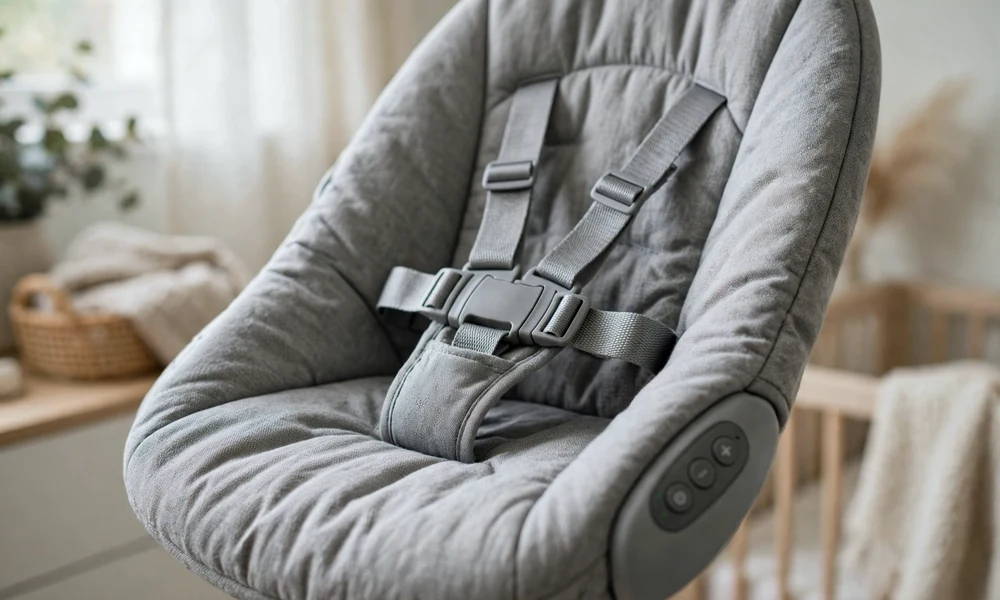
Next, look at the harness. A five-point harness, with straps over both shoulders, around the waist and between the legs, is the standard to look for. The straps should adjust easily, lie flat without twisting, and fasten with a buckle that an adult can open with one hand but a baby cannot. Use the harness every single time, even for a short sit, and even if the baby seems too small to move. A swing without a harness in use is a seat a baby can slide out of, and a loose harness is little better than none at all.
Motion comes third. Look for several speeds, starting very slow, and for more than one direction if you can. Some babies settle best with a side-to-side sway, others with a front-to-back swing, and a baby who likes one may hate the other. A swing that only offers one fast speed will suit very few babies. The motor should be quiet, because a loud hum or click will fight against the soothing sounds and the calm you are trying to create. If you can, try the swing in the shop and listen to it run.
Safety First: The Rules That Matter
Safety is not a feature on a baby swing. It is how the swing is used, every time. Always stay in the same room while the baby is in the swing, and keep the baby where you can see them. A swing is for supervised awake time, not for naps and never for overnight sleep. If a baby falls asleep in the swing, move them to a flat, firm sleep surface as soon as you can, on their back, with no loose blankets, pillows or toys. That move is a nuisance, especially when a baby has only just settled, but it is the safe choice, and it is worth making every time.
Check the weight and age limits before the first use, and check them again as the baby grows. Stop using the swing when the baby reaches the limit, can sit up unaided, or can climb out, whichever comes first. Never add blankets, pillows or soft toys to the seat to make it cosier, and never hang toys from the frame in a way that could fall onto the baby. Keep cords, mobiles and anything that could wrap around a small neck well away from the swing, and never place the swing near stairs, a heater or a window with a blind cord.
Buy from a maker you can check, and keep the instructions and the receipt. Before the first use, put the swing together exactly as the instructions show, tighten every screw and clip, and test it empty before you put the baby in. Check the frame, the straps and the buckle regularly for wear, loose stitching or cracks, and stop using the swing if anything is damaged. If you are buying second-hand, ask for the instructions, check that no parts are missing, and check whether the model has been recalled. If you are unsure about anything to do with your baby’s sleep or safety, ask your paediatrician or health visitor rather than guessing, and follow their advice over anything you read in a buying guide, including this one.
Home safety goes beyond the swing itself. A baby who is starting to move will explore everything within reach, so the room the swing sits in needs the same care as the swing. Our guide to the best baby gates of 2026 covers how to keep stairs and kitchens safely closed off, and it is worth reading before a baby becomes mobile rather than after.
Portable Swings and Travelling With One
Portable swings are smaller, lighter and often battery powered. They fold flat, fit in a car boot, and can be carried from room to room or taken to a relative’s house. The trade-off is a smaller seat, a simpler motion and a shorter battery life. A portable swing is a good second swing, or a good choice for a small flat, but it is rarely as soothing as a full-size model for a baby who needs a lot of help settling.
Motion and Speed
The best motion is the one your baby likes, and babies are not polite about telling you. Some settle with a slow side-to-side sway that barely moves the seat. Others need a longer front-to-back swing with a clear rhythm. A swing with several speeds and more than one motion direction gives you more chances to find the right one. Start on the slowest speed, watch the baby for a few minutes, and only speed up if they are still unsettled. Faster is not better, and a baby who is crying harder is a baby who needs holding, not a faster swing.

Comfort, Fabric and Placement
A baby swing is used close to the skin, so the fabric matters. Look for a soft, breathable cover that does not make a baby sweaty, with no rough seams where a baby’s head or legs rest. A removable newborn insert is useful for the first weeks, when a baby is small and needs extra support around the head and body. Take the insert out when the baby grows into the seat, and do not keep using it once it makes the seat too tight or pushes the baby forward.
Think about the room as well. A swing that lives in the living room will be used more than one that lives in a spare room, because the baby stays near the family. Keep it where you spend your time, in a spot with space around it, away from direct sunlight and away from anything the baby could reach and pull down. If you need to watch the baby from another room while they are awake in the swing, do not rely on the swing alone. Our guide to the best baby monitors of 2026 explains what a monitor can and cannot do, and why it is no substitute for being in the same room while a baby is in a swing.
What to Avoid When Buying a Baby Swing
Avoid swings with no harness, or with a harness that is only a waist strap. A baby needs shoulder straps as well, because a baby who slides down in the seat can end up in a position that makes breathing harder. Avoid swings that feel light and narrow, because a narrow base tips more easily than a wide one. Avoid models that only swing at one speed, or that are noisy, because a swing that cannot be slowed down or quietened will not suit a newborn.
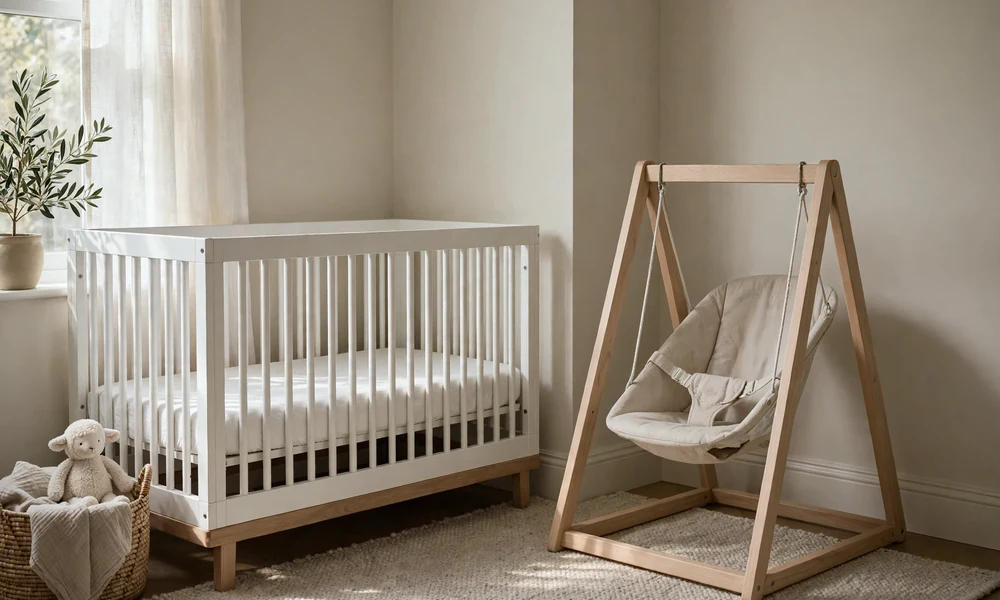
Avoid buying a swing as a sleep solution. No swing is a safe place for a baby to sleep, however comfortable it looks and however well the baby sleeps in it. That is true of the most expensive swing and the cheapest one alike. A baby who falls asleep in a swing should be moved to a cot or crib, on a firm flat mattress, on their back. Our guide to the best cribs of 2026 covers what to look for in a proper sleep space, and it is the right place to spend money if sleep is the problem you are trying to solve.
Setting It Up on Day One
Put the swing together on the floor, not on a table, and follow the instructions step by step. Do not skip a screw because it looks unimportant, and do not use the swing until every part is fitted and tight. Test it empty first: switch it on, try every speed, and watch it run for a few minutes. Listen for clicks, rattles or uneven movement, and check that it stops smoothly. Then put the baby in, fasten the harness snugly, and stay beside them for the first few sessions while you learn what speed and motion they like.
Frequently Asked Questions
Can a baby sleep in a swing? No. A baby swing is not a safe sleep space, and a baby who falls asleep in one should be moved to a cot or crib as soon as possible. This is the most important rule in this guide, and it applies to every swing, at every price. If your baby only sleeps in the swing, talk to your paediatrician about safe sleep, because there may be a better way to help them settle.
When should a baby stop using a swing? Stop when the baby reaches the weight or age limit in the instructions, when they can sit up unaided, or when they can climb or push themselves out, whichever comes first. A baby who has outgrown the swing is not safer in it because they still enjoy it, and keeping the swing going past its limits is how accidents happen.
The best baby swing is the one that fits your baby, your home and your routine. Choose a wide stable frame, a five-point harness that you will use every time, a slow gentle motion with several speeds, and a seat that is comfortable and easy to wash. Use it for short supervised sits, never for sleep, and move a sleeping baby to their cot. Get those choices right, and a swing can be a genuinely useful part of the day, giving you a few calm minutes while your baby is safe, close by and gently soothed.