
A baby walker is one of those purchases that looks simple in the shop and turns out to be anything but simple at home. It is a seat on wheels, a tray full of toys and a promise that your baby will be happy and busy for a while, all in one neat package. The best baby walkers of 2026 do that job well: they are stable, easy to clean, comfortable for a short session and simple to fold away when the room needs to be a living room again. The worst ones wobble, tip too easily, pinch small fingers or roll far too fast across a hard floor.
Before choosing one, it helps to be honest about what a walker is for. It is not a teacher. A baby walker does not teach a baby to walk, and it does not speed up walking. Babies learn to walk by pulling up, cruising along furniture, falling down and trying again, and no piece of equipment can replace that practice. What a good walker can do is give a baby who can already sit up well and hold their head steady a safe, upright view of the room for a short, supervised stretch, with toys within reach and a parent close by.
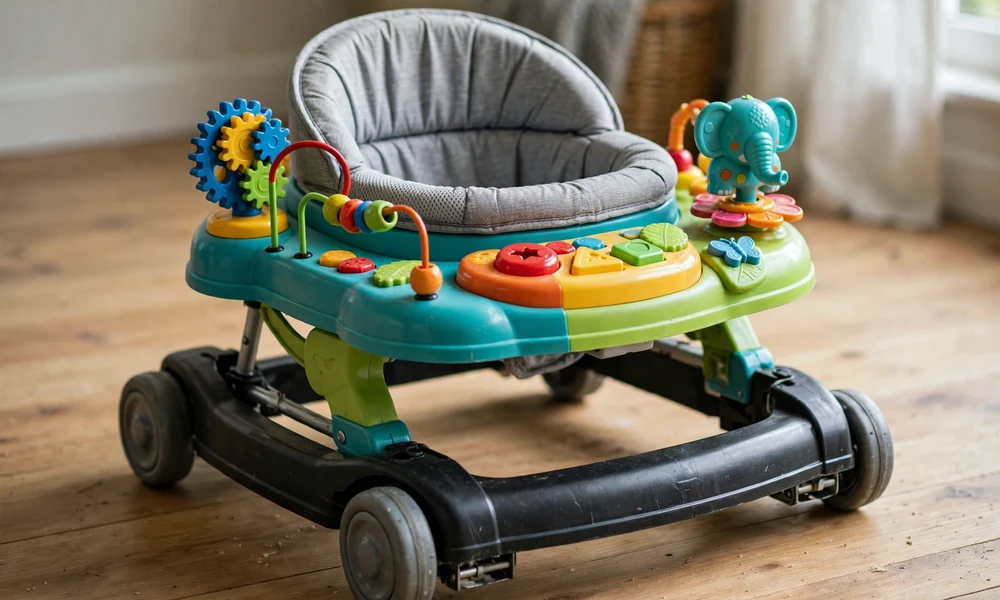
What Makes a Baby Walker Different From Other Baby Gear
A baby walker is not a bouncer, a high chair or a push-along toy, although it borrows something from each of them. A bouncer stays in one place. A high chair is for meals. A push walker is something a baby holds onto and pushes while standing. A seated wheeled walker is different because the baby sits inside it and moves it with their feet, which is exactly why the design details matter so much. The base must be wider than the seat, the wheels must roll smoothly without racing away, and the seat must hold the baby upright without letting them slump or slide down.
How to Choose: The Things That Matter Most
Start with stability. This is the one thing you should never compromise on. A good baby walker has a wide, heavy base that resists tipping when your baby leans to one side to reach a toy. Pick it up in the shop if you can and give it a gentle push from the side. It should stay upright. Check that the wheels are set well apart and that the frame feels solid rather than flimsy. A walker that feels light and rattly in your hands will feel worse with a wriggling baby inside it.
Next, look at the brakes and the way the wheels behave. Some walkers have wheels that roll freely in every direction, which sounds fun but can send a baby across a room far faster than a parent expects. Others have friction pads or rubber stoppers underneath that slow the walker down and stop it at the edge of a step. Those stoppers matter. They are the difference between a walker that pauses at a doorway and one that keeps going. Test the wheels on a hard floor and on a rug if you can, because a walker that is fine on carpet can be far too fast on wood or tiles.
The seat comes third, and it is where comfort lives. A good seat is padded, washable and supportive, with a firm back that holds your baby upright. The fabric should come off for washing, because it will need washing often. Check the leg openings too: they should be wide enough that your baby’s legs move freely, with no hard edges or seams that rub. A seat that is too tight will make your baby unhappy within minutes, and a baby who is unhappy in a walker should come straight out of it.
Finally, check what age and weight the maker suggests, and take those limits seriously. Most wheeled walkers are made for babies who can sit up unaided and are not yet walking on their own, usually from around six months, with a weight limit that is often around twelve kilograms. Those limits are there for a reason. A baby who is too small can slump in the seat, and a baby who is too big or too strong can tip the walker or climb out of it. If your baby has already started walking, a walker has done its job and it is time to move on.
Safety First: The Rules That Matter More Than Any Feature
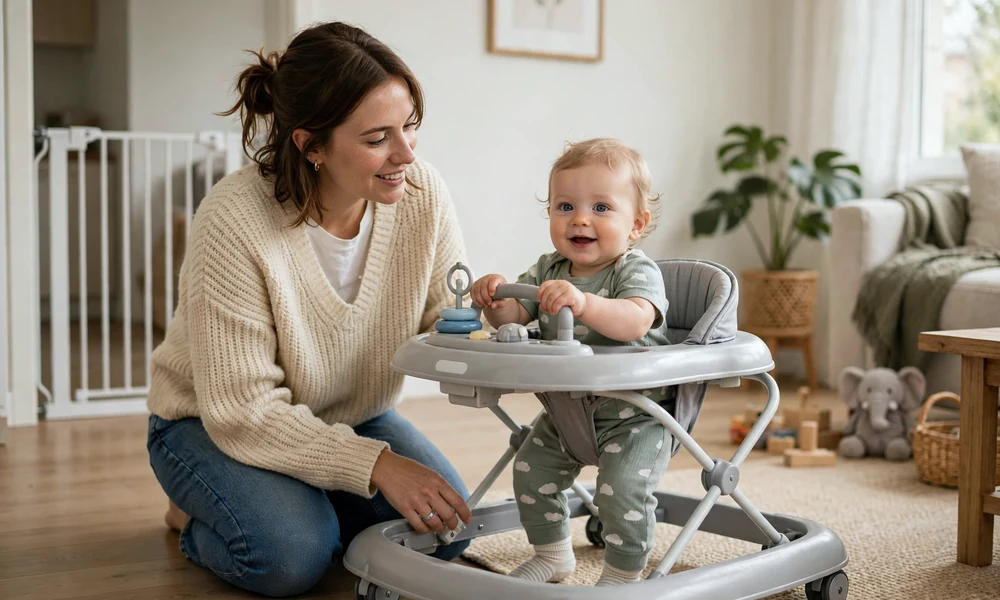
Safety is not a feature on a baby walker. It is the way you use it, and it matters more than the brand, the price or the toys on the tray. The first rule is simple: never leave a baby alone in a walker, not for a minute, not while you answer the door and not while you pop into the next room. A baby in a walker can move surprisingly fast, reach things you thought were out of reach and get into trouble in seconds. Stay in the same room, within arm’s reach, for the whole session.
The second rule is about the room itself. Before your baby goes into the walker, clear the floor, block the stairs with a fixed safety gate, close doors to kitchens and bathrooms, and move hot drinks, sharp objects, dangling cords and small items well out of reach. A walker raises a baby up and moves them around, so anything at tray height is now within grabbing distance. Check the room at your baby’s new eye level, not your own, and you will spot hazards you would otherwise miss.
Keep sessions short. Twenty minutes at a time is plenty for most babies, and many babies are happy with far less. A walker is not a place for a baby to spend the morning. Babies need plenty of time on the floor, on their tummies and free to move, crawl and pull up, because that is how they build the strength and balance they need for walking. If your baby seems tired, frustrated or uncomfortable in the walker, lift them out, give them floor time and try again another day, or not at all.
It is also worth knowing that many paediatricians and child health experts advise against wheeled baby walkers altogether, and some countries have restricted their sale, because of the risk of falls down stairs and other injuries. That advice deserves to be taken seriously. If you are unsure whether a walker is right for your baby, or if your baby has any health or development concerns, talk to your paediatrician or health visitor before you buy one. They know your baby and can give advice that fits your family, which no buying guide can do.
Comfort, Feet and What Your Baby Wears in a Walker
What your baby wears on their feet in a walker matters more than most parents expect. Bare feet or soft socks give your baby the best grip and feel for the floor, and they let little toes spread and push naturally. Hard-soled shoes inside a walker can make feet slip on a smooth floor and can change the way your baby pushes. Save the proper shoes for outdoors, and let feet be bare or softly covered at home. Our guide to the best baby shoes of 2026 covers first shoes for walking outdoors, which is a different job from moving around the living room in a walker.
Socks deserve a thought too. A pair of soft socks with a grippy sole stops feet sliding on wood floors and keeps toes warm in winter, and they are far easier to wash than a walker seat. Our guide to the best baby socks of 2026 looks at the soft, stay-on pairs that survive a wriggling baby and a washing machine. In a walker, the simplest choice is usually the best one: bare feet on a rug, or grippy socks on a hard floor.
What to Avoid When Buying a Baby Walker
Avoid any walker with no stair stoppers or friction pads underneath. Those small pads are not a nice extra. They are one of the main safety features on a wheeled walker, and a model without them should not be on your shortlist. If you are buying second-hand, check that the stoppers are still there and still in good condition, because they wear down and can go missing.
Getting Around With a Baby, and What Comes Next
A walker is only one small part of getting around with a baby. For trips out, a carrier or a pushchair does the job a walker never can, and the right one depends on your baby’s age, your home and how you travel. Our guide to the best backpack baby carriers of 2026 covers carrying an older baby hands-free outdoors, which is useful once your baby outgrows being held in your arms for a whole walk.
As your baby grows, the walker will be used less and less, and then not at all. That is a good sign. It means your baby is pulling up, cruising and getting ready to walk alone, which is what all that floor time was building towards. When your baby starts walking, retire the walker, clean it and pass it on or store it away. Keep the push toys, the soft play mats and the safe floor space, because those are the things your new walker will reach for next.
Frequently Asked Questions
Do baby walkers help babies learn to walk? No. There is no good evidence that a wheeled walker helps a baby walk sooner, and some experts worry that too much time in one can delay walking, because a baby in a walker practises pushing with their toes rather than taking proper steps and building balance. Floor time, tummy time, pulling up and cruising along furniture are the things that help a baby learn to walk. A walker can be a short, supervised change of scene, but it is not a shortcut to walking.
How old should a baby be before using a walker? Most makers suggest from around six months, once a baby can sit up unaided, hold their head steady and reach for toys, and most suggest stopping once a baby can walk alone or reaches the weight limit. Every baby is different, so use the maker’s guidance alongside your own judgement and, if you are unsure, ask your paediatrician or health visitor. A baby who cannot sit well yet is not ready, however keen they look.
The best baby walker is the one that fits your baby, your home and your routine, and that you can use safely every time. Choose a wide, stable base, working stair stoppers, a washable seat at the right height and a tray your baby enjoys, and use it for short, supervised sessions on a clear, flat floor. Choose on looks or price alone, and you will be choosing again far sooner than you planned, with a walker that is harder to use and harder to trust.


