
Baklava That Balances Honey and Crunch in 2026
The best baklava in 2026 is easy to recognise and surprisingly hard to find. You pick up a piece and the phyllo shatters under your fingers, flakes falling onto the plate before you have even taken a bite. Inside, the nut filling is generous and fragrant, and the syrup is sweet without being sticky, soaking the layers just enough to hold them together without turning them soggy. The whole thing tastes of honey, butter and nuts in balance, not of sugar alone. This guide explains what to look for, which types are worth your money, and how to tell a bakery baklava from a factory one before you pay for it.
Key takeaways
- A great baklava shatters when you bite it, with crisp, flaky phyllo outside and a moist, fragrant nut filling inside.
- The syrup should soak the layers, not drown them: sweet, lightly floral, and never pooling at the bottom of the box.
- Pistachio is the classic premium filling, but walnut baklava is often the better everyday buy.
- Butter beats oil for flavour, and a bakery that brushes each sheet by hand beats a factory line almost every time.
- Buy baklava the day it is made, eat it within two days, and never refrigerate it, because the cold kills the crunch.
How the best baklava was chosen
Every type below was scored on five measures. Crunch comes first: does the phyllo shatter and flake, or does it bend and chew like wet paper? Nut quality is second, judged on the amount, the freshness and whether the filling tastes of real nuts rather than crumbs and sugar. Syrup balance is third, because the syrup should sweeten and bind the pastry, not flood it. Butter flavour is fourth, since baklava made with real butter tastes rich and clean, while one made with oil tastes flat and greasy. Value is fifth: the real cost once you compare a bakery piece with a supermarket box. The closest sweet in the pantry is honey itself, and our guide to the best honey explains why a floral honey lifts a syrup while a flat, sugary one only adds sweetness.

Comparison table: the best baklava in 2026
| Rank | Baklava type | Best for | Watch out for |
|---|---|---|---|
| 1 | Pistachio baklava | The classic, special occasions | High price, pale green dye |
| 2 | Walnut baklava | Everyday eating, value | Stale nuts, too much cinnamon |
| 3 | Classic honey baklava | Sweetness balance, gifts | Syrup that pools in the box |
| 4 | Chocolate baklava | Dessert, chocolate lovers | Chocolate that masks the nuts |
| 5 | Almond baklava | A lighter, nutty alternative | Dry filling, bland flavour |
| 6 | Mixed nut baklava | Sharing, mixed boxes | Uneven pieces, filler nuts |
| 7 | Supermarket baklava | Budget, easy to find | Soggy base, syrup overload |
The best baklava in 2026
1. Pistachio baklava: the best overall
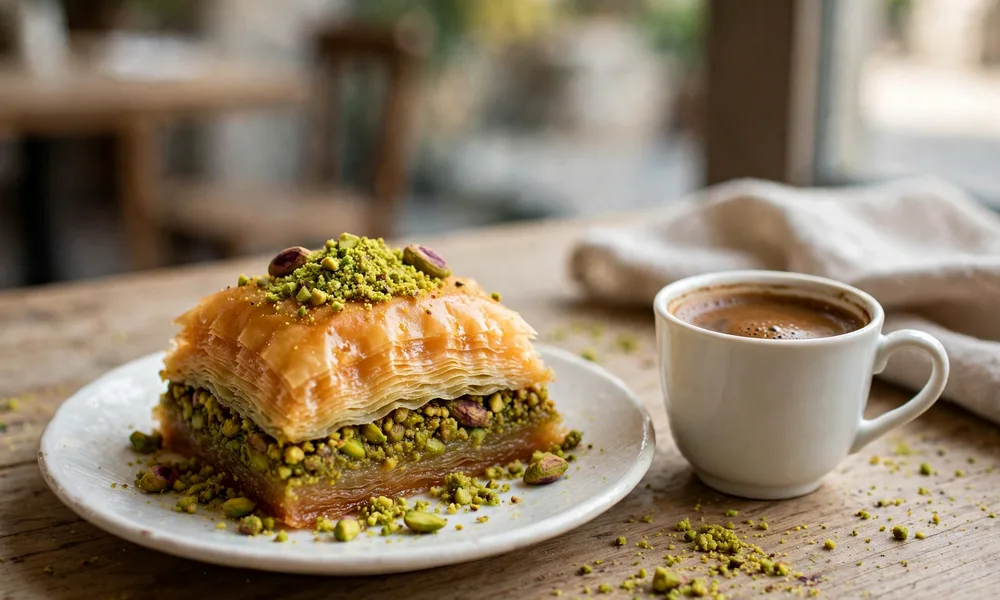
Pistachio baklava is the benchmark, and the best of it comes from the Gaziantep tradition, where the pistachios are bright green, freshly ground and used generously between forty thin sheets of phyllo. A good piece is deep gold on top, crisp enough to scatter flakes, and heavy in the hand for its size, because the filling is real. The first bite should be mostly crunch, then the rich, almost floral flavour of the pistachio, then the honey syrup warming the back of the throat.
Watch out for two cheats. The first is dye: a pistachio filling that is vivid, almost neon green is usually coloured, while real pistachio is a softer, duskier green. The second is a thin filling: if you can see through the nut layer, or the piece feels light and hollow, the bakery has stretched a little pistachio a long way.
2. Walnut baklava: the best for everyday eating
Walnut baklava is the workhorse of the baklava world, and for everyday eating it is often the smarter buy. Walnuts are cheaper than pistachios, so a bakery can afford to fill the pastry properly, and their warm, slightly bitter flavour stands up to the syrup better than a delicate nut. The best walnut baklava is spiced gently, usually with cinnamon and sometimes a little clove, and the filling is coarse rather than ground to dust, so you can feel the nuts as you chew. Our guide to the best nuts for snacking explains what fresh walnuts should taste like, and the same test applies here.
3. Classic honey baklava: the best for sweetness balance
Classic honey baklava is judged on one thing above all: the syrup. The best versions use a honey syrup, sometimes with a little lemon or orange blossom, poured over the hot pastry so it soaks down through the layers without pooling at the bottom. The result is sweet but not cloying, with a floral note that makes you want a second piece rather than a glass of water. The phyllo should still crackle after the syrup has gone in, which is the real test of the baker: a soggy top means the syrup was too hot, too much, or poured too late.
Check the box before you buy. If syrup is pooling in the corners, the baklava has been sitting in its own syrup too long and the bottom layers will be soft. If the top looks dry and pale, the syrup never reached it.
4. Chocolate baklava: the best for dessert
Chocolate baklava is the newest of the classic types, and when it is done well it is a proper dessert rather than a gimmick. The chocolate should be dark, at least 55 percent cocoa, layered thinly with the nuts so that it melts into the filling rather than sitting on top like a bar. The best versions use hazelnut or walnut alongside the chocolate, because the nut flavour keeps the chocolate from taking over, and the syrup is lighter than usual, since the chocolate already brings sweetness.
The trap is a chocolate baklava that is really a chocolate bar with pastry attached: a thick layer of sweet milk chocolate, a thin nut filling, and syrup on top of that. A good one tastes of nuts first, chocolate second, and honey last.
5. Almond baklava: the best lighter alternative
Almond baklava is the quietest of the seven, and for people who find pistachio too rich or walnut too bitter, it is the best choice. Almonds give a clean, mild, almost marzipan flavour, and the best almond baklava leans into that, sometimes with a little orange zest in the filling to lift it. The texture is the thing to judge: almonds ground too fine make a dry, powdery filling, while almonds left too coarse make a piece that falls apart.
Buy it from a bakery that grinds its almonds fresh, and eat it within two days; after that the pastry softens and the almond flavour fades first.
6. Mixed nut baklava: the best for sharing
Mixed nut baklava is the best choice when you are buying for a group, because a mixed box gives everyone a favourite and nobody has to commit to one nut. The best mixed boxes are honest about what is inside: pistachio pieces that are really pistachio, walnut pieces that are really walnut, and no piece bulked out with cheap peanuts or breadcrumbs. The pieces should be cut evenly, so nobody gets a scrap, and the syrup should be the same across the box, so the last piece tastes as good as the first.

7. Supermarket baklava: the best budget buy
Supermarket baklava is the cheapest way to eat baklava, and the best of it is perfectly serviceable if you know what to expect. The pastry is usually made on a line, the nuts are often a blend with more walnut than the label suggests, and the syrup is sweeter and heavier than a bakery version. Even so, a fresh supermarket box, eaten the day you buy it, can be enjoyable: the top layers are usually still crisp, the filling is generous enough, and the price is a fraction of a bakery box. The trick is to buy the box with the shortest shelf life left and the latest production date, and to eat it quickly, because supermarket baklava goes soft faster than any other type.
Walk away from a box where the pieces have slumped, the syrup has pooled, or the top is pale and soft. Those are signs the box has been sitting for days, and no amount of reheating will bring the crunch back.
What to avoid when buying baklava
The most common baklava regret is not a bad type but a stale box: pastry that was crisp on Monday and soggy by Friday, bought because it was cheap and left in the fridge. Avoid the trap by checking three things before you pay: the colour of the top, which should be deep gold rather than pale or dark brown; the weight of a piece, which should feel substantial rather than light and hollow; and the smell, which should be buttery and nutty rather than stale or oily. Our guide to the best pistachio milk makes the same point about pistachio quality.
Checklist: buying baklava
- Pick a piece up: the top should crackle and flake, not bend or tear like soft bread.
- Look at the nut layer: it should be thick, even and green or brown from real nuts, not dyed or dusty.
- Check the box for pooled syrup: a puddle in the corners means the base layers are already soggy.
- Smell it before you pay: butter and nuts should lead, with honey behind them, never stale oil.
- Ask when it was baked and buy the freshest tray, ideally the one that sells out by the afternoon.
- Eat it within two days and keep it at room temperature in a loosely covered box, never in the fridge.
Frequently asked questions
How long does baklava stay fresh?
Two days at room temperature is the honest answer, and the first day is the best. Keep it in a loosely covered box, not sealed airtight and never in the fridge, because cold turns the phyllo leathery and the syrup dull.
Should baklava be served warm or cold?
Room temperature is best. Warming it briefly in a low oven for five minutes can revive the crunch of a day-old piece, but the microwave will make it soggy.
Which nut is best in baklava?
Pistachio is the classic premium choice, with a rich, floral flavour and a bright green colour. Walnut is the best everyday choice, cheaper and bolder, and it stands up to syrup better. Almond is the mildest.
Why is my baklava soggy?
Usually because the syrup was too hot, too plentiful, or poured over pastry that had already cooled, so it sat on the surface instead of soaking through. Buy from a bakery that pours syrup over hot pastry and sells through its trays daily.
Is baklava very sweet?
Good baklava is sweet, but it should not be only sweet. The nuts and the butter should balance the honey, so each bite tastes of all three.
Can you freeze baklava?
You can freeze it before the syrup goes on, and many bakeries do, but freezing a finished, syruped piece kills the crunch.
Bottom line
The best baklava in 2026 is the one that balances honey and crunch: phyllo that shatters, nuts that taste of themselves, and a syrup that soaks without drowning. Pistachio is the classic to buy for a special occasion, walnut is the smarter everyday choice, and a bakery tray that sells out by the afternoon beats a supermarket box every time.

