
A beach umbrella is the cheapest shade you can buy and the easiest to get wrong. The right one turns a scorching stretch of sand into a cool patch you can sit under for hours, reading, napping and watching the sea without squinting or burning. The wrong one lifts off in the first gust of wind, leans at a sad angle by lunchtime, or throws a shadow so small that only your feet are covered. The best beach umbrellas of 2026 solve the problems that actually ruin beach days: they stay put in wind, they tilt so the shade follows the sun, and they are light enough to carry from the car park to the water without a second trip.
What a Beach Umbrella Is Really For
A beach umbrella does two jobs at once, and both matter. First, it blocks the sun, which is stronger at the beach than almost anywhere else because the sand and the water bounce light back up at you from below. A hat shades your head, but an umbrella shades your shoulders, your back and your legs as well, which is where most beach sunburn happens. Second, it marks your spot. On a crowded beach, an umbrella is your base camp: the place where the towels, the drinks and the book live, and the landmark you look for when you come back from a swim.
It helps to know what an umbrella is not. It is not a tent, and it should not be judged like one. A tent encloses you and keeps out wind and drizzle, but it is heavier, slower to put up and harder to move when the sun shifts. An umbrella is open, airy and quick: you push the pole into the sand, open the canopy and sit down. Our guide to the best beach tents of 2026 covers full shade for the whole family, but if you want simple, portable cover for one or two people, an umbrella is the better tool.
How to Choose: The Five Things That Matter Most
Start with the canopy size, because it decides how much shade you actually get. A canopy of about two metres across sounds generous, but the shadow it throws is smaller than the canopy itself once the sun is at an angle, and it moves as the afternoon goes on. For one person, a canopy of around 1.8 metres is enough. For two people sitting side by side, look for at least 2.1 metres, and for a family, 2.4 metres or more. Measure the shade, not the canopy: a wide canopy that sits high throws a smaller shadow than a slightly narrower one that sits low.
Next, look at the tilt. A fixed umbrella points straight up, which means its shade is directly underneath it at midday and nowhere near you by four in the afternoon. A tilting umbrella lets you angle the canopy toward the sun, so the shade stays over your chair as the sun moves. Check how the tilt works before you buy. A push-button tilt that locks firmly is worth more than a stiff joint that slips, and a tilt that only moves in one direction will leave you shifting your chair instead.
Fabric comes third, and it is where cheap umbrellas give themselves away. Polyester is the standard choice: it dries quickly, resists mildew and holds its colour in strong sun. Look for a UPF rating of 50 or above, which means the fabric blocks almost all of the sun’s ultraviolet rays. A canopy without a UPF rating may look solid but let through far more ultraviolet light than you expect. Check the stitching at the ribs as well, because that is where the fabric tears first when the wind catches it.
The pole is fourth, and it matters more than it looks. Aluminium poles are light, resist rust and are easy to carry, while steel poles are cheaper and heavier and will rust if the coating chips and salt water gets in. Wooden poles look beautiful and suit a garden, but they are heavy and awkward to carry across soft sand. Check that the pole comes in two pieces that screw together, because a one-piece pole will not fit in most cars, and look for a pointed tip that can be pushed into firm sand without a mallet.
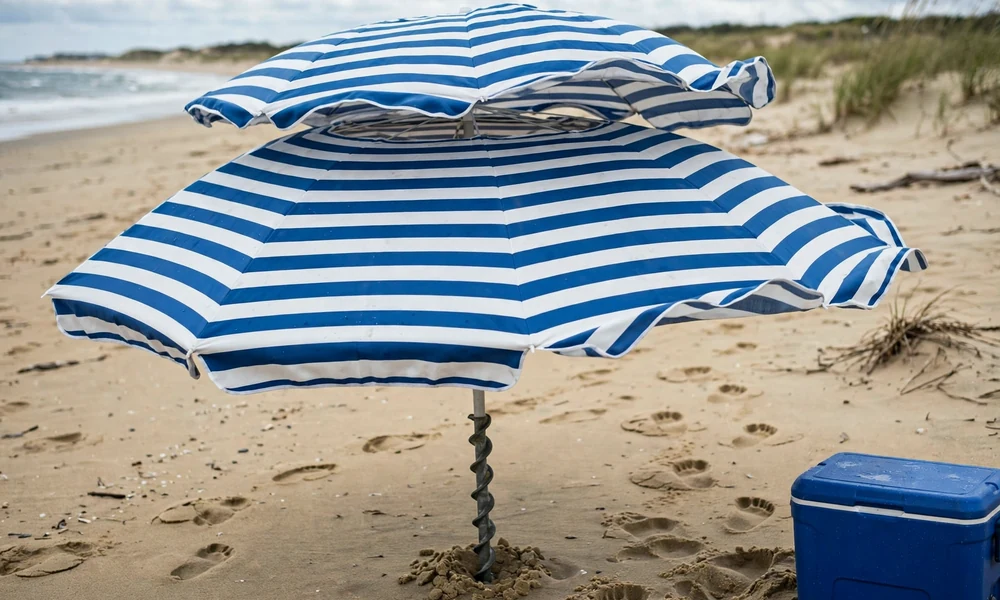
Finally, check the anchor, because this is the part that decides whether your umbrella stays up or ends up rolling down the beach. A simple pointed pole pushed into the sand is not enough on a windy day. The best beach umbrellas come with a sand anchor: a screw, an auger or a wide spike that twists deep into the sand and grips it. A screw anchor that you twist in by hand takes a minute to set up and holds far better than a pole simply shoved into a hole.
The Main Types of Beach Umbrella
The classic tilting umbrella is the safest choice for most beachgoers. It has a single canopy on a two-piece pole, a tilt joint halfway up, and a sand anchor at the base. It is light, it packs down small, and it does the one job you need: shade that follows the sun. Its weakness is wind. In a strong breeze, a flat canopy acts like a sail, so look for a model with a vented top, where a second smaller canopy sits above the main one and lets the wind pass through instead of lifting the whole umbrella.
The vented umbrella is the best choice for windy beaches. The gap between the two layers of canopy lets gusts escape, which keeps the umbrella steady and stops the fabric flapping. It costs a little more and weighs a little more than a plain umbrella, but on an exposed beach the difference is obvious: a vented umbrella stays up while a flat one is already being chased down the sand. If your favourite beach is open to the sea breeze, this is the type to buy.
The family umbrella is the biggest option, with a canopy of 2.4 metres or more and a thicker pole to support it. It shades two chairs, a towel and a cooler at once, which makes it the right pick for a family day out. The trade-off is weight and bulk: a family umbrella is heavier to carry and needs a bigger anchor, so it suits a short walk from the car rather than a long hike down a boardwalk. Pair it with comfortable seating, and our guide to the best beach chairs of 2026 covers chairs that sit well under a wide canopy.

Size, Shade and UPF: How Much Cover Do You Need?
UPF is the number to trust for sun protection, not the colour of the fabric. A dark canopy feels shadier, but a pale canopy with a UPF 50 rating blocks more ultraviolet light than a dark canopy with no rating at all. Check the label for the rating, and be wary of umbrellas that talk about sun protection without giving a number. Remember too that an umbrella does not replace sunscreen: reflected light from sand and water reaches skin that is in the shade, so cover up and reapply through the day.
Anchoring: The Part Most People Get Wrong
Most beach umbrellas fail at the anchor, not the canopy. The usual mistake is to push the pole a few centimetres into loose, dry sand and hope for the best. Dry sand has almost no grip, so the pole needs to reach the damp, firm sand underneath, which is often 30 to 40 centimetres down. Dig a small hole first, push the pole in as far as it will go, then pack wet sand firmly around the base and twist the anchor in until it bites.
Wind, Rain and Real-World Survival
Wind is the true test of a beach umbrella. A good one survives a steady sea breeze without flapping, leaning or lifting, because the vent lets gusts through and the anchor holds the pole. A bad one turns into a sail at the first gust, and the ribs bend or snap when it hits the sand. Check the ribs before you buy: fibreglass ribs flex and spring back, while thin metal ribs bend and stay bent. Eight ribs hold a canopy steadier than six, and a canopy with a vent will always cope better than a flat one.

Before You Buy: A Short Checklist
- Check the canopy size, and buy at least 2.1 metres across for two people.
- Look for a UPF 50 rating on the fabric, not just a dark colour.
- Test the tilt, and make sure it locks firmly in both directions.
- Choose a vented canopy if your beach is open to the wind.
- Check the anchor: a screw or auger holds far better than a plain spike.
- Pick fibreglass ribs over thin metal, and eight ribs over six.
- Weigh the packed umbrella, and make sure you can carry it in one trip.
- Check that the pole splits in two and fits in your car with the rest of your kit.
For the rest of your beach kit, a good towel matters as much as good shade. Our guide to the best beach towels of 2026 covers towels that dry quickly, shake off sand and pack small beside an umbrella.
Frequently Asked Questions
What size beach umbrella do I need for two people? A canopy of at least 2.1 metres across, with a tilt so the shade follows the sun. A 1.8-metre canopy suits one person, while a family needs 2.4 metres or more to shade two chairs and a towel.
How do I stop a beach umbrella blowing away? Use a screw anchor twisted deep into damp, firm sand, pack wet sand around the base, and choose a vented canopy so gusts pass through instead of lifting it. Take the umbrella down in strong wind and never leave it up unattended.
Are vented beach umbrellas worth the extra cost? Yes, on any beach open to a sea breeze. The vent lets wind escape through the top of the canopy, which keeps the umbrella steady, stops the fabric flapping and makes the ribs far less likely to bend.
The Bottom Line
The best beach umbrella of 2026 is the one that fits how you spend your time by the sea: wide enough to shade you at four in the afternoon as well as at midday, vented enough to stand up to a sea breeze, and anchored well enough that you can relax instead of watching it. Start with an honest look at your beach days, not the catalogue. Think about how far you walk, how many people you shade, whether your beach is windy, and how much you are willing to carry. Then choose the type that fits: a tilting umbrella for most days, a vented one for windy beaches, a family umbrella for a crowd, or a travel umbrella for a long walk. Get the anchor right, and the rest of the day takes care of itself.


