
A car is the smallest room you will ever try to scent, and that is exactly why most car air fresheners get it wrong. A product that smells pleasant in a shop can turn overpowering in a closed cabin within minutes, and one that seems too subtle on the first day can be the one still working three weeks later. The best car air fresheners of 2026 understand that balance: they release scent slowly, they suit the size of a car rather than a house, and they keep working through hot afternoons, cold mornings and long motorway drives without demanding attention.
What Makes a Car Air Freshener Different
A car is not a living room. The space is tiny, the air changes every time a door opens, and the temperature swings far more than any room in a house. On a sunny day the dashboard can get hot enough to make a freshener release its scent far faster than the maker intended, while on a cold morning the same product can seem to have disappeared altogether. A good car air freshener is built for those swings. It releases scent steadily rather than in one strong burst, and it does not rely on a plug socket or a flat surface that a car simply does not offer.
The other difference is how close you sit to the scent. In a house you can walk away from a strong fragrance. In a car you are strapped into a seat about an arm’s length from the dashboard, with the scent coming straight at you through the vents or hanging right in front of the windscreen. That is why the best car air fresheners are gentler than their home equivalents. If you want the wider picture, our guide to the best air fresheners of 2026 covers the home market, but for a car the rules are different: lighter scent, slower release, and a design that fits a cabin rather than a shelf.
The Four Types Worth Knowing
Almost every car air freshener falls into one of four types, and each suits a different kind of driver. Vent clips attach to the air vent and use the airflow from the heating or air conditioning to spread scent through the cabin. They are neat, they stay out of the way, and they only work hard when the fan is running, which makes them a good match for drivers who want scent on demand rather than all the time. The best ones have an adjustable vent so you can turn the scent up on a long drive and down again when a passenger finds it strong.
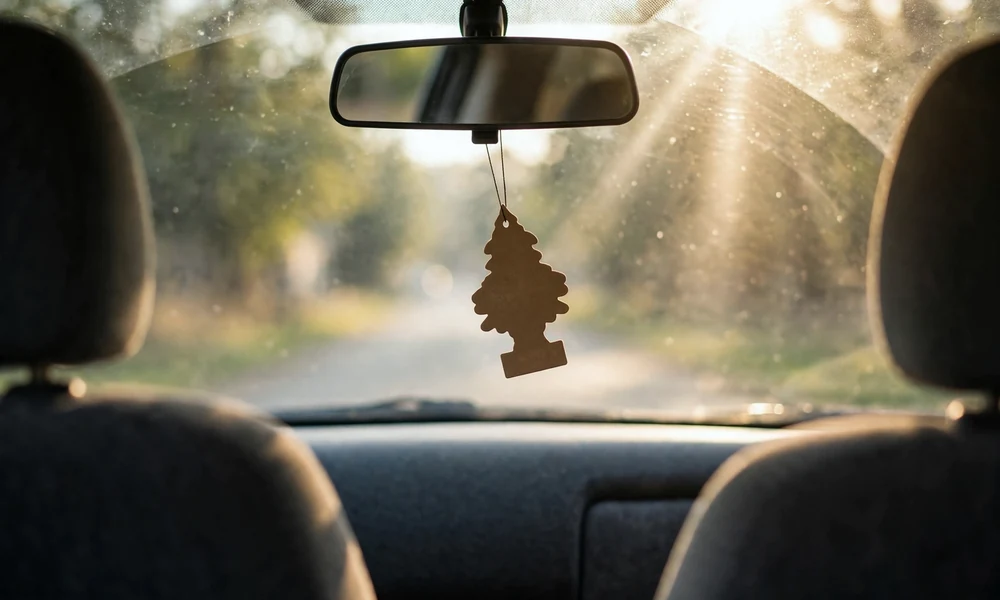
Hanging fresheners are the classic choice: a paper card or a small bottle on a cord, looped over the rear-view mirror. They cost the least, they need no fitting at all, and they are easy to swap when you fancy a change. Their weakness is that they release scent at their own pace regardless of what the car is doing, so a strong one can be too much in a small hatchback on a hot day. They also swing while you drive, which some drivers find distracting, so it is worth hanging them short and keeping them clear of your view of the road.

Gel and canister fresheners sit in a cup holder or a door pocket and release scent slowly from an open gel or a vented lid. They are the steadiest of the four types, with no sudden bursts, and they tend to last the longest because the scent escapes gradually rather than all at once. The trade-off is that they take up a cup holder and they work slowly, so they suit drivers who want a constant low background scent rather than an instant fix after a gym bag or a takeaway has been in the car.
Sprays are the odd one out because they are not a continuous freshener at all. A quick spray freshens the cabin in seconds, which makes them ideal for a specific moment: after a dog has been in the back seat, after a long journey with the windows shut, or before picking someone up. The scent fades within an hour or two, so a spray is a top-up rather than a solution on its own. Kept in the door pocket, though, a small spray is the most useful of the four types to have around, and it pairs well with any of the others.
How to Choose: The Five Things That Matter Most
Start with strength, and choose lighter than you think you need. In a shop, with fresh air all around, a strong scent can seem appealing. In a closed car it will feel twice as strong within ten minutes. The best car air fresheners give you some control: an adjustable vent clip, a gel with a lid you can half close, or a hanging freshener you can tuck behind the mirror to soften it. If a product offers no way to turn it down, it is a gamble, and the stakes are a whole journey with a scent you cannot escape.
Next, think about longevity, and be honest about what a claim means. A freshener that promises a month of scent usually means a month of gradually fading scent, with the first week the strongest and the last week barely noticeable. Vent clips tend to last two to four weeks, hanging fresheners two to three, and gels often four to six, though heat shortens all of them. A product that stays steady for three weeks is better than one that is strong for three days and then gone, even if the strong one smells better on day one.
Then consider placement, because where a freshener sits decides how well it works. A vent clip only earns its place if your vents blow where you sit, and a hanging freshener only works if air moves past it. A gel in a cup holder near the centre of the cabin scents the whole car more evenly than one hidden in a door pocket. Before buying, look at your own car: where the vents are, which cup holders you actually use, and whether a hanging freshener would block your view. The right type for someone else’s car is not necessarily the right type for yours.
Smell is the fourth thing, and it is the most personal. Fresh, clean scents such as linen, citrus and light woods tend to work best in cars because they read as clean rather than perfumed, and they suit the widest range of passengers. Heavy sweet scents, strong florals and anything that smells like a dessert can become tiring on a long drive, and they are the ones most likely to draw a complaint from a passenger. If you share the car, pick a scent a passenger would not mind, not just one you like. A neutral, fresh scent is rarely anyone’s favourite, but it is almost never anyone’s problem either.
Finally, look at the practical details that only show up after a week of use. Does the vent clip actually grip your vent slats, or does it fall off on the first bumpy road? Does the gel leak if the canister tips over? Does the hanging freshener leave a mark on the mirror or the dashboard in hot weather? A good car air freshener is one you forget about, in the best sense: it stays where you put it, it does not rattle, drip or stain, and it keeps the car smelling clean without you having to think about it at all.

Scents That Work in a Car, and Scents That Do Not
Not every pleasant smell belongs in a car. Light citrus, clean linen, fresh ocean and soft woods are the safest choices because they smell clean at low strength and do not build up into something heavy. They also hide the everyday smells of a car, such as warm plastic, old upholstery and the faint smell of fuel, without trying to cover them with perfume. A fresh scent that smells like clean air will always beat a complicated fragrance that smells like a shop.
What to Avoid
The worst car air fresheners share a few habits, and they are easy to spot before you buy. The first is a scent so strong that it hits you when you open the door. That is not freshness; it is overpowering, and it will only get worse as the car heats up. The second is a product that promises to remove smells but only layers perfume over them. A freshener cannot do the job of cleaning, and if the car smells of old food or damp, no scent will fix it. For smells that need removing rather than covering, our guide to the best odor eliminators of 2026 is the better starting point, because it deals with the cause instead of the cover-up.
The third habit is poor fitting. A vent clip that does not fit your vents, a hanging freshener that swings into your line of sight, or a canister that slides around the cabin will annoy you every single day, long after the scent has faded. And the fourth is the impulse buy: the cheapest freshener at a petrol station, bought because the car smells stale right now. It is almost always too strong, too short-lived, or both. Some car accessories are simply not worth the money, and our round-up of the worst car accessories that waste money is a useful reminder of how often a quick purchase turns into a regret.
A Short Note on Safety
Car air fresheners are safe when used as directed, but a car is a small, sealed space, so a little care goes a long way. Keep the car ventilated, especially when you first fit a new freshener: open the windows for a few minutes, let the first strong burst clear, and then close up. If you or a regular passenger has asthma, allergies or a sensitivity to fragrance, choose the lightest scent you can find, keep it on its lowest setting, and remove it at the first sign of irritation rather than waiting to see if it passes. Nobody should have to endure a headache for the sake of a fresh-smelling car.
The Verdict
The best car air freshener is rarely the strongest or the most expensive. It is the one that fits your car, releases its scent slowly, and smells clean rather than perfumed. For most drivers that means a vent clip with an adjustable setting for everyday use, a gel in the cup holder for steady background scent, and a small spray in the door pocket for the moments that need a quick fix. Hanging fresheners still have their place for drivers who want something cheap and simple, as long as the scent is light and the cord is kept short.
Choose lighter than you think, give a new freshener a few days before judging it, and remember that a clean car needs less scent than a dirty one. A quick vacuum and an open window will do more for the smell of your car than any freshener, and once the cabin is clean, the right freshener only has to keep it that way. That is the whole job, and the best car air fresheners of 2026 do it quietly, steadily, and without ever making themselves the thing you notice most about the drive.


