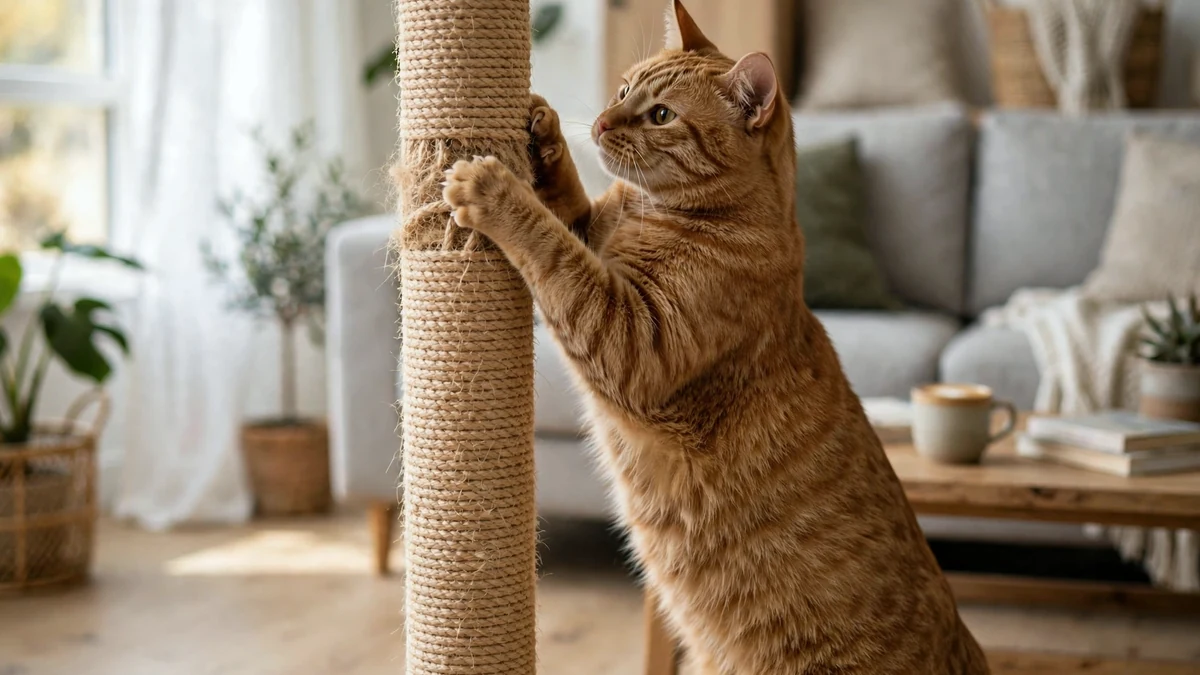
Every cat owner knows the sound: claws dragging down the arm of the sofa, usually at the exact moment you have sat down to relax. Scratching is not mischief. It is how cats keep their claws in shape, stretch the muscles along their back and shoulders, and leave their scent on the places they consider theirs. A cat that has nowhere good to scratch will simply pick the nearest piece of furniture, and no amount of scolding changes that. The fix is not to stop the scratching. It is to give the cat something better to scratch than your sofa, and to put it in the right place.
The best cat scratchers of 2026 are not complicated. They are tall enough for a full stretch, heavy enough not to wobble, and covered in a material that actually catches a claw. The ones that fail usually fail on one of those three points: they are too short, too light, or wrapped in carpet that a cat finds boring. This guide walks through the types that work, what to check before you buy, where to put the scratcher so your cat actually uses it, and how to tell when it is time to replace one.
Why cats scratch in the first place
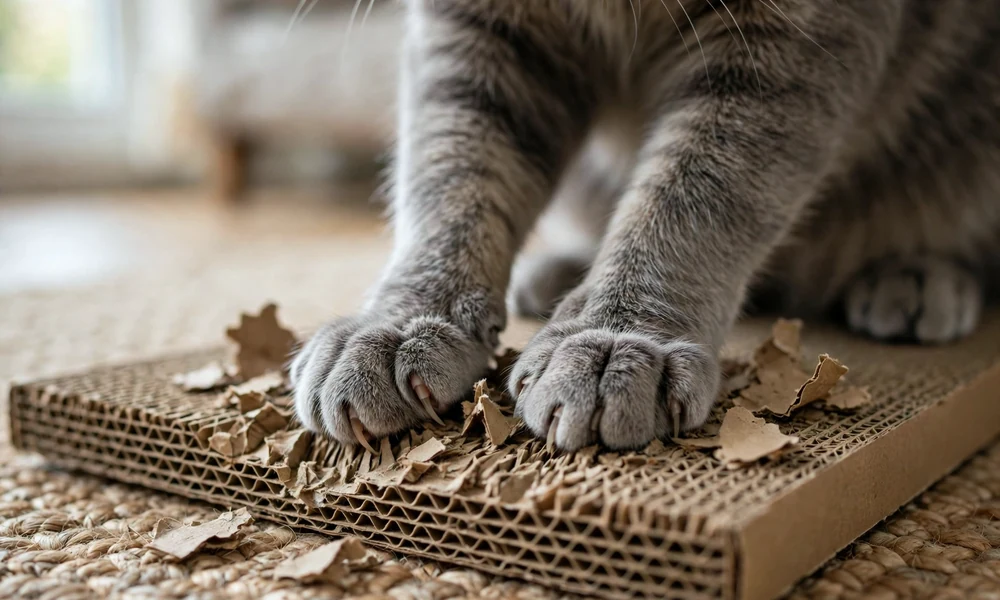
Cats scratch for three reasons, and a good scratcher has to serve all three. The first is claw care. A cat’s claws grow in layers, and scratching peels away the worn outer sheath so the sharp claw underneath can come through. Watch a cat finish a scratching session and you will often see little crescent-shaped husks left behind on the floor. That is the system working. A scratcher with a rough, fibrous surface does this job far better than a smooth one, which is why sisal rope and corrugated cardboard remain the two most popular materials.
The second reason is stretching. A cat that rears up against a tall post and pulls downward is stretching its spine, shoulders and front legs in one long movement. Cats do this most often after a nap, which is why a scratcher placed near a sleeping spot gets so much use. A post that is too short forces the cat to hunch instead of stretch, and many cats simply will not bother with it. As a rough rule, a vertical scratcher should be at least as tall as your cat when it stands on its hind legs with its front paws fully extended, and taller is better.
The third reason is scent. Cats have scent glands between their toes, and scratching deposits their scent on a surface. It is a quiet way of saying that this corner of the room belongs to them. That is also why cats scratch the same spot again and again, and why a brand new scratcher can take a few days to earn their attention. The old one smells like them. The new one does not, yet.
The tall sisal post: still the best all-rounder
If you only buy one scratcher, make it a tall vertical post wrapped in sisal rope. Sisal is rough enough to catch claws and shed the old sheath, it lasts far longer than carpet, and most cats take to it quickly. Look for a post at least 80 centimetres tall, with a wide, heavy base that keeps it standing when a large cat throws its full weight into a scratch. A base of 40 centimetres square or more is a good sign. Anything smaller will rock, and a scratcher that rocks is a scratcher a cat abandons.
Flat cardboard scratchers: the low-cost favourite
Not every cat likes to scratch standing up. Some prefer to rake at a flat surface on the floor, and for those cats a corrugated cardboard scratcher is often the favourite item in the house. Cardboard pads are cheap, light, and easy to replace, and many cats go wild for the texture. They also double as a place to lie down, which is why you will often find a cat asleep on the very pad it has just shredded.
Scratching posts with platforms and toys
Scratchers that combine a post with a perch and a dangling toy are built for kittens and young cats, and they earn their keep by turning scratching into play. A kitten that bats at a hanging toy will rake the sisal underneath without thinking about it, and that is exactly how good habits start. For an older cat the toy matters less, but the platform still does: a cat that naps on top of a scratcher will stretch and scratch the moment it wakes up.

These are also worth considering alongside the rest of your cat’s furniture. A scratcher with a perch works well near a window, where the cat can watch the world, and it pairs naturally with a proper climbing setup. If your cat already loves to climb, read our guide to the cat trees your cat will actually climb in 2026 before you buy, because a good tree often includes scratching surfaces of its own, and the two pieces should complement each other rather than compete for the same corner.
Wall-mounted scratchers: the space savers
For small flats, a wall-mounted scratcher is the smartest option. A sisal panel fixed to the wall at the right height takes up no floor space at all, and it cannot tip over, which solves the stability problem completely. Cats that like to scratch door frames are usually the best candidates, because a wall panel gives them the same vertical surface in a spot you choose instead of one they chose.
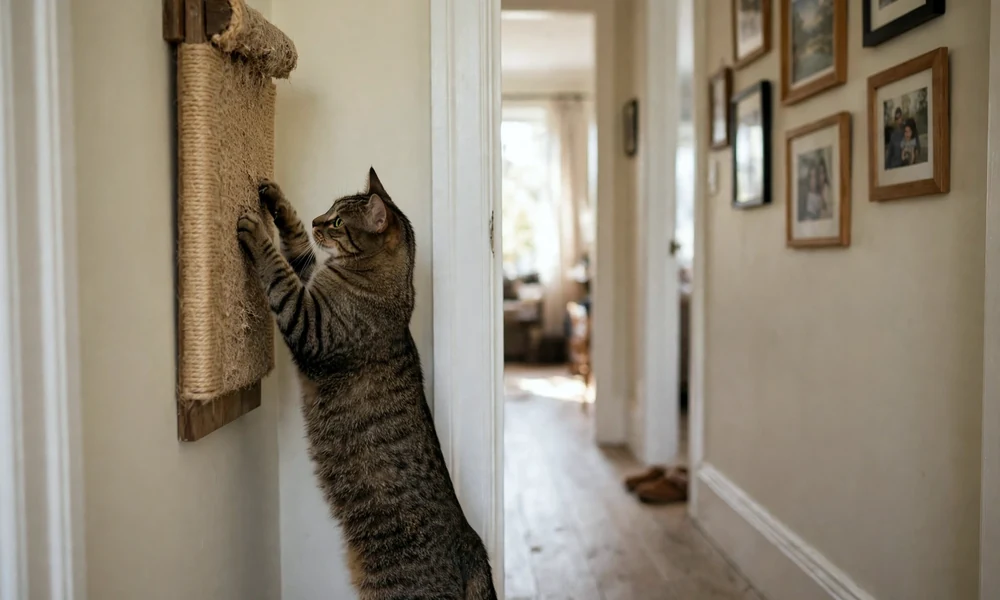
Wall-mounted scratchers also work well in hallways and beside the doors cats already target. If your cat has been scratching the same door frame for months, put the panel right there. The cat is already telling you where it wants to scratch. You just need to give it a better surface in that exact spot.
What to check before you buy
Stability comes first. Push the scratcher from the top before you buy it, or as soon as it arrives, and see how much it moves. A good scratcher barely shifts. If it rocks or slides, it will fail. Weight at the base matters more than the material of the post, and a wide base matters more than a heavy one that is narrow. On hard floors, a base with a non-slip underside helps, and on carpet, a slightly larger footprint stops it sinking into the pile.
Height comes second. Measure your cat standing on its hind legs and reaching up. Most adult cats need a vertical surface of at least 75 to 80 centimetres, and large breeds like Maine Coons need closer to a metre. Flat pads have no height requirement, but they should be long enough for the cat to stretch out along them, at least 45 centimetres for an average cat.
Material comes third. Sisal rope is the safest bet for most cats. Sisal fabric, which is a flat woven sheet rather than rope, is a close second and sheds less. Corrugated cardboard is the favourite of many cats but wears out fast. Carpet-covered scratchers are the weakest choice: the loops can catch claws, the texture is often too soft to strip the sheath, and once a cat learns that carpet is for scratching, your actual carpet is next.
Where to put it: placement is half the battle
The most common mistake is putting the scratcher in a corner nobody uses. Cats scratch where they spend time, and they scratch most often just after waking and just after coming indoors. Put the main scratcher near the cat’s favourite sleeping spot and another near the entrance to the room where the family gathers. A scratcher hidden in a spare bedroom will stay pristine and unused.
Watch where your cat already scratches. If the arm of the sofa is the target, put the new scratcher directly in front of that arm, even if it looks untidy for a week. Once the cat is using it, you can move it a few centimetres a day toward the spot you would prefer. Cats accept gradual moves. They do not accept being told their favourite scratching spot is now across the room.
Placement also matters for the rest of the cat’s routine. A scratcher near the litter area gets used on the way out, and keeping the whole setup in one zone makes the house feel organised for the cat as well as for you. If you are rethinking the layout, our guide to the best cat litter boxes of 2026 covers the same question of where things belong, and the two pieces of advice work best together.
Getting your cat to actually use it
A new scratcher often gets ignored for a few days, and that is normal. The cat’s scent is not on it yet, and it smells of the shop. Rub a soft cloth on your cat’s cheeks, where the scent glands are, and then rub the same cloth on the scratcher. That transfers the scent and marks it as theirs. A pinch of catnip rubbed into sisal or cardboard works for many cats too, though some cats are indifferent to catnip and a few get overexcited by it, so use a small amount first.
Play near the scratcher rather than forcing the cat onto it. Dangle a toy so the cat reaches up and touches the post, or drag a feather across the cardboard pad. The moment the claws catch, most cats get the idea. Never push a cat’s paws onto a scratcher yourself. It frightens them, and a frightened cat avoids the object completely.
When to replace a scratcher
A sisal post is done when the rope has frayed down to the core along most of its length, or when the post itself wobbles because the fixings have loosened. A cardboard pad is done when the surface is flat and smooth in the middle, because a smooth pad no longer strips the claw sheath and the cat will move on to something rougher. A wall panel is done when the sisal has worn thin enough to see the backing board through it.
Finally, remember that scratchers are part of the wider kit that keeps a cat happy at home and on the move. A cat that travels well is a cat that can get to the vet without a wrestling match, and the right carrier makes that far easier. Our guide to the pet carriers that travel comfortably in 2026 covers the carriers that cats actually settle into, which is worth sorting out long before the next vet visit rather than the morning of it.
The short version
Buy tall, buy heavy, and buy sisal or cardboard. A tall sisal post is the best all-rounder, a flat cardboard pad is the cheapest way to cover more rooms, and a wall-mounted panel is the answer when floor space is tight. Put the scratcher where your cat already spends time, not where it looks tidy. Give a new scratcher a few days, help it along with scent and play, and replace it before it is worn smooth. Do those things and the sofa survives, the claws stay in shape, and the cat gets to do what it was always going to do anyway, on a surface built for the job.


