
The best coffee grinders for travel in 2026 prove that a great cup of coffee does not have to wait until you get home. A compact grinder that fits in a carry-on lets you brew fresh coffee in a hotel room, at a campsite, or on a quiet balcony halfway around the world.
Travel grinders have improved dramatically in recent years. Manual models now use steel conical burrs that rival full-size home grinders, while pocket-size electric grinders charge over USB-C and grind enough beans for two cups in under a minute.
This guide compares the strongest travel coffee grinders of 2026, explains what actually matters when you are buying small, and gives you a simple checklist so you can pack a grinder that earns its place in your bag.
Key Takeaways
- Conical burrs are essential: blade grinders chop beans unevenly and ruin the flavour of good coffee.
- Manual hand grinders offer the best grind quality for the size and weight, and they never need charging.
- Compact electric grinders win on speed and convenience, and the best ones now charge over USB-C.
- A good travel grinder weighs under 500 grams and holds 20 to 30 grams of beans.
- Match the grind range to your brewer: pour-over and French press need different settings.

What Makes a Great Travel Coffee Grinder
A travel grinder is not simply a smaller version of a kitchen grinder. It has to survive being packed and used where you have no counter space, no spare parts, and no patience for fiddly tools.
Size and Weight
Size is the first thing to check, because a grinder that does not fit your bag will stay at home. The best travel grinders are roughly the size of a water bottle or smaller, and most weigh between 300 and 500 grams. Manual grinders tend to be slimmer, since they have no motor or battery, while electric models are shorter and wider. Before you buy, measure the pocket you plan to carry it in, and remember you also need room for beans and a brewer.
Burr Quality
Burrs do the actual grinding, and they matter more than any other part. Steel conical burrs are the standard in good travel grinders because they produce even particles, which makes coffee taste sweet and clear instead of bitter and muddy. Ceramic burrs are lighter and never rust, but they can chip if dropped. Blade grinders should be avoided entirely: they chop beans into a mix of dust and chunks.
Grind Range
A travel grinder should cover the grind sizes you actually brew. Pour-over needs a medium grind, French press needs a coarse grind, and AeroPress works best somewhere in between. The most useful travel grinders adjust across that whole range in small, repeatable steps. Stepless adjustment gives the finest control, but stepped adjustment with clear clicks is easier to use half asleep in a hotel room. Make sure the setting stays put during grinding.
Durability and Power
Travel gear gets knocked around, so build quality matters. Stainless steel and aluminium bodies survive drops far better than plastic, and a grinder with few loose parts is less likely to lose something important in a hostel dorm. For electric grinders, look for at least 15 to 20 grinds per charge and USB-C charging. Manual grinders have no battery to worry about, which is one reason many travellers prefer them.
The Best Coffee Grinders for Travel 2026
The grinders below cover every kind of traveller, from the ultralight backpacker to the hotel-room pour-over enthusiast. Each one is a genuine travel design, and each earns its place here for grind quality first and portability second.
Best Overall Manual Grinder
The best all-round manual travel grinder pairs a steel conical burr set with a slim body that weighs around 400 grams. It grinds 20 grams of beans in about 45 seconds. The crank folds flat against the body, so the grinder slips into a side pocket without snagging on clothes. Adjustment is stepped and clearly marked, covering fine AeroPress settings to coarse French press. For most travellers, this is the sweet spot: excellent coffee, no charging, and a size that disappears into a bag.
Best Premium Manual Grinder
The premium manual pick costs more, but it grinds noticeably faster and more evenly than budget models, thanks to a larger burr set and a smoother bearing. It suits travellers who brew every day and notice the difference between a good cup and a great one. The body is machined aluminium, and adjustment is stepless, so you can fine-tune the grind until your pour-over drains exactly on time. At around 500 grams it is slightly heavier, but the grind rivals many home grinders.
Best Electric Travel Grinder
The best electric travel grinder of 2026 is barely larger than a tall travel mug, charges over USB-C, and grinds a full dose in under 30 seconds. Its conical burrs deliver a consistent medium grind that suits pour-over and AeroPress, and a simple dial covers coarse and fine settings without an app. A single charge lasts for roughly 20 grinds. It is heavier than a manual grinder, at about 550 grams, and it makes a soft whirring noise. For hotel stays and road trips, it is the easiest option on this list.
Best Budget Travel Grinder
A good budget travel grinder costs less than a week of cafe coffee and still uses real conical burrs. The best budget models are simple: a light metal body, a steel burr set, and a crank that detaches for packing. Grind quality is good rather than exceptional, but most travellers will not notice the difference in a pour-over. The hopper holds about 20 grams, enough for one generous cup, and the whole grinder weighs under 350 grams. This is the right pick for occasional travellers or a first travel grinder.
Best Ultralight Travel Grinder
For backpackers and one-bag travellers, the ultralight pick makes the cut when every gram is counted. It weighs around 250 grams, stands under 16 centimetres tall, and still uses a proper steel conical burr set. The trade-off is capacity: it holds about 15 grams of beans, enough for one cup, so couples will need to grind twice. The crank is short, so grinding takes a little longer, but the size is worth it when your whole life fits in a 30-litre pack.

Travel Coffee Grinders Compared
Manual grinders are lighter and never need power, electric grinders are faster and easier, and ultralight models sacrifice capacity for size.
| Type | Weight | Power | Best For | Price Range |
|---|---|---|---|---|
| Manual, best overall | 400 g | Hand crank | Most travellers | $80–$120 |
| Manual, premium | 500 g | Hand crank | Daily brewers | $150–$250 |
| Electric, compact | 550 g | USB-C battery | Hotels and road trips | $100–$180 |
| Manual, budget | 350 g | Hand crank | Occasional trips | $30–$60 |
| Manual, ultralight | 250 g | Hand crank | Backpacking | $60–$100 |
You pay more for larger burrs, smoother grinding, and better materials. A budget grinder with steel burrs will make better coffee than an expensive grinder with a blade, so burr quality should always come before brand name or looks.
Manual vs Electric: Which Travels Better?
The manual versus electric question comes down to how you travel. Manual grinders are lighter, quieter, and impossible to run flat, which makes them the safer choice for camping, hostels, and flights. The downside is effort: grinding 20 grams by hand takes 45 to 90 seconds, and a fine grind takes longer.
Electric grinders remove that effort entirely: press a button, wait 30 seconds, and your beans are ground. That convenience matters on busy mornings and when you are brewing for two or more people. The cost is weight, noise, and dependence on a charged battery. Choose manual for adventure travel and electric for city and hotel travel. Either way, pair your grinder with the right brewer, and the best coffee makers for camping are a good place to start if your trips take you outdoors.
How to Choose the Right Travel Grinder
Start with your brewer, because the grind size it needs narrows the field fast. Pour-over needs a consistent medium setting, French press needs a coarse setting that stays even, and AeroPress needs fine to medium grinds without dust. If you switch brewers between trips, choose a grinder with a wide, repeatable range.
Next, think honestly about your luggage. A grinder that fits your bag easily will travel with you; one that forces you to leave something else behind will get left at home. Packing smart helps, and the best travel packing cubes can keep your coffee kit organised inside a crowded suitcase. Finally, set a budget that matches how often you travel: a daily coffee drinker will notice what a premium grinder offers, while an occasional traveller will be happy with a budget model that uses real burrs.
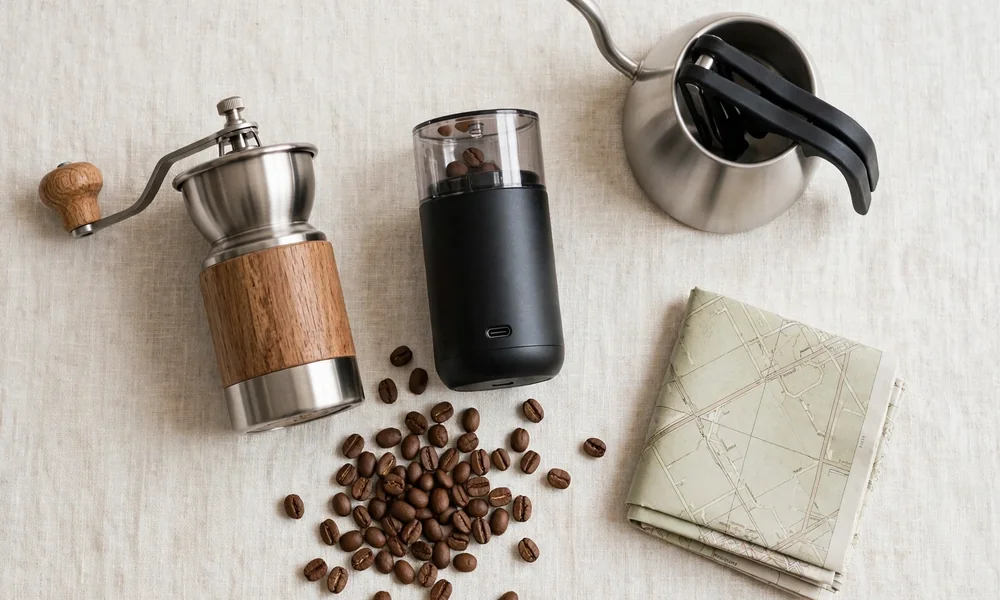
Travel Coffee Grinder Packing Checklist
Run through this checklist the night before you leave, and you will never arrive somewhere beautiful with beans but no way to grind them.
- Grinder, cleaned and dry: brush out old grounds and pack it in a pouch.
- Whole beans: 15 to 20 grams per cup per day, in a sealed bag.
- Brewer and filters: a pour-over dripper or AeroPress, packed flat.
- Charging cable: a USB-C cable for electric grinders, shared with your phone charger.
- Cleaning brush: a small stiff brush keeps the burrs free of stale grounds.
- Mug or travel cup: a light, sturdy cup that your brewer sits on.
Frequently Asked Questions
Can I take a coffee grinder on a plane?
Yes. Manual grinders are allowed in hand luggage and checked bags, and most compact electric grinders are allowed too, since their batteries are small and built in. Keep the grinder accessible in case security wants a closer look.
Are manual coffee grinders good enough for travel?
Yes, and for many travellers they are the best option. A good manual grinder with steel conical burrs produces a grind that matches most home electric grinders, and it never needs charging. The only real cost is a minute of effort each morning.
How much should a travel coffee grinder weigh?
Aim for under 500 grams. Ultralight models weigh around 250 grams, standard manual grinders weigh 350 to 450 grams, and compact electric grinders weigh 500 to 600 grams.
What grind size do I need for travel brewing?
It depends on your brewer. Pour-over needs a medium grind, like coarse sand. French press needs a coarse grind, like breadcrumbs. AeroPress works best with a fine to medium grind. A travel grinder with a wide adjustment range covers all three.
Do I need special beans for a travel grinder?
No. Any fresh whole beans work, but lighter roasts and single origins reward a good grinder most, because an even grind lets their brighter flavours come through. Buy beans roasted within the last few weeks and grind only what you need. The best plant-based milks for coffee can also round out your kit if you take milk in your brew.
How do I clean a travel coffee grinder?
Brush the burrs and grounds container after each use, and take the grinder apart for a deeper clean every few days on a long trip. Never wash burrs with water unless the maker says it is safe. A dry brush and a quick shake are enough for daily care.
The Bottom Line
The best coffee grinders for travel in 2026 make fresh coffee possible almost anywhere, without weighing down your bag. For most travellers, a manual grinder with steel conical burrs is the smartest buy: light, quiet, reliable, and genuinely great coffee. If you prefer zero effort, a compact USB-C electric grinder is the next best thing. Choose the grinder that fits your bag, your brewer, and your trips, and your best cup of coffee might just be the one you brew far from home.


