The Best Command Hooks for Renters, Bathrooms and Busy Entryways in 2026
Command hooks are the small adhesive hooks that hold your keys, your coat and your towels without a single hole in the wall. They are the renter’s answer to a drilled hook, and when they work they feel like a small miracle: press one onto a clean wall, wait an hour, hang something on it, and forget it exists. When they fail, they fail suddenly, dropping whatever they held onto the floor. The difference between those two outcomes is rarely luck. It is the size of the hook, the weight on it, the wall underneath it, and the thirty seconds you spend pressing it on.
Key Takeaways
- Match the hook to the weight: small hooks hold up to about half a kilogram, medium hooks up to about one and a half, large hooks up to about three and a half.
- The wall matters more than the hook: smooth, clean, painted plaster is ideal, while textured, dusty, damp or freshly painted walls cut the holding power in half or worse.
- Press each hook firmly for thirty seconds and wait a full hour before hanging anything on it, so the adhesive bonds properly.
- Use two hooks for anything wide or heavy, so the load is shared and one hook never carries the whole weight alone.
- Remove a hook by pulling its tab slowly straight down the wall, never outwards.
What a Command Hook Actually Is
A command hook has two parts that do two different jobs. The hook is the visible part: a curved piece of plastic or metal that holds whatever you hang on it. The strip is the invisible part: a pad of foam tape with strong adhesive on both faces, one face gripping the wall and the other gripping the hook’s base.
A command hook is not a replacement for a screwed hook where the load is heavy, repeated or swinging. A wet winter coat, a full school bag and a heavy mirror all belong on a fixing that goes into the wall, and our guide to wall hooks for heavy coats explains why. A command hook is for light and medium loads where holes are forbidden or unwelcome.
The Main Types of Command Hook Compared
Command hooks fall into a few clear families, and the right one depends on what you are hanging and where.
Small hooks: keys, lanyards and cables
Small hooks are the lightest in the range, rated for around half a kilogram. They suit keys, lanyards, charging cables, lightweight decorations and the small jobs that otherwise end up in a drawer. Three small hooks in a line hold a family’s keys far better than one medium hook holding all of them.
Medium hooks: bags, towels and hats
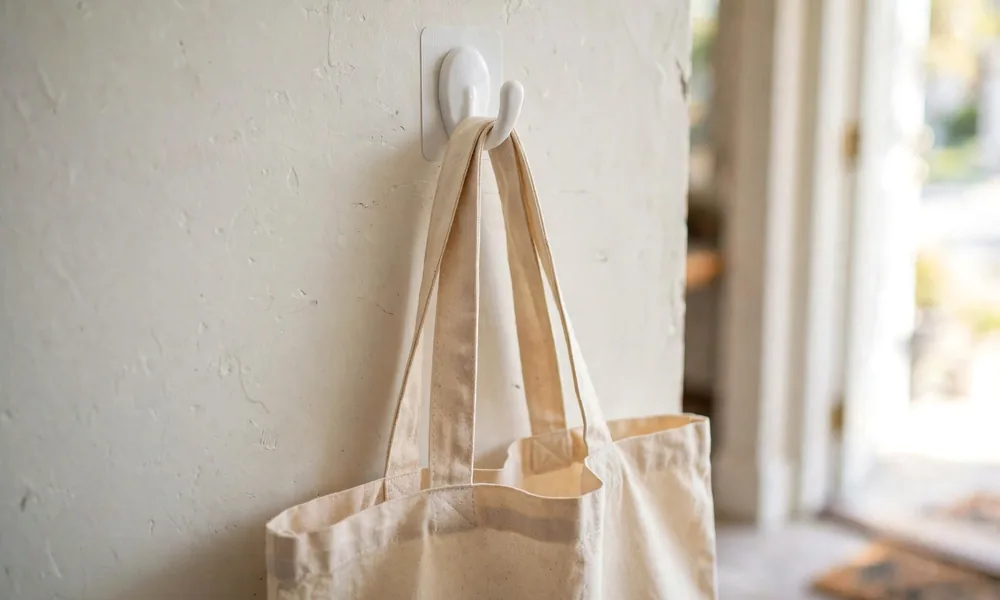
Medium hooks are the workhorse of the range, rated for around one and a half kilograms. They hold a handbag, a tote bag, a hand towel, a hat or a set of headphones. If you are buying your first pack, start here: neat on the wall, yet strong enough for everyday loads.
Large hooks: coats, backpacks and robes
Large hooks are rated for around three and a half kilograms, which covers a dry coat, a backpack, a dressing gown or a heavy tote. They need a flat stretch of wall to sit properly. Never hang a wet coat on one: water doubles the weight and the hook was never rated for it.
Clear and decorative hooks
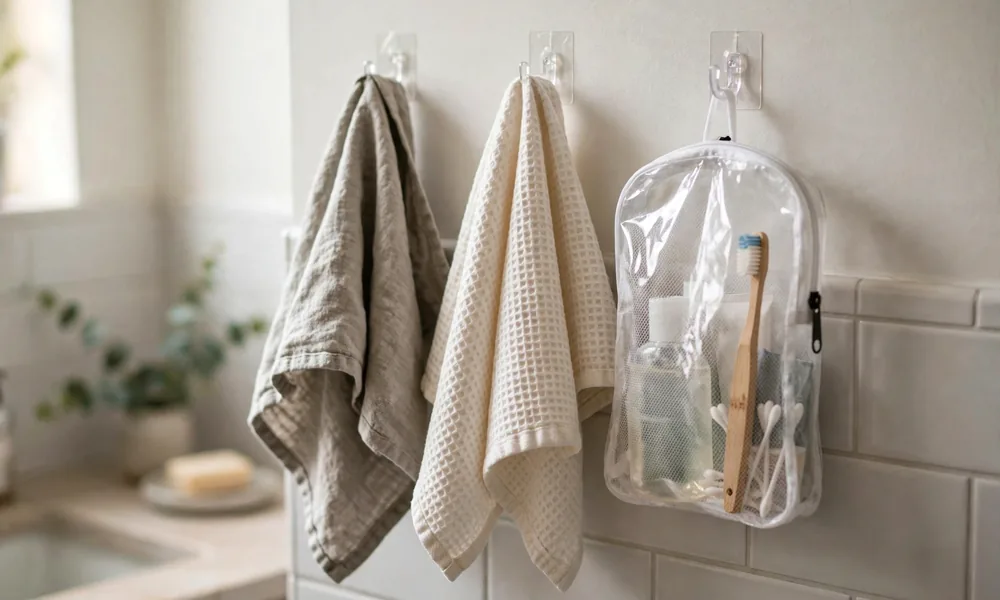
Clear hooks use a transparent base and hook, so they almost disappear on glass, tile and pale walls. They are the right choice in a bathroom, where a white hook would stand out against tile, and on a window, where they can hold a light decoration. Decorative hooks come in metal finishes such as brushed nickel and matt black, and they suit rooms where the hook stays visible, such as a hallway or a bedroom. The finish changes the look, not the holding power.
Outdoor and bathroom hooks
Outdoor hooks use an adhesive that copes with damp and temperature swings, and they are the only type worth using on a porch, in a bathroom or near a window that gets condensation. Standard strips soften in constant damp, so if the room gets wet, buy the waterproof version.
Command Hooks Compared at a Glance
| Hook type | Weight limit | Best for | Watch out for |
|---|---|---|---|
| Small hook | Up to 0.5 kg | Keys, lanyards, cables | Too weak for bags |
| Medium hook | Up to 1.5 kg | Tote bags, towels, hats | One hook per heavy bag |
| Large hook | Up to 3.5 kg | Dry coats, backpacks, robes | Never a wet coat |
| Clear hook | Up to 1 kg | Glass, tile, bathrooms | Shows dust on the base |
| Decorative metal hook | Up to 2 kg | Visible hallways, bedrooms | Finish does not add strength |
| Outdoor hook | Up to 2 kg | Porches, bathrooms, damp rooms | Standard strips fail in damp |
Matching the Hook to the Weight and the Wall
Weigh the thing before you choose the hook. A tote bag feels light in your hand, but a tote full of books weighs two kilograms, and a dressing gown feels light until it is damp. A coat is the hardest test: a dry jacket may weigh under a kilogram, while a wet winter coat can weigh three or more. If the weight is near the limit, go up a size or use two hooks.
The wall decides almost as much as the weight. Smooth painted plasterboard is the best surface: the strip makes full contact and the adhesive bonds evenly. Fresh paint is a trap: the strip bonds to paint that has not yet hardened, and the soft paint comes away when the hook is removed, so wait at least a month after painting. Textured wallpaper, rough plaster, brick and bare wood are poor surfaces, because the strip only touches the high points. Glass and glazed tile are excellent when clean and dry, which is why clear hooks work so well in bathrooms.
How to Put a Command Hook On So It Stays On
The fitting routine takes two minutes and decides everything. Clean the wall first with a cloth and a little rubbing alcohol, then let it dry completely. Dust is the enemy: a wall that looks clean may carry a fine layer that stops the strip making full contact. Do not use a cleaner that leaves a residue, and never stick a hook onto a damp wall.
Press the strip onto the back of the hook, then press the hook onto the wall and hold it firmly for thirty seconds; the adhesive needs sustained pressure to flow into the paint’s texture. Then wait a full hour before hanging anything on it, since a hook loaded after five minutes is loaded at half strength.
For anything wide, such as a picture frame, use two hooks spaced apart so the load is shared; one hook in the middle concentrates the whole weight on one point. The strips themselves are a separate product, and if you ever need to hang something flat, our guide to command strips explains which strip suits pictures, mirrors and light decor.
Where Command Hooks Work Best
Command hooks are at their best in rented homes and freshly decorated spaces, where holes are forbidden or unwelcome. They suit the entryway, where keys, bags and a light jacket need a home by the door, and the bathroom, where towels need to hang where they can dry and a clear hook on tile is almost invisible.
Where Command Hooks Fail
The failures are predictable, and almost all come from asking a hook to do a job it was never designed for. Heavy coats are the classic example: a wet winter coat weighs several kilograms and swings every time the door opens. If you need a hook for heavy coats, a screwed hook is the honest answer.
Heat is another failure point: a hook above a radiator or in a sunny conservatory softens until the strip lets go. Damp is the third, which is why the outdoor version exists, and a hook on a textured wall was never really stuck at all.
Command Hooks vs the Alternatives
A command hook is one of four ways to hang something, and each suits a different job. A screwed wall hook holds the most weight but leaves a hole. An over-door hook holds coats and towels without touching the wall, but only works where there is a door, and it can mark the paint or stop it closing properly. A suction hook holds on glass and tile but falls off when the seal fails. A command hook sits between them: stronger than suction, less permanent than a screw, and usable on any smooth wall.

Removing a Command Hook Without Damaging the Paint
Removal is where most damage happens, and it is entirely avoidable. Take what is hanging off first, hold the base of the hook gently against the wall, and pull the tab slowly straight down along the wall. Stretch it slowly, at least fifteen centimetres, until the strip lets go. Never pull the tab outwards, and never yank it.
If the tab breaks, warm the base gently with a hairdryer for thirty seconds, then work a length of dental floss behind the base in a slow sawing motion. The floss cuts through the foam without touching the paint, and any residue comes off with rubbing alcohol.
Checklist: Before You Stick a Command Hook On
- Weigh what you will hang and choose a hook rated comfortably above it.
- Check the wall is smooth, clean, dry and painted at least a month ago.
- Clean the spot with rubbing alcohol and let it dry completely.
- Press the hook firmly for thirty seconds, then wait a full hour before loading it.
- Use two hooks for anything wide or heavy, so the load is shared.
- Keep heavy, wet or swinging loads for a screwed hook, not an adhesive one.
Frequently Asked Questions
How much weight can a command hook hold?
Small hooks hold up to about half a kilogram, medium hooks up to about one and a half, and large hooks up to about three and a half. Those ratings assume a smooth, clean wall at room temperature, so stay comfortably below them.
Do command hooks damage walls?
Not when fitted and removed properly. Damage comes from pulling the tab outwards, sticking a hook to fresh paint, or overloading it until the strip tears away.
Why do my command hooks keep falling off?
The usual reasons are a dusty or textured wall, a hook loaded before the adhesive had an hour to bond, a load heavier than the rating, or heat and damp softening the strip. Clean the wall, press for thirty seconds, wait an hour, and check the weight.
Can command hooks be used in bathrooms?
Yes, but use the outdoor or waterproof version on glazed tile or glass rather than painted plaster. Standard strips soften in constant steam; clear hooks are the neatest choice on tile.
Can you reuse a command hook?
The hook can be reused many times, but the strip cannot: once stretched and removed, it is finished. Buy spare strips in the right size, so a hook that comes down goes straight back up.
What is the difference between a command hook and a command strip?
A command hook is the hook itself, a moulded piece of plastic or metal that holds things, fixed to the wall with a strip. A command strip is the adhesive pad alone, used to stick flat things such as picture frames to the wall. Hooks hang things; strips stick things.
Bottom Line
Command hooks earn their place by doing one small job perfectly: holding a light or medium load on a wall that must stay undamaged. Weigh what you hang, respect the wall, press the hook on properly and wait the hour, and it will hold for years.