Cookie Dough That Bakes Evenly Every Time in 2026
Good cookie dough is the difference between a tray of golden, evenly baked cookies and a tray where half the batch is pale and doughy while the rest is dark around the edges. The best cookie dough in 2026 is not necessarily the most expensive tub on the shelf. It is the dough that holds its shape in the oven, spreads at a predictable rate, and bakes through to the centre without drying out.
Most uneven baking is decided before the tray goes into the oven. Dough that is too warm spreads fast and bakes thin at the edges. Dough scooped in uneven lumps bakes unevenly, because the small pieces finish long before the large ones. Understand those few variables and almost any cookie dough can be made to bake evenly.
Key takeaways
- Chill cookie dough before baking: cold dough spreads slowly, so the edges set before the centre over-bakes.
- Portion every cookie the same size: uniform balls bake at the same rate.
- Butter temperature decides spread: softened butter gives a thicker, chewier cookie, while melted butter gives a flatter, crisper one.
- Refrigerated dough suits spontaneous baking, frozen dough suits planned baking, and scoop-and-bake packs suit anyone who wants zero measuring.
- Let the tray cool between batches: a hot tray melts the next batch of dough before it reaches the oven.
What makes cookie dough bake evenly
Even baking starts with even dough. A good cookie dough is uniform all the way through: the butter is distributed in small, even pockets, the flour is fully hydrated, and the chocolate chips are spread evenly rather than clumped in one corner. When dough is mixed properly, every scoop behaves the same way in the oven. When it is under-mixed, some cookies get all the butter and spread wide while others stay pale and cakey.
Temperature is the second factor. Dough straight from the fridge is firm and cold, and it holds its shape for the first minutes in the oven while the edges begin to set. Dough at room temperature starts spreading the moment it touches a warm tray. Keeping the dough cold between batches is the simplest fix in baking. The tray matters too: a light-coloured, heavy baking sheet for cookies heats gently, while a thin, dark sheet browns the bottoms fast and can burn the edges before the centres finish.
Refrigerated, frozen and scoop-and-bake dough compared
Refrigerated cookie dough comes in a tub or a log, and it is ready to scoop the moment you open it. It is the most flexible format: you can bake two cookies or two dozen, and the rest keeps in the fridge for a week or two. The trade-off is that refrigerated dough is soft, so it needs a short chill after scooping if you want thick cookies, and once opened it dries out faster than a sealed frozen pack.
Frozen cookie dough is portioned into balls or pucks before freezing, which is its greatest strength. Every piece is the same size, so every cookie bakes at the same rate, and you can bake exactly as many as you need straight from the freezer, adding a minute or two to the baking time. Frozen dough keeps for months, which makes it the best choice for anyone who bakes in batches. Scoop-and-bake dough sits between the two: it goes from fridge to oven with no measuring at all, and it is the easiest format for children and new bakers.
| Format | Best for | Storage | Evenness | Effort |
|---|---|---|---|---|
| Refrigerated tub | Spontaneous baking | 1 to 2 weeks chilled | Good, if scooped evenly | Low |
| Frozen pucks | Planned batches | 2 to 3 months frozen | Excellent, uniform size | Very low |
| Scoop-and-bake | Quick, easy baking | 1 to 2 weeks chilled | Good, check portions | Minimal |
| Home-mixed dough | Full control of flavour | 3 days chilled, 3 months frozen | Excellent, if chilled and scooped | Higher |
| Slice-and-bake log | Neat, uniform rounds | 2 weeks chilled | Very good, even slices | Low |

How to read a cookie dough label
The ingredient list tells you more about a cookie dough than the picture on the front. Butter should appear near the top: it is the fat that gives cookies their flavour and their spread. Doughs that list butter first tend to taste richer and bake more predictably than doughs built on palm oil or other vegetable fats, which can make cookies greasy rather than buttery.
Flour is the structure of the dough, and most ready-made doughs use plain wheat flour, which is fine for everyday cookies. The label should also tell you whether the dough contains eggs, milk, nuts or soya, and whether it is made in a factory that handles nuts. Check the leavening too: baking soda gives cookies spread and a chewy bite, while baking powder gives lift and a cakier crumb. Treat the bake time and temperature on the pack as a starting point, not a rule, because every oven runs a little hot or a little cool.
Chilling, portioning and baking for even results
Chilling is the step most people skip and the step that matters most. After mixing or scooping, rest the dough in the fridge for at least thirty minutes, and overnight if you can. Chilling firms the butter, lets the flour absorb moisture, and deepens the flavour. A chilled dough spreads slowly, so the edges have time to set before the centre is done, and the finished cookie has a crisp edge and a soft middle.
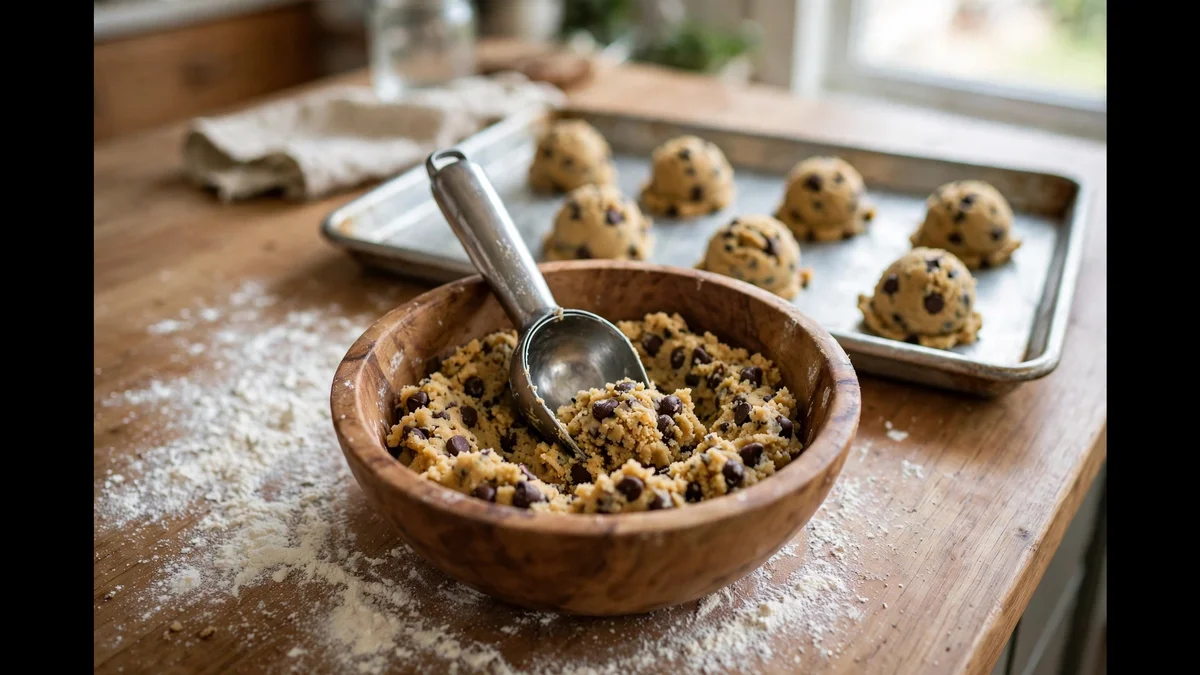
Portioning is the second half of the job. A spring-loaded scoop gives the same size every time, and it is faster than rolling balls by hand. Space the balls at least five centimetres apart, because dough that touches its neighbour bakes into one wide, uneven sheet. Always bake one tray at a time on the middle shelf, because two trays block the airflow and the bottom tray bakes faster than the top. Lining the tray with parchment paper helps too: it insulates the bottom of the cookie, so the base browns gently instead of burning. A good parchment paper that stops sticking lets you slide the whole sheet onto a cooling rack in one movement. Let the tray cool completely before the next batch goes on it.
Flavours and mix-ins that bake well
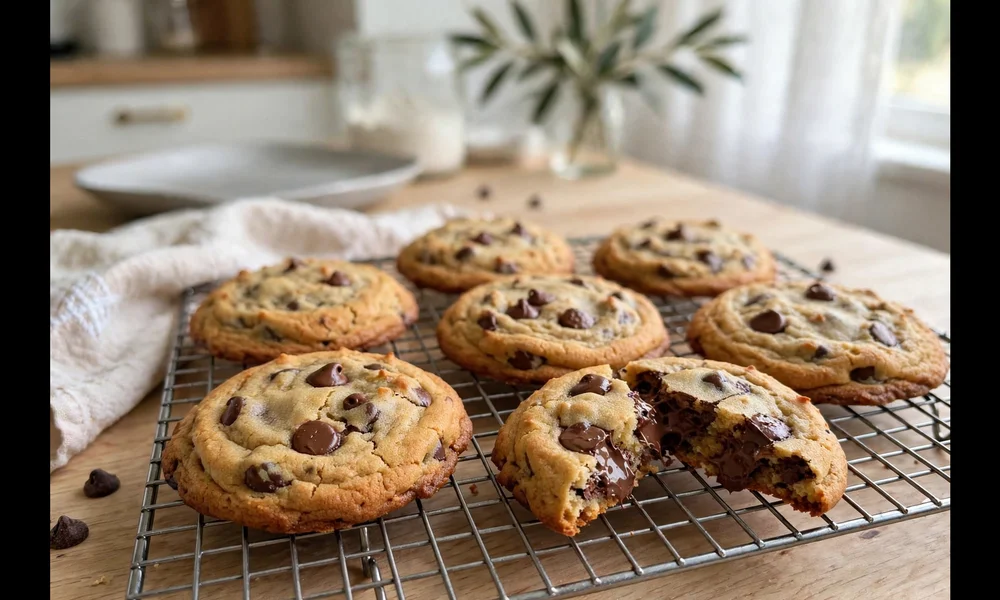
Chocolate chip is the classic for a reason: the chips hold their shape, melt just enough to go soft, and distribute evenly through the dough. Dark chocolate chips bake more evenly than milk chocolate, because they have less sugar and hold their shape better at high heat.
Oatmeal, raisin and nut doughs behave differently from plain chocolate chip. Oats absorb moisture, so the dough thickens as it sits, and a dough that looked wet in the bowl can bake up firm and chewy. Raisins plump in the oven and add moisture, so a raisin dough often needs a minute longer than the pack suggests. Nuts toast as the cookie bakes, so watch the first batch closely. Double chocolate and cocoa doughs are the trickiest to judge, because you cannot see the browning the way you can with a pale dough: a cocoa cookie looks done long before it is, and the only reliable test is the edge. When the edge feels set and the centre still looks slightly soft, the cookie is ready to come out. Peanut butter doughs are the opposite: they barely spread at all, so they need to be flattened slightly before baking.
Storing dough and baked cookies
Raw cookie dough keeps well if you treat it right. In the fridge, a sealed tub lasts one to two weeks, and a log wrapped tightly in cling film lasts about the same. In the freezer, portioned balls keep for two to three months in a sealed bag with the air pressed out, and they bake straight from frozen with two extra minutes in the oven.
Baked cookies keep best in an airtight tin at room temperature, where they stay good for four to five days. Crisp cookies and chewy cookies should never share a tin, because the chewy ones give off moisture and turn the crisp ones soft within a day. Freezing baked cookies is also worth doing: let them cool completely, stack them in a rigid container with parchment between the layers, and freeze for up to three months.
Common problems and how to fix them
Cookies that spread into flat puddles usually mean the butter was too warm or the dough was not chilled. The fix is simple: chill the scooped dough for thirty minutes before it goes in the oven, and make sure the tray is cool. If the problem persists, check the fat on the label: doughs made with a high proportion of oil spread more than doughs made with butter, and no amount of chilling will fully fix that.
Cookies that burn on the bottom while the tops stay pale usually mean the tray is too dark or too thin, or the oven shelf is too low. Move the tray up one shelf, switch to a lighter-coloured sheet, and line it with parchment. And if the first batch is perfect and the second is not, the tray was still hot when the second batch went on, which is the most common mistake in a busy kitchen. For rolled cookies, a rolling pin that rolls dough evenly matters more than the dough itself.
Cookie dough checklist
- Chill the dough for at least thirty minutes before baking, and overnight when you have time.
- Portion with a scoop so every cookie is the same size and bakes at the same rate.
- Line the tray with parchment paper and let the tray cool fully between batches.
- Bake one tray at a time on the middle shelf for even airflow and even browning.
- Check the label for butter first, then the sugar balance, then the allergen warnings.
- Store raw dough sealed and airtight, and freeze portioned balls for baking on demand.
Frequently asked questions
Can you bake cookie dough straight from the fridge?
Yes, and for most doughs it is the best way to bake. Cold dough spreads slowly, so the cookies hold their shape and bake evenly.
How long does refrigerated cookie dough last?
An unopened tub usually lasts one to two weeks in the fridge, and an opened tub lasts about a week if it is sealed well. If the dough smells sour or feels slimy, throw it away. Frozen dough keeps for two to three months.
Why do my cookies spread too much?
The most common causes are warm butter, warm dough, and a hot tray. Chill the dough and use a cool tray lined with parchment.
Can you freeze cookie dough?
Yes, and it freezes very well. Scoop it into balls, freeze them on a tray until firm, then move them to a sealed bag. Bake straight from frozen, adding about two minutes to the baking time.
Is it safe to eat raw cookie dough?
Raw dough can carry bacteria from raw flour and raw egg, so it is not safe to eat in large amounts. Doughs labelled as safe to eat raw are made with heat-treated flour and no egg.
Should cookie dough be room temperature before baking?
No, cold dough bakes more evenly than room-temperature dough. The only exception is a slice-and-bake log that is too firm to cut, which needs a few minutes on the counter before slicing.
The bottom line
The best cookie dough in 2026 is the dough that makes even baking easy: butter high on the ingredient list, portions that are the same size, and a format that fits how you actually bake. Frozen pucks win on consistency, refrigerated tubs win on flexibility, and a well-mixed home dough wins on flavour.