
Why the Best Crepe Makers in 2026 Make Breakfast Feel Effortless
The best crepe makers in 2026 turn one of the fussiest breakfasts into the easiest one. A crepe is a thin pancake that needs even heat and a thin, even spread of batter, and a dedicated electric crepe maker gives you both: a flat heated plate held at a steady temperature, a wooden spreader that thins the batter in one smooth sweep, and a non-stick surface that lets the finished crepe lift off without tearing.
That ease is what separates a crepe maker from the tools people confuse it with. A crepe pan is a stovetop pan you lift and tilt by hand, which takes practice and a steady wrist. A griddle is a wide, flat cooking surface built for whole breakfasts at once, and it has no spreader and no crepe-sized temperature control. A crepe maker is a single-purpose appliance built for one job, and this guide compares the best crepe makers of 2026 so you can buy the one that matches how often you make crepes.
Key Takeaways
- A crepe maker is a plugged-in electric appliance with a flat heated plate and a spreader, not a stovetop pan and not a griddle.
- Even, steady heat matters more than maximum temperature: a plate that holds its setting beats a hotter plate that swings.
- Plate size decides what you can make: 30 centimetres suits family crepes, while a compact 20-centimetre plate suits one or two people.
- A good spreader, a clear ready light and a non-stick surface that releases are worth more than extra settings you will never touch.
- Crepes cook in under a minute each, so batch speed comes from plate size and recovery, not wattage alone.
Why a Crepe Maker Beats a Pan for Thin Crepes
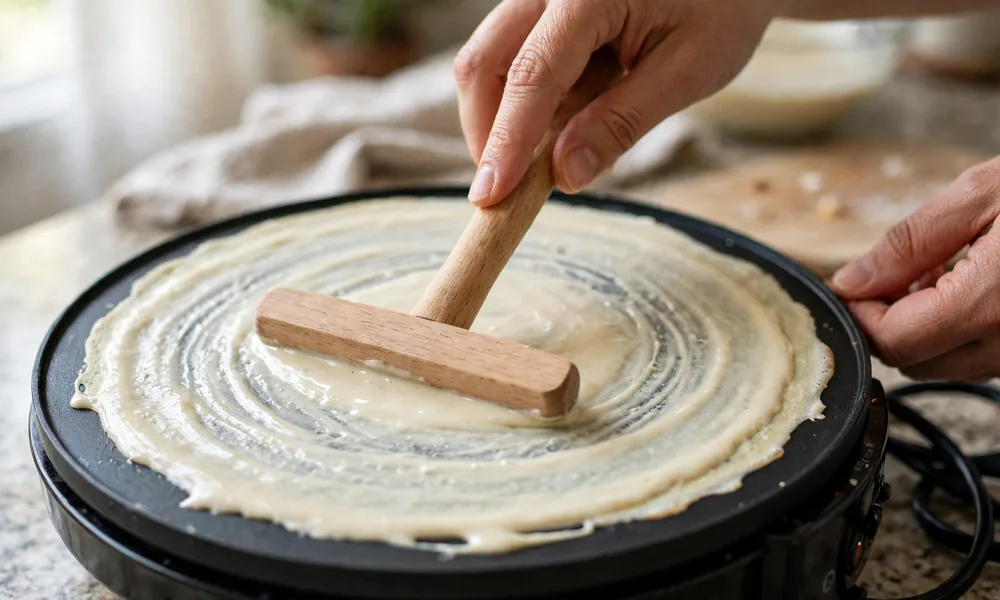
The hard part of a crepe is not the batter. It is the spread. Batter poured into a pan must be thinned to a layer you can almost see through, and thinned fast, before the heat sets it. In a pan you do that by lifting the pan off the hob and tilting it in a circle, a skill that takes a dozen ruined crepes to learn. On a crepe maker you pour the batter onto a plate that is already at temperature, then draw a wooden T-shaped spreader across it in one smooth arc, and the crepe comes out the same thickness edge to edge.
The second advantage is temperature. A hob burner cycles, and a pan cools every time cold batter hits it, which is why pan crepes come out patchy: pale in the middle, dark at the edges. An electric crepe maker holds its plate at the temperature you set, topping it back up between crepes. The third crepe looks like the first, which matters when you are cooking a stack for a family breakfast.
There is a trade-off worth naming honestly. A crepe maker does one thing, and it lives in a cupboard the rest of the year. If you make crepes twice a year, a pan is the smarter buy. If you make them every weekend, or you cook for a crowd, the maker earns its shelf space. Our guide to the best crepes covers the finished dish itself, from fillings to folding.
The Crepe Maker Types at a Glance
Crepe makers fall into four main types, and the right one follows from how often you cook and how many people you feed. The flat-plate electric maker is the classic: a round heated plate on a base, with a dial and a spreader. The dipping-tray maker flips the idea over — you dip the hot plate into a tray of batter, which coats it in a perfectly even layer. The compact maker shrinks the plate to 20 centimetres for singles and small kitchens, while the large maker stretches it for big, filled crepes.
| Type | Best For | Plate Size | Watch Out For |
|---|---|---|---|
| Flat-plate electric | Most home cooks | 30 cm round | Cheap plates with hot spots |
| Dipping-tray maker | Parties, very even crepes | 20 cm round | Small crepes only |
| Compact maker | Singles, small kitchens | 20 cm round | Too small for filled crepes |
| Large or rectangular | Families, big filled crepes | 33 cm or rectangular | Needs counter space and storage |
Our Picks: The Best Crepe Makers by Job
There is no single best crepe maker for everyone. The right pick depends on your kitchen, your household, and what you cook most often.
Best Overall: Flat-Plate Electric Maker
The flat-plate electric maker is the default for a reason. A 30-centimetre round plate fits a proper crepe, the dial gives you five or six heat settings, and the spreader in the box is the one you will actually use. Look for a plate that heats evenly to the edge, a ready light, and a base that stays put.
Best for Parties: Dipping-Tray Maker
A dipping-tray maker is the party trick of the crepe world. You pour batter into the tray, dip the hot plate face-down into it for a few seconds, and lift it back up with a perfectly even coat already on. There is no spreading to learn, so guests can take turns without instruction. The crepes are smaller, around 20 centimetres.
Best Compact: Small Round Maker
A compact maker with a 20-centimetre plate is the right call for a single person, a couple, or a kitchen with no spare cupboard. It heats faster than a full-size plate, stores in a drawer, and makes a crepe that folds neatly around a filling for one. The compromise is size: a big savoury crepe will not fit, and cooking a stack for four takes noticeably longer.
Best for Big Batches: Large or Rectangular Maker
If you cook for a family of five or host a crepe night, a large plate is worth the counter space. A 33-centimetre round plate makes a crepe big enough to fill and fold twice, and some rectangular models cook two smaller crepes side by side. The thing to check is recovery time: a big plate that cools sharply after each crepe will slow you down more than a smaller plate that bounces back fast.
Best Budget: Simple Dial Maker
A budget crepe maker is a flat plate, a dial, a spreader and a light, and that is genuinely enough. What you give up is evenness at the edges and coating life, so check the plate for a thick, even finish and read reviews that mention the tenth crepe, not the first. Avoid models with a fixed temperature and no dial: without control, you cannot rescue a batter that browns too fast.
What to Look For Before You Buy
Start with the plate. A thick plate holds heat and spreads it evenly; a thin plate develops hot spots, and hot spots are how crepes tear and brown in patches. Cast aluminium is the common middle ground, light and even, while coated steel is cheaper and more prone to warping. A plate that rocks or flexes will cook unevenly.
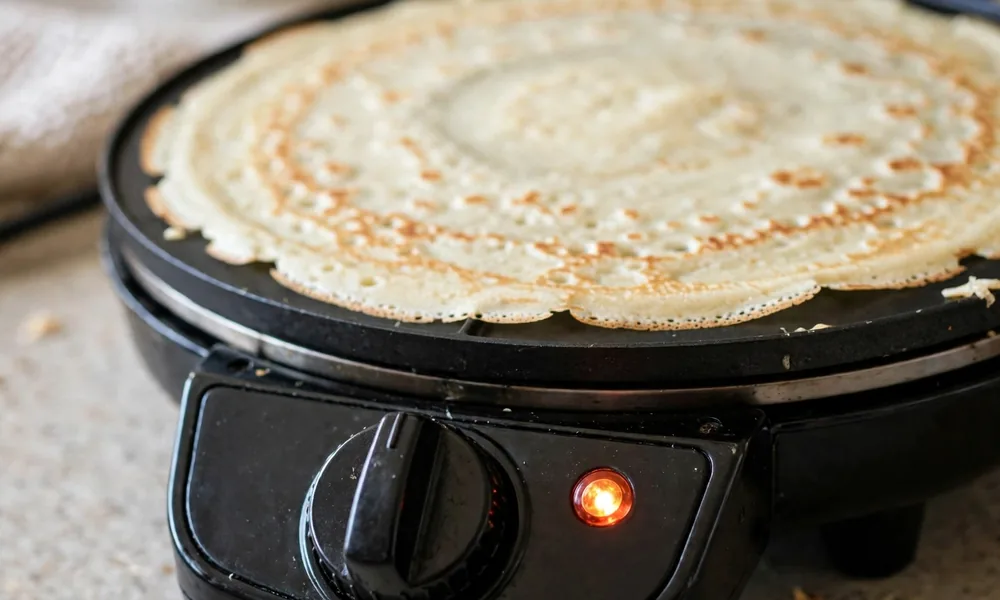
Temperature control is the second thing that matters. A dial with at least five settings lets you match the heat to the batter — a thin, milky batter needs a gentler plate than a thick, eggy one — and a thermostat that holds the setting keeps the fifth crepe looking like the first. A ready light is not a gimmick: it tells you when the plate has recovered after the last crepe, so you stop pouring onto a cooling plate.
Then check the spreader and the surface. The spreader should be a solid wooden T, long enough to reach across the plate in one sweep, not a flimsy plastic wand. The non-stick coating should release a crepe with a gentle nudge. Removable plates are a bonus, not a necessity: most crepe makers wipe clean with a damp cloth while still warm.
Finally, think about storage and safety. A cord that wraps under the base, a cool-touch rim, and feet that grip the counter all matter more than they sound. A crepe maker is a hot, flat, open plate on a kitchen counter, often with children nearby, so a stable base and a clear off position are real safety features, not marketing lines.
Crepe Maker vs Crepe Pan vs Griddle
These three tools get confused because they all cook flat food on a flat surface, but they are different tools for different jobs. A crepe maker is a plugged-in appliance: you set a temperature, pour batter onto a fixed plate, and spread it with a tool. A crepe pan is a stovetop pan you lift and tilt, with the heat controlled by the hob. A griddle is a wide cooking surface for whole meals — pancakes, bacon, eggs and burgers at once — with no spreader and no crepe-specific temperature range.
The practical test is simple. If you want thin crepes with the least skill involved, buy the maker. If you enjoy the craft and cook crepes rarely, buy the pan. If you want one surface that cooks an entire breakfast for four, buy the griddle and accept thicker, less even crepes. None of the three is a bad tool. The mistake is buying one and expecting it to do another one’s job.
Checklist: Buying a Crepe Maker Without Regret
- Match the plate to your household: 30 centimetres for a family, 20 for one or two people.
- Choose a dial with at least five heat settings and a thermostat that holds its temperature.
- Check the spreader is a solid wooden T that reaches across the plate in one sweep.
- Test that the non-stick surface releases cleanly and the plate sits flat, with no rock or flex.
- Make sure the base grips the counter, the cord wraps away, and the dial has a clear off position.
- Measure your cupboard first — a 33-centimetre plate needs real storage space.
Frequently Asked Questions
Is a crepe maker better than a crepe pan?
For most people, yes: the maker controls the temperature and the spreader thins the batter for you. A pan gives a skilled cook more control and takes up less storage, so it suits people who make crepes rarely.
Can I use a crepe maker for pancakes?
You can, but the result is a very thin pancake rather than a fluffy one, because the plate is built for thin batter spread flat. Pancakes are better on a griddle or in a pan.
What temperature should I set a crepe maker to?
Start in the middle of the dial and adjust from there. A thin batter needs medium heat so it spreads before it sets; a thicker batter can take a hotter plate. If the crepe browns before you finish spreading, turn the dial down.
Do I need to oil the plate before each crepe?
No. A good non-stick plate needs only a very light wipe of butter or oil before the first crepe, and then nothing between crepes. Too much fat pools under the batter and stops it spreading.
Why do my crepes tear on a crepe maker?
Usually the plate is too hot, the batter is too thick, or the spreader is moving too slowly. Thin the batter with a splash of milk, lower the heat, and spread in one sweep.
How do I clean a crepe maker?
Let it cool slightly, then wipe the plate with a damp cloth while it is still warm. Never use metal utensils or scouring pads on a non-stick plate, and never submerge the base in water.
The Bottom Line
The best crepe maker is the one that matches how often you cook and how many people you feed: a 30-centimetre maker for most households, a dipping-tray maker for parties, a compact plate for small kitchens, and a large plate for big family batches. Buy for even heat, a temperature dial, a solid wooden spreader and a surface that releases. Get those four things right and every crepe in the stack will look like the first one.


