A dog does not complain about sore paws the way a person complains about sore feet. It keeps walking, keeps playing, and keeps following its owner, even when salt burns between its toes, hot pavement stings the pads, or ice balls up in the fur. The best dog boots of 2026 solve that quiet problem. They protect paws from winter salt and summer heat, give grip on slippery floors and icy paths, and keep cuts and thorns away from tender skin. The best boots are not the toughest-looking ones, and they are not the most expensive. They are the boots that stay on, fit snugly without rubbing, and let a dog walk, run and turn naturally.
Why Dogs Need Boots at All
Dog paws look tough, but they are not built for everything modern life throws at them. Road salt and de-icing chemicals can burn and crack paw pads, and a dog that licks the salt off later can end up with an upset stomach as well. Hot pavement in summer can reach temperatures that blister pads in minutes, and rough gravel, broken glass and sharp thorns can cut even a large, sturdy dog. In winter, snow packs between the toes and forms painful ice balls, especially on long-coated breeds. Boots create a simple barrier between the paw and all of that, and for many dogs they turn a short, uncomfortable walk into a normal one.
What Makes a Dog Boot Good
The first thing to judge is the fit. A boot that is too loose twists around the paw and falls off; a boot that is too tight rubs, cuts off circulation and makes the dog limp. A good boot matches the width of the paw when the dog is standing, because paws spread under weight, and it allows the toes to sit naturally rather than squeezed together. Measure the paw on paper, standing up, and check the size chart for the widest paw, since front and back paws are often different sizes. Many owners buy two sizes, one for the front pair and one for the back, and that is often the right call.
The Main Types of Dog Boots
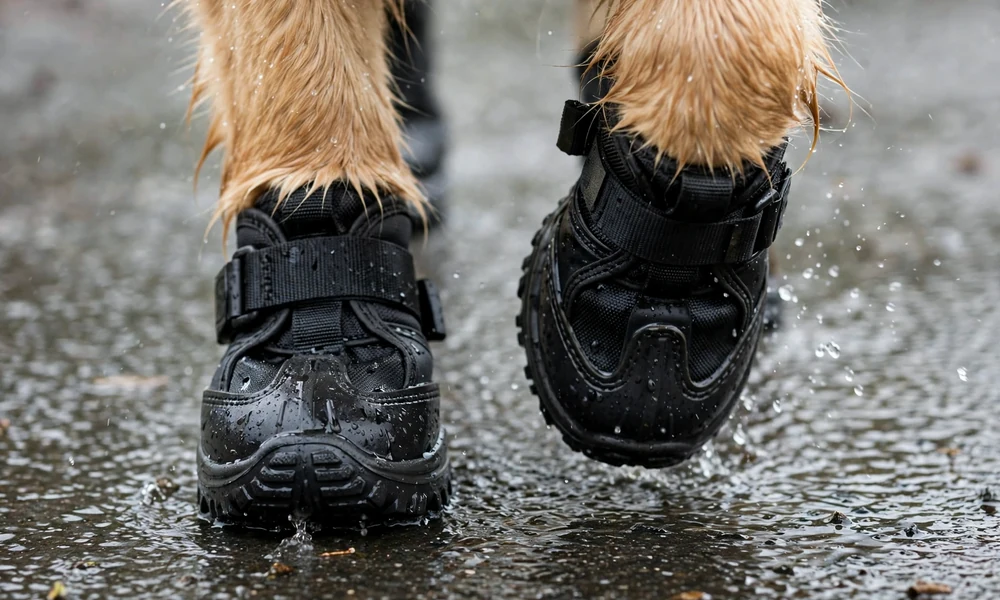
All-weather boots are the most popular type, and they suit most dogs most of the year. They usually have a rugged rubber sole, a water-resistant upper and two Velcro straps, and they handle rain, mud, snow and rough trails without fuss. They are the best starting point for a first pair, because they cover the widest range of conditions. Their weakness is warmth: they protect from wet and cold, but they are not insulated like a dedicated winter boot, so in deep snow or long exposure a lined version is better.
How to Measure Your Dog for Boots
Measuring takes five minutes and saves weeks of returns. Place a sheet of paper on a hard floor, have the dog stand on it with its weight evenly spread, and mark the widest point of the paw and the longest point from the back of the pad to the tip of the longest nail. Do this for all four paws, because the front paws are usually wider than the back ones. Measure twice, and use the larger measurement for each pair. If a paw falls between sizes, size up rather than down, since a slightly roomy boot can be tightened with a strap, while a tight boot cannot be stretched.

Trim the nails before measuring and before the first wear, because long nails push the paw forward in the boot and change the fit. Check the fur between the toes as well: long fur can make a paw look wider than it is, and trimming it helps the boot sit properly. When the boots arrive, try them on indoors first, on a clean floor, and watch the dog walk for a few minutes. A little high-stepping at first is normal. Limping, chewing at the boots, or a boot that twists sideways is not, and it usually means the size or the strap tension needs adjusting.
Getting Your Dog Used to Boots
Most dogs do not love boots on the first try, and that is normal. The trick is to go slowly and make the boots mean good things. Start by letting the dog sniff the boots, then put on just one boot, give a treat, and take it off. Next time, put on two, then all four, each time followed by something the dog enjoys: a treat, a favourite toy, or a short walk to a good sniffing spot. Keep the first sessions to a few minutes indoors, then move to the garden, then to a short walk around the block. Most dogs settle within a week of short, positive sessions.
Dog Boots for Winter Snow and Salt
Winter is the season when boots earn their keep. Salt and grit on pavements can crack paw pads, and the chemicals in de-icers irritate the skin between the toes. Snow itself is less of a problem than the ice balls that form in the fur, which pull and hurt with every step. A good winter boot keeps salt off the pads, stops snow packing in, and adds grip on ice, which matters for older dogs and for breeds with less natural traction. After a winter walk, take the boots off indoors, wipe the paws, and let the boots dry out before the next outing.
Human winter footwear faces the same conditions, and the lessons overlap: grip, insulation and waterproofing matter more than looks. If you are sorting out your own cold-weather kit as well, the guide to the best snow boots of 2026 covers the features that keep feet warm and steady on ice, and many of the same ideas, such as a luggy sole and a cuff that seals out snow, apply to dog boots too. For the dog, though, fit comes first: a winter boot that slips or rubs will be kicked off long before the walk ends, however warm it is.
Dog Boots for Rain, Mud and Wet Ground
Wet weather brings a different set of problems. Muddy paws track dirt through the house, puddles can hide sharp objects, and wet paws stay damp for hours, which can lead to sore skin between the toes. A waterproof or water-resistant boot keeps the paw dry and the house cleaner, and a grippy sole stops the dog slipping on wet leaves and slick pavements. After a rainy walk, rinse the boots, shake off the mud, and dry them somewhere with airflow rather than on a radiator, which can warp the sole and stiffen the upper.
The same thinking applies to human rain gear: keeping water out matters more than keeping it looking smart. The guide to the best rain boots of 2026 explains how waterproofing, sole grip and a comfortable fit work together on wet ground, and dog boots need the same combination, scaled down to a paw. A boot that keeps water out but has no grip is a liability on a wet slope, while a grippy boot that soaks through leaves the paw cold and damp, so both features need to be there together.
Dog Boots for Hiking and Rough Trails
Trail walking asks more of a boot than a pavement walk does. Sharp rocks, thorns, hot sand, stream crossings and long distances all test the sole and the straps, and a boot that survives a street walk may not survive a mountain path. Look for a thick, flexible rubber sole with deep tread, a tough upper that resists tears, and a closure that stays tight over hours of movement. A bright colour helps you spot a boot if one does come off on the trail, and carrying a spare boot in a pocket is a sensible habit on a long hike.

Dog Boots for Older Dogs and Mobility
Older dogs often benefit from boots more than any other group. Worn pads, arthritis, and weaker muscles make slipping a real risk, and a fall on a hard floor can knock an old dog’s confidence for weeks. A boot with a soft, grippy sole gives traction on wooden and tiled floors, and a little extra cushioning can make standing and walking more comfortable. Lightweight boots are usually best here, because a heavy boot tires an older dog faster, and a boot that is easy to put on matters when the dog is stiff in the morning.
Boots are only one part of helping an older dog move around the house and get outside safely. Ramps, non-slip mats and a little patience with stairs all help, and the guide to the best dog ramps of 2026 covers the options for getting a stiff or small dog in and out of a car or up onto a bed without jumping. Used together, boots for grip and a ramp for height take a lot of strain off ageing joints, and many owners find their dog becomes noticeably more willing to move once both are in place.
How to Care for Dog Boots
Dog boots last far longer with a little care. Brush off mud after each walk, rinse them in lukewarm water when they are dirty, and let them air-dry away from direct heat. Check the Velcro regularly, because mud and fur clog the hooks and weaken the hold; a quick brush with an old toothbrush restores most of it. Inspect the soles for wear, especially at the heel and the toe, and replace a pair when the tread is smooth or the sole has cracked. A worn sole is worse than no sole in some ways, because it gives a false sense of protection while offering little grip.
Common Mistakes to Avoid
The most common mistake is buying boots by breed or by weight instead of by measurement. Two dogs of the same breed can have very different paw sizes, and a chart that says a Labrador takes a large may be wrong for your dog. The second mistake is choosing boots for looks rather than for the surface: a cute boot with a smooth sole is useless on ice, and a heavy winter boot is overkill for a summer pavement. The third mistake is skipping the break-in period and expecting a dog to walk for an hour in new boots on day one.
Another mistake is leaving boots on all day. Boots are for walks and outings, not for wearing indoors for hours, because paws need air and the skin between the toes can get sore if it stays damp. Check the paws after each walk for redness, rubbing or small cuts, and give the feet a rest between outings. Finally, do not ignore a dog that keeps trying to chew a boot off. That is usually a sign of a rub or a pressure point, not stubbornness, and it deserves a refit rather than a scolding.
The Bottom Line
The best dog boots of 2026 are the ones your dog will actually wear: a pair that fits the widest paw, stays on with two secure straps, grips the ground you walk on, and suits the season you are in. Start with a solid all-weather pair, add a winter pair if snow and salt are part of your daily walk, and keep a light pair for hot pavements in summer. Measure carefully, introduce the boots slowly, and check the paws after every walk. Do that, and boots stop being a battle and become just another part of the walk, like the lead and the treats. Your dog will not thank you in words, but a comfortable, confident walk is thanks enough.