If your knees complain every time you run, ellipticals may be the answer. Ellipticals have become the go-to cardio machine for people with sore, stiff, or ageing knees, because they deliver a real workout without the pounding that makes running miserable. The best ellipticals in 2026 are smoother, quieter, and more compact than the clunky machines of a decade ago, and for bad knees that matters more than any touchscreen or subscription feature.
Key Takeaways
- Ellipticals remove the impact of every footstrike, which is why they suit bad knees better than treadmills.
- Stride length matters more than price: most adults need at least 18 inches, taller users 20 inches or more.
- A heavier flywheel means a smoother, more joint-friendly motion, so avoid the lightest machines.
- Front-drive machines usually feel the most natural, but rear-drive models often suit taller users and tight rooms.
- Start with short, low-resistance sessions and build up slowly, even on the kindest machine.
Why Bad Knees Change the Cardio Equation
Every running step lands with a force of roughly two to three times your body weight, travelling straight through the knee joint. Healthy knees absorb it without a thought. Knees with worn cartilage, old injuries, or arthritis feel every landing, and the ache can last for days. That is not a failure of willpower. It is physics.
Walking is gentler, but it is hard to raise your heart rate high enough for serious fitness without walking very fast or uphill, and fast walking can itself irritate a sore knee. Cycling is another good low-impact option, but it works the legs seated and does little for the upper body. An elliptical fills the gap: it raises your heart rate like running, works arms and legs together, and keeps your feet planted on the pedals, so there is no landing at all.
Low impact does not mean low effort. On a treadmill the stress goes through your knees with every step. On an elliptical it spreads across your leg, hip, and arm muscles while the joints glide through a smooth oval path, which is why physiotherapists so often recommend them for knee recovery.
How an Elliptical Protects Your Knees
The protection comes from the shape of the movement. Your feet stay on the pedals and travel in a long, flat oval. There is no moment when your foot leaves the pedal and slams back down, so there is no impact spike. Compare that with a treadmill, where every step is a small collision, repeated thousands of times per session.

The second benefit is control. Resistance stays smooth and constant, with no belt slipping under your feet. If your knee twinges, you can ease off instantly, without fumbling for a stop button while a belt keeps moving beneath you.
The Oval Path Matters More Than the Brand
Not all ovals are equal. A short, round pedal path feels choppy and can force your knees into an awkward up-and-down motion. A long, flat oval feels like a natural stride, closer to walking, and keeps the knee tracking smoothly. This is why stride length is the first specification to check. A machine with a 14-inch stride will feel cramped for most adults, no matter how expensive it is.
Resistance Should Feel Smooth, Not Grabby
Cheap magnetic resistance can feel jerky at low levels, catching and releasing as you pedal, and that jerkiness transmits straight to the knees. Better machines use a heavier flywheel, so resistance feels like pedalling through thick air rather than fighting a brake. When you test a machine, pedal slowly at the lowest resistance and feel for catching. If it feels rough at a gentle pace, it will feel worse when you are tired.
Elliptical vs Treadmill: The Honest Comparison
Treadmills are not bad machines. They are excellent for runners and for training that must mimic outdoor running. But for bad knees, the comparison is not close.
| Factor | Elliptical | Treadmill |
|---|---|---|
| Impact on knees | Very low; feet never leave the pedals | High; every step is an impact |
| Calorie burn | High, especially using the arms | High, slightly higher at a run |
| Upper-body workout | Yes, moving handlebars included | No, unless you add weights |
| Noise | Very quiet | Motor and footstrike noise |
| Running training | Poor substitute for real running | Excellent, closest to the road |
| Best for bad knees | Usually the better choice | Only walking, with cushioning |
The fairest summary is this: if you can run pain-free, a treadmill is wonderful. If you cannot, an elliptical lets you train hard without paying for it the next morning. To compare properly, read our guide to the best treadmills: the best treadmills of 2026 have better cushioning than older models, and walking on a well-cushioned deck is genuinely knee-friendly.
The Types of Ellipticals Worth Buying in 2026
Ellipticals come in three main layouts, named for where the flywheel sits, and the layout changes how the machine feels under your feet.
Front-Drive Ellipticals
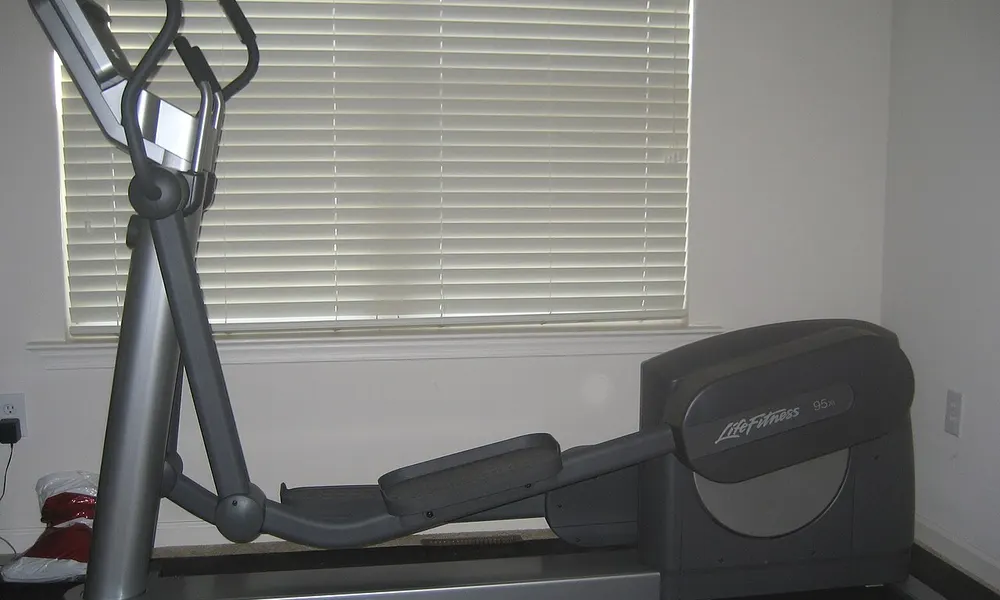
The flywheel sits at the front and the pedals ride on long rails behind it. This is the most common design, and it usually gives the flattest, most natural stride, closest to walking. Front-drive machines tend to be stable and affordable, but they are often the longest, so measure your room carefully.
Rear-Drive Ellipticals
The flywheel sits at the back, which shortens the machine and gives a slightly more upright, running-like feel. Rear-drive models suit taller users well, because the pedal path tends to be long and open. They cost more than front-drive machines of similar quality, but they are worth considering if floor space is tight.
Centre-Drive Ellipticals
Centre-drive machines put the flywheel on either side of the pedals, making the machine compact and stable, with a more upright posture. They suit small rooms, but for sore knees the simplest, smoothest motion usually wins.
What to Look For Before You Buy
Ignore the count of workout programmes and the size of the screen. Focus on the mechanics, because the mechanics are what your knees will feel every day.
Stride length comes first. Eighteen inches is the minimum for most adults, twenty is better for anyone over five foot eight, and twenty-two suits taller users. Some machines offer adjustable stride, which sounds ideal but adds joints and potential wobble, so test it thoroughly. A fixed stride that fits you beats an adjustable one that rattles.
Flywheel weight comes second. Heavier is smoother, and smoother is kinder to knees. Look for at least 15 pounds on a budget machine and 20 pounds or more if you can afford it. Weight capacity matters too: a machine rated well above your weight will feel solid, while one rated close to your weight may flex and creak.
Check the incline and resistance range. Incline shifts effort to the glutes and can take pressure off sore knees, but only if it adjusts smoothly. Resistance should offer fine steps at the low end, because the difference between level one and level two should be gentle, not a sudden jump. Finally, check the footprint with the machine fully assembled, including the space your body needs at the front and back.
The Worst Elliptical Mistakes
The most common mistake is buying on price alone. The cheapest ellipticals have light flywheels, short strides, and wobbly frames. A wobbly machine forces your knees to stabilise every stride, which is precisely the extra work sore knees do not need.
The second mistake is skipping the test ride. Try the machine in a shop, even for five minutes. Pedal slowly, pedal fast, change the resistance, and notice whether your knees track straight or drift inward. If you are buying online, check the return policy first and treat the first two weeks as a trial. A generous return window is worth more than a discount.
The third mistake is doing too much in the first week. Start with ten or fifteen minutes at low resistance, three times a week, and add five minutes per week. Your knees will tell you if you are pushing too hard, usually the morning after. Listen the first time, not the third. The goal is a habit that lasts years, not a heroic first week followed by silence.
A Knee-Friendly Elliptical Routine
A good routine for bad knees is boring on purpose. Warm up for five minutes at the lowest resistance, letting your joints loosen before you ask anything of them. Then settle into a steady pace you could hold a conversation at, for fifteen to thirty minutes. If you want more intensity, raise the resistance slightly rather than speeding up, because faster pedalling with poor form loads the knees more than gentle resistance does.
Twice a week, add short intervals if your knees allow: one minute slightly harder, two minutes easy, repeated four or five times. Finish with easy pedalling, then stretch your calves, quadriceps, and hip flexors while warm. Tight calves and hips change how the knee tracks, so stretching is part of protecting the joint.
If you are building a wider home setup, our guide to the best home gyms covers the mats, flooring, and layout that make a small training space work. For a second low-impact option, our guide to the best exercise bike for small spaces is a good place to start, because alternating between two machines keeps any one joint from taking all the load.
Buying Checklist
- Stride length of at least 18 inches, or 20 inches if you are over five foot eight.
- Flywheel of 15 pounds or more, heavier if your budget allows.
- Frame rated at least 50 pounds above your body weight for stability.
- Smooth, quiet magnetic resistance with fine steps at the low end.
- Footprint measured with room to spare at the front and back.
- Return policy of at least 30 days, so you can test it properly at home.
Frequently Asked Questions
Are ellipticals really better than treadmills for bad knees?
For most people with knee pain, yes. Ellipticals remove the impact of every footstrike, which is the main thing that aggravates sore knees. Treadmills are fine for walking, especially on a cushioned deck, but running on one repeats the same impact that causes the pain.
Can an elliptical make knee pain worse?
It can, if the stride is too short, the resistance is too high, or you do too much too soon. Start gently, keep the stride long and smooth, and stop if you feel sharp pain rather than mild effort.
How long should I use an elliptical each day?
Most people with bad knees do well with fifteen to thirty minutes, three to five times a week. Shorter, more frequent sessions usually beat one long session, because they build fitness without overloading the joint.
Front-drive or rear-drive: which is better for knees?
Both can be excellent. Front-drive machines usually feel the flattest and most natural, while rear-drive machines often suit taller users. Stride length and smoothness matter more than drive position.
Do I need the moving handlebars?
They help, especially for bad knees, because your arms share the workload and let you reach a good heart rate with less leg effort. Fixed-handlebar machines are fine, but for most buyers the moving arms are worth having.
How much should I spend on a good elliptical?
A solid mid-range machine usually costs more than the cheapest options, but you do not need the most expensive model. Prioritise stride length, flywheel weight, and build quality over screens and subscriptions.
The Bottom Line
Ellipticals beat treadmills for bad knees for one simple reason: they let you work hard without the impact that causes the pain. No footstrike means no repeated collision through the joint, and that single difference changes everything for people whose knees have had enough. Choose a machine with a long stride, a heavy flywheel, and a solid frame, start gently, and build the habit slowly. Your knees will thank you by letting you keep moving, and that is the whole point.