
Footstools that give your feet a proper rest in 2026 are small, low, and easy to overlook, which is exactly why most people buy the wrong one. A good footstool lifts your feet to the height where your knees rest level, takes the weight off your lower back, and lets you sit for an hour without shifting or fidgeting. A bad one is too low, too soft, or too far from the chair, and it does nothing at all except take up floor space.
A footstool is not a small ottoman, and the difference matters. An ottoman is a larger upholstered piece that can serve as extra seating or storage, and it usually sits at the same height as your chair seat, around 40 to 48 centimetres. A footstool is a smaller, lower footrest whose only job is to support your feet: usually 25 to 35 centimetres high, light enough to move with one hand. Our guide to the best ottomans of 2026 covers the bigger piece in detail; this guide is about the small one.
Key Takeaways
- A footstool should sit lower than your chair seat, usually 25 to 35 centimetres high, so your knees rest slightly below your hips.
- Firm beats soft every time: a footrest that sinks under your legs is no rest at all.
- Place the footstool 25 to 30 centimetres from your chair, close enough that your heels do not hang off the edge.
- An angled footrest suits reading and desk work, while a flat padded top suits relaxing with your feet up.
- Buy the footstool for the chair it will serve, not for the room: the two must work as a pair.
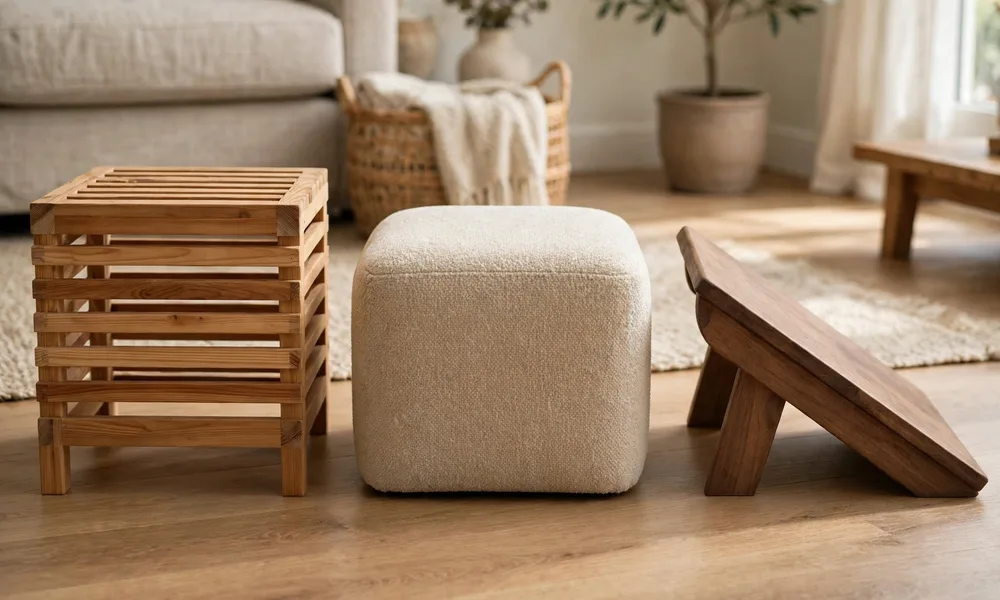
Why Your Feet Need a Rest
Feet dangle more than most people realise. Sit in an armchair with your feet on the floor and your knees bend sharply, your calves take your legs’ weight, and your lower back compensates for the angle. After twenty minutes, your legs ache. After an hour, your back does too. A footstool changes the geometry: with your feet raised and supported along their length, your knees open up and the pressure leaves your lower back.
The effect is easy to test. Sit in your usual chair, put your feet on a firm box about 30 centimetres high, and stay there for ten minutes. Most people feel the difference within the first minute: shoulders drop, breathing slows, and the chair itself feels more comfortable, even though nothing about the chair has changed. Raising your feet also reduces swelling in the ankles after a long day standing.
The Main Types of Footstool
Footstools come in a handful of shapes, each suiting a different chair and way of sitting. The right choice depends on whether you will read, relax, or work, and whether the footstool moves between chairs or stays in one place.
Flat Padded Footstools
The flat padded footstool is the classic: a low rectangular or square cushion on short legs or a solid base, usually upholstered in fabric or leather. It suits armchairs and sofas, and it is the best choice when the footstool will stay in one place and serve one chair. Look for firm, resilient filling that springs back when you press it, because soft filling compresses under your legs within weeks.
Angled Footrests
An angled footrest is a sloped wooden or padded platform, usually adjustable, that holds your feet at a gentle incline. It suits reading chairs and desk work, where a flat top can feel too low and an incline supports the whole foot more naturally. Look for an adjustable model with at least two or three positions, and for a non-slip surface, because a smooth angled board is useless if your socks slide down it.
Wooden Slatted Footstools
A wooden slatted footstool is a small, sturdy frame of hardwood slats, often with a curved top that cradles the feet. It is the hardest-wearing type, easy to clean, and handsome enough to leave visible in a living room. Wood suits homes with pets and children, because it wipes clean and does not stain. The trade-off is comfort: bare wood is firm and cool, so add a thin cushion if anyone will rest bare feet on it for long.
Rocking and Glider Footstools
Some footstools are made to move with their chair, gently rocking or gliding as you shift your feet. They pair naturally with rocking chairs, where a fixed footstool can feel oddly still while the chair moves, and our guide to the best rocking chairs of 2026 covers those chairs in detail. A rocking footstool suits nurseries and porches, where the motion itself is soothing.
Adjustable and Folding Footrests
Adjustable footrests change height and angle, and they suit households where one footstool serves several people of different heights, or where the same footrest moves between a desk and an armchair. Folding footrests collapse flat for storage, which suits small flats. The weakness of both is the mechanism: more moving parts mean more to wear out, so test the adjustment several times in the shop and check that it locks firmly at every setting.
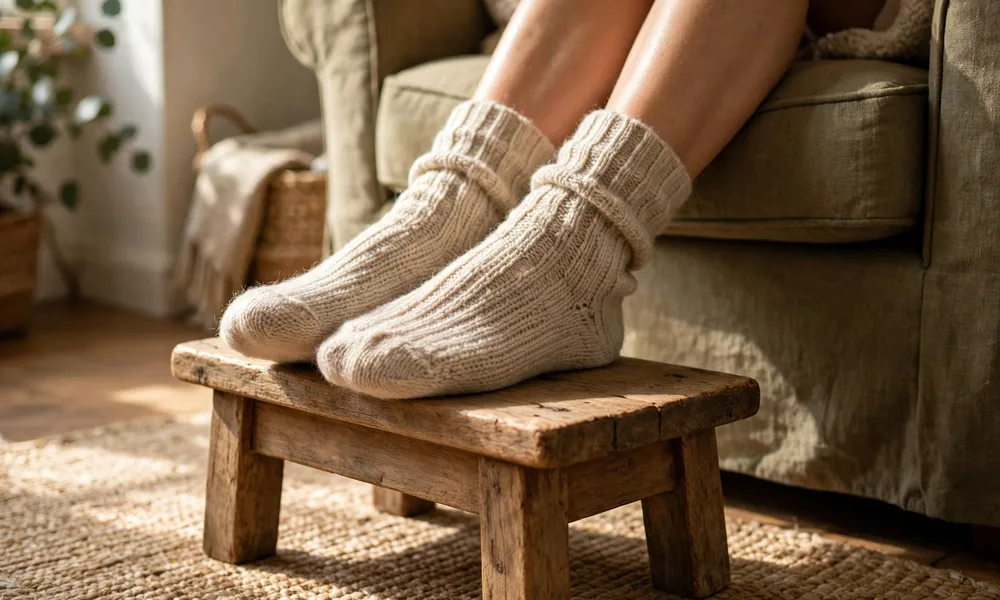
Getting the Height and Position Right
Height is the measurement that decides whether a footstool works, and it is the one most buyers get wrong. A footstool should be lower than the seat of the chair it serves, so that your knees sit slightly below your hips and your feet rest without pressure behind the knees. For most armchairs, that means a footstool 25 to 35 centimetres high. Much lower than that and your knees bend sharply; much higher and your knees rise above your hips and your lower back takes the strain.
Position matters as much as height. Place the footstool 25 to 30 centimetres from the front of the chair, close enough that the whole foot, heel to toe, rests on the top. If the footstool sits too far away, your heels hang off the edge and your calves take the strain. The test is simple: sit in the chair, put your feet on the footstool, and stay there for five minutes. Nothing should ache, and you should not need to keep adjusting your feet.
Footstools at a Glance
| Type | Best for | Height | Watch out for |
|---|---|---|---|
| Flat padded footstool | Armchairs, relaxing | 25 to 35 cm | Soft filling that sinks |
| Angled footrest | Reading and desk work | Adjustable | Smooth surface, sliding feet |
| Wooden slatted footstool | Busy homes, pets | 25 to 30 cm | Hard surface, splinters |
| Rocking footstool | Rocking chairs, nurseries | 25 to 35 cm | Squeaky mechanism |
| Adjustable footrest | Shared use, desk and chair | Adjustable | Mechanism that slowly sinks |
Footstool or Ottoman: Which Do You Need?
The confusion between footstools and ottomans is understandable, because they overlap: both give your feet a place to land. The difference is in the job. A footstool does one thing, resting feet, and it does it at a lower height, in a smaller footprint, with less weight. An ottoman does several things: it rests feet, seats an extra person, and hides blankets and remotes. If you need one piece to do all of that, buy an ottoman. If you only need your feet to rest properly, a footstool does it better, cheaper, and in less space.
Room size usually decides it. In a small living room, a footstool earns its place because it slides under a chair or against a wall when not in use, and it can be carried to whichever chair is in use. An ottoman, being larger and heavier, needs a permanent spot and a clear walkway around it. For the wider question of which seat suits a small room, our guide to the sofa vs armchair for a small living room is worth reading before you buy either piece.
Materials, Filling and Durability
A footstool lives at floor level: it gets kicked, dragged, stood on by children, and used as a step by pets, so its materials matter more than its looks. The frame should be solid wood or sturdy metal, with joints that are glued and screwed rather than stapled. Press down hard on the top and push it from the side: a sound footstool barely flexes, while a weak one twists and creaks.
Filling is where most footstools fail. Firm, high-density foam or a well-packed natural filling holds its shape for years; soft fibre filling compresses within months and leaves a permanent dip where feet rest. Test it by pressing your palm firmly into the top and lifting it away: the surface should spring back within a second or two. If it stays dented, it will stay dented under your feet too. Fabric should be tightly woven and spot-cleanable, and a removable cover is the single most practical feature a padded footstool can have.

What to Check Before You Buy
- Sit in a chair of the same seat height and rest your feet on the footstool for five minutes: nothing should ache or dangle.
- Press the top firmly with your palm: it should spring back within a second, not stay dented.
- Check the height against your chair: 25 to 35 centimetres suits most armchairs, with knees slightly below hips.
- Push the footstool from the side: a sound frame barely twists, while a weak one racks and creaks.
- Measure the footstool against your walkway: it should leave a clear path when in use, and slide away when not.
- Look for a removable, washable cover on padded models, and smoothly sanded slats with no splinters on wooden ones.
Frequently Asked Questions
How high should a footstool be?
For most armchairs, 25 to 35 centimetres is right, with your knees sitting slightly below your hips. The exact height depends on your chair: measure the seat height and choose a footstool roughly 10 to 15 centimetres lower than the seat.
Is a footstool better than an ottoman for resting feet?
For resting feet alone, yes: a footstool is lower, lighter, and shaped for feet rather than for seating. An ottoman is the better choice if you also want extra seating, storage, or a coffee-table surface. Choose the piece that matches the job, not the one that looks best in the shop.
Are angled footrests good for your back?
An angled footrest can help by supporting the whole foot and opening the knee angle, which takes pressure off the lower back during long sits. The angle should be gentle and adjustable, and the surface must be non-slip. A footrest is a comfort aid, not a medical treatment, so persistent back pain deserves proper advice.
Can a footstool help with swollen ankles?
Raising your feet on a footstool can ease ordinary ankle swelling after a long day on your feet, because it helps fluid drain rather than pooling. Swelling that is sudden, severe, or one-sided should be checked by a doctor rather than treated with furniture.
What is the best footstool for a rocking chair?
A rocking or glider footstool that moves with the chair is the natural match, because a fixed footstool feels oddly still while the chair rocks. If you prefer a fixed footstool, place it slightly further from the chair than usual, so the rockers have room to move.
How do I keep a fabric footstool clean?
Vacuum it weekly, since it lives at shoe level and collects dust faster than any other seat. Spot-clean marks promptly, and choose a removable, washable cover if you can: it is the single most practical feature a padded footstool can have. Leather footstools need only a wipe and occasional conditioning.
Bottom Line
A footstool that gives your feet a proper rest is low, firm, and matched to its chair: 25 to 35 centimetres high, with a top that springs back under pressure, placed close enough that your whole foot rests on it. It is not an ottoman, and it should not try to be one: its job is smaller, simpler, and better done at a lower height. Get the height right, buy firm filling, and test it with your own chair before you pay.


