
A golf push cart is a simple idea that changes a round of golf more than most golfers expect. Instead of carrying a heavy bag on your shoulder for four hours, you strap the bag to a small three or four wheeled cart and push it along the fairway. Your shoulders stay fresh, your back stays straight, and you arrive at each shot with more energy left for the swing. A bad push cart, though, pulls to one side, rattles over rough ground, or folds up awkwardly when you need it to fold flat. The best golf push carts of 2026 are the ones that do their job so quietly you forget they are there.
What Makes a Golf Push Cart Good
The first thing to judge is how it rolls. A push cart is pushed for miles over a round, so the wheels matter more than anything else. Large rear wheels roll over bumps, thick grass and cart paths without jolting, while small hard wheels catch on every uneven patch and make the cart feel heavy. A cart that rolls smoothly feels light even with a full bag on it, and a cart that fights you on every slope feels heavy no matter how light the frame is.
The second thing is balance. A golf bag is tall and heavy, and it sits high on the cart, so a badly balanced cart tips backwards on a hill or sideways on a slope. The best carts hold the bag low and close to the axle, with straps at the top and the bottom that keep it from sliding. The bag should sit upright and still, not lean or twist as you walk. A cart that keeps the bag steady is a cart you can trust on a hilly course, and a cart that lets the bag wobble is one you will be adjusting all day.
The third thing is the handle. You hold it for the whole round, so it should sit at a comfortable height without forcing you to stoop or reach up. An adjustable handle is worth having, because golfers are different heights and a fixed handle suits only some of them. The grip should be soft enough to hold for hours and shaped so your hands do not slip when they are damp. If the handle feels wrong in the first minute, it will feel worse by the last hole.
The Main Types of Golf Push Cart
Three wheel push carts are the classic choice. They have two large rear wheels and one smaller front wheel, they are light and easy to steer, and they fold down to a slim shape that fits most car boots. They suit a golfer who walks a fairly flat course and wants a cart that is quick to open and close. The trade off is stability on steep ground, because three wheels can feel tippy if the bag is heavy and the slope is sharp. For most golfers, on most courses, a three wheel cart is the one to buy.
Four wheel push carts are the steady option. They have two wheels at the front and two at the back, so they stand on their own and feel planted on slopes and uneven ground. They are the best choice for a golfer with a heavy bag, or for someone who plays a hilly course and wants the cart to stay upright without being held. The downside is size and weight, because a four wheel cart is usually bulkier and takes up more room in the boot. For a golfer who values stability above all else, a four wheel cart is the one that works.
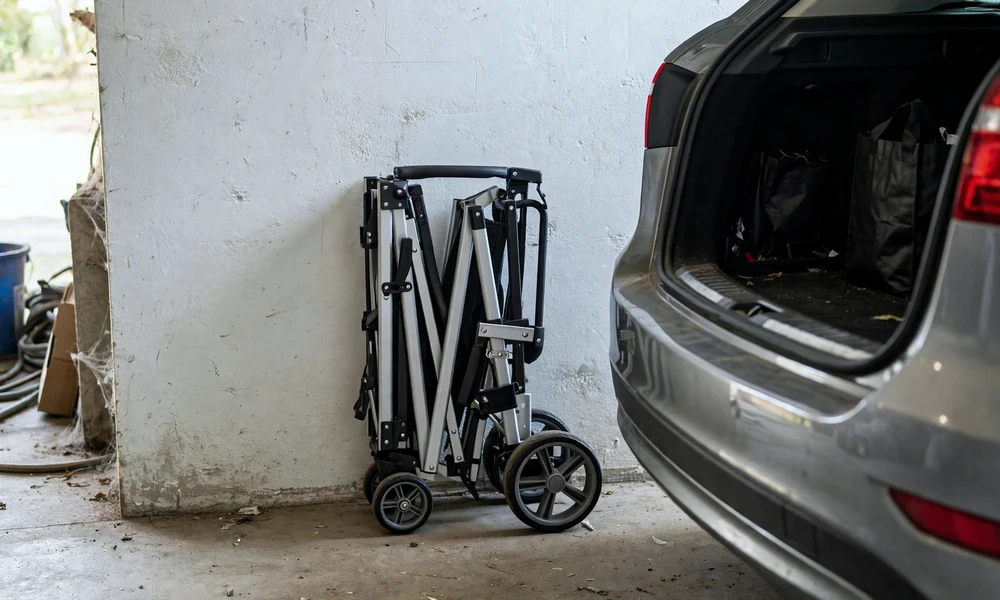
Compact folding push carts are the travel friendly option. They are built to fold into the smallest possible shape, sometimes with wheels that come off or fold in, and they suit a golfer with a small car or limited storage space at home. They are the best choice for someone who drives a small hatchback or stores the cart in a flat. The trade off is that the folding joints can feel less solid than a simpler frame, so it pays to open and close the cart a few times before you buy it.
Three Wheel or Four Wheel
The choice between three wheels and four wheels comes down to your course and your bag. A flat course with smooth paths suits a three wheel cart, because it is lighter, turns in a tighter circle, and is easier to push around the green. A hilly course with rough ground suits a four wheel cart, because it stays upright on slopes and does not need to be held while you take a shot. Think about the courses you play most often, not the one you played once on holiday. The right number of wheels is the one that suits your regular round.
Wheels, Brakes and Handling
Wheels deserve a close look before you buy. Large wheels with a soft tread grip the ground and roll over rough patches, while small hard wheels skid and bounce. Air filled tyres give the smoothest ride, but they can puncture, so many golfers prefer solid foam filled wheels that never go flat. Look at the wheel bearings too, because a cart with smooth bearings rolls with a light push and a cart with rough bearings feels like pushing through sand. Spin each wheel by hand and listen, because a wheel that spins freely and quietly is a good sign.
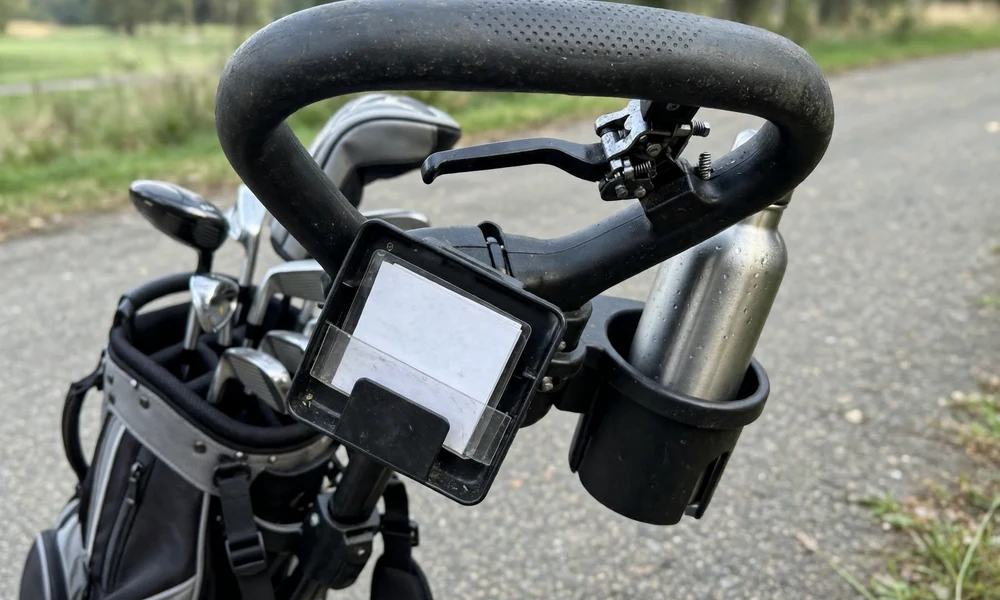
A brake is not a luxury, it is a necessity. You will park the cart on slopes while you take a shot, and a cart without a working brake will roll away. The best brakes are a simple lever on the handle that locks the rear wheels with one squeeze, and releases just as easily. A foot brake works too, but it is harder to reach when your hands are full. Test the brake on a slope if you can, and make sure it holds with a full bag on the cart. A brake that slips is worse than no brake at all, because it gives false confidence.
Storage, Holders and Extras
A push cart is more than a frame and wheels, it is also your caddy for the day. A cup holder matters on a warm round, and it should hold a bottle firmly without letting it bounce out on rough ground. A scorecard holder with a cover keeps your card dry and easy to read, and a small storage pocket is useful for tees, balls and a glove. An umbrella holder is worth having if you play in changeable weather, and a mesh basket underneath the bag is handy for a jumper or a waterproof jacket. These extras are small, but you will use them on every hole.
The best extras are the ones that are built in, not bolted on. A holder that is part of the frame stays put, while a holder that clips on can rattle loose or fall off. Check that each holder is easy to reach while you are walking, and that nothing gets in the way of the handle. A cart with too many extras can become cluttered and heavy, so choose the holders you will actually use and ignore the rest. A simple cart with the right holders beats a complicated cart with holders you never touch. Your bag choice matters here too, and the best golf bags are the ones that sit neatly on a cart without sliding around.
Fitting Your Bag and Your Clubs
Not every bag fits every cart, so check the fit before you buy. A stand bag with legs can be awkward on a cart, because the legs stick out and catch on the frame, while a cart bag is made to sit flat and strap down neatly. The cart should have adjustable straps at the top and the bottom, and a support at the base that stops the bag from slipping down. Put your own bag on the cart and strap it in, then lift the cart and see if the bag moves. A bag that stays put is a bag you will not have to fix mid round.
Your clubs matter too, because the bag sits at an angle on a cart and the clubs should be easy to reach. The bag should sit high enough that you can pull a club out without bending too far, but low enough that the cart stays stable. The best golf clubs are no help if you cannot get them out of the bag easily, so test the reach with your own set. A cart that holds the bag at a comfortable height makes the whole round smoother, and a cart that holds it too low or too high will slow you down on every shot.
Folding, Weight and the Car Boot Test
Every push cart folds, but not every push cart folds well. A good cart folds in one or two moves, with no fiddly catches and no parts that need to be removed. It should open again just as easily, and it should lock open with a clear click so you know it is safe. A cart that needs three hands to fold, or that pinches your fingers, will be left in the garage. Fold and unfold the cart a few times in the shop, and time yourself.
What to Avoid
Avoid a cart with a wobbly frame. Push it from side to side and see if the frame flexes or rattles. A frame that flexes will feel worse over time, as the joints wear and the cart becomes looser. A rigid frame is worth paying for, because it is the frame that carries the weight and keeps the bag steady. A cart that feels solid in the shop will stay solid, and a cart that feels loose will only get looser. Rigidity is the first sign of quality.
How to Choose in 2026
Start with your course, then your bag, then your car. A flat course suits a light three wheel cart, a hilly course suits a steady four wheel cart, and a small car suits a compact folding cart. A heavy bag needs a strong frame and good straps, and a light bag gives you more choice. A small boot needs a cart that folds flat, while a large boot gives you freedom. Write down your course, your bag and your boot before you shop, and you will narrow the choice quickly. The best cart is the one that fits your life, not the one with the longest list of features.
Then test the cart with your own bag on it. Push it, turn it, fold it, lift it and park it on a slope. Check the brake, the handle height and the holders, and make sure your shoes are comfortable for walking too, because the best golf shoes make a walking round far easier than a cart alone ever could. A cart that passes all of these tests is a cart you can buy with confidence, and a cart that fails any of them is one to leave on the shelf. The best golf push carts of 2026 are the ones that roll straight, fold flat, hold your bag steady and let you enjoy the walk, hole after hole, round after round.


