Best Greenhouse Heaters 2026
A greenhouse without heat is a fair-weather room. It is wonderful from late spring to early autumn, and then the first cold night arrives and everything tender inside it is at risk. Tomatoes stop ripening, seedlings stall, and a single frost can undo months of careful growing in a few hours.
Get the heating right, though, and the greenhouse becomes a year-round growing space. These are the best greenhouse heaters of 2026, chosen for warmth, control, safety, and running cost, so you can keep plants alive through winter without heating the whole garden.
Key Takeaways
- Size the heater to the greenhouse, because a heater that is too small will run all night and still lose the fight against frost.
- Electric fan heaters suit most small and medium greenhouses, while gas and paraffin heaters suit larger spaces and places without a nearby power supply.
- A thermostat matters more than raw power, since steady temperature control protects plants far better than bursts of heat.
- Keep the heater dry, clear of leaves and compost, and away from anything flammable, because a greenhouse is a damp place full of dry material.
- Insulate before you buy a bigger heater, since bubble wrap and draught sealing can cut the heat you need by a surprising amount.
Greenhouse Heaters 2026 at a Glance
| Best for | Heater type | Power | Standout strength |
|---|---|---|---|
| Best overall | Electric fan heater with thermostat | 2 kW | Even heat, precise control, and safe running |
| Best for small greenhouses | Compact electric fan heater | 1 kW | Small, cheap to run, and easy to move |
| Best for large greenhouses | Gas heater | 4 kW | Strong heat with no mains power needed |
| Best for frost protection | Tubular heater | 120 W per metre | Gentle background warmth along the bench |
| Best for off-grid growing | Paraffin heater | 2 kW | Works anywhere, with no plug in sight |
| Best for seedlings | Fan heater with frost setting | 2 kW | Holds a steady low temperature all night |
What a Greenhouse Heater Is Really For
A greenhouse heater does two jobs at once. First, it keeps the temperature above the point where tender plants are damaged, which for most vegetables and bedding plants means staying above freezing, and ideally above five degrees. Second, it keeps the air moving, which matters more than most growers realise, because still, damp air invites mould and grey mould on leaves and stems.
It helps to know how a heater fits into the wider greenhouse. The structure itself decides how much heat escapes, and our guide to the best greenhouse kits of 2026 covers glazing, frames, and sizes in detail. A heater is the second half of that decision, and the right choice depends on the size of your greenhouse and how cold your winters get.
Getting the Size Right
Size is where most greenhouse heater purchases go wrong. A heater rated for a small lean-to will not protect a twelve-foot freestanding greenhouse on a frosty night, and a heater far too large will cycle on and off, dry the air, and cost a fortune to run. Measure the greenhouse first, then match the heater to it.

A useful rule of thumb is to allow about one hundred watts per square metre for a reasonably insulated greenhouse kept frost-free, and closer to one hundred and fifty watts per square metre for a large, single-glazed greenhouse in a cold spot. A six-by-eight-foot greenhouse is roughly four and a half square metres, so a one-kilowatt heater is a sensible starting point, while a ten-by-twelve-foot greenhouse needs two kilowatts or more.
The Main Types of Greenhouse Heater
Greenhouse heaters fall into a handful of types, and each suits a different kind of growing. The right choice depends less on brand than on your greenhouse, your power supply, and what you grow.
The electric fan heater is the safest choice for most homes. It is a small box with a heating element and a fan, and it spreads warm air quickly and evenly. Its strength is control, since most models have a thermostat and several heat settings. Its weakness is dependence on mains power, and the running cost on a cold night, which is real but predictable.
The tubular heater is the quiet specialist. It is a long, low tube that sits along a bench or under staging, giving gentle background warmth exactly where seedlings sit. It will not heat a whole greenhouse on a freezing night, but it is ideal for keeping a small space just above frost, and it uses very little electricity.
The gas heater is the answer to a large greenhouse. It burns bottled gas, produces strong heat, and needs no mains power at all. Gas heaters are popular with serious growers, but they need ventilation, because burning gas produces moisture and carbon dioxide, and they need a gas bottle that must be stored and swapped safely.

Paraffin heaters are the old-fashioned option, and they still have their fans. They need no electricity, they are cheap to buy, and they will keep a small greenhouse frost-free through a cold snap. The trade-offs are smell, moisture, and the need to refill and light them by hand, which is not for everyone. If you would rather warm the garden seating area than the greenhouse, our guide to the best patio heaters of 2026 covers outdoor heaters built for people, not plants.
Thermostats and Temperature Control
A heater without a thermostat is a blunt tool. It is either on, pouring out heat, or off, letting the temperature fall, and the plants live through the swings. A thermostat changes that completely, switching the heater on only when the temperature drops below the level you set, and off again when it recovers.
Place the thermostat sensor where the plants are, not next to the heater. A sensor beside a hot heater will read warm and switch off while the far end of the greenhouse is still freezing. Hang it at bench height, in the middle of the greenhouse, away from direct sun and away from the heater itself, and the reading will mean something.
Placement, Airflow, and Humidity
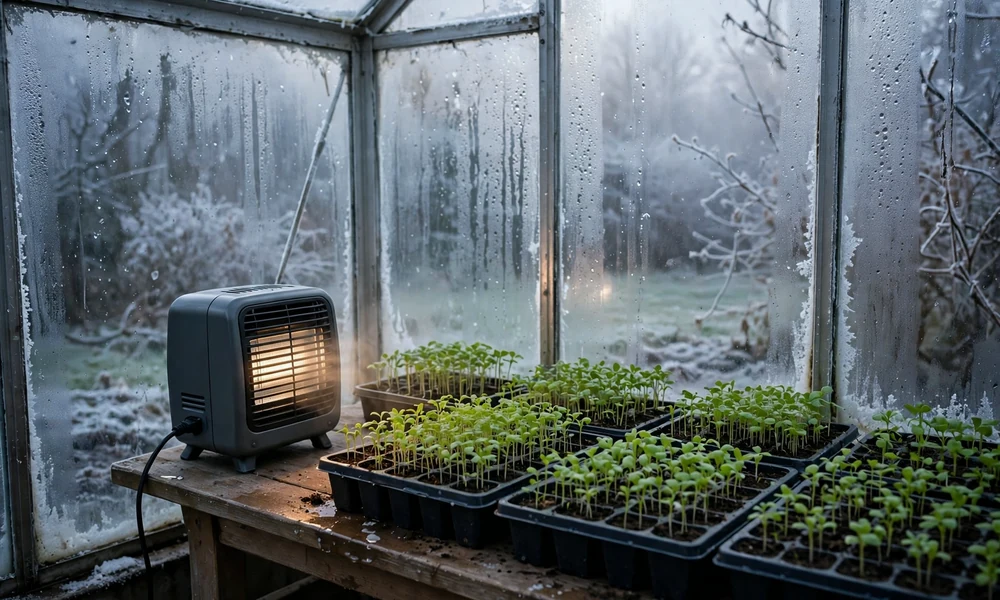
Where you put the heater matters almost as much as which heater you buy. A heater in a corner warms that corner, while the opposite end stays cold. A heater in the middle, low down, with its fan pointing along the length of the greenhouse, warms the whole space far more evenly.
Safety in a Damp Place
Electric heaters belong on a circuit protected by a residual current device, and the socket should be an outdoor-rated one, mounted above splash height. Keep cables off the floor, out of puddles, and away from paths where they can be tripped over or cut. Check cables and plugs at the start of every winter, and replace anything cracked, frayed, or green with damp.
Running Costs and Insulation
Bubble wrap is the cheapest win in greenhouse growing. A layer of large-bubble wrap fixed inside the glass can cut heat loss by a third or more, and it costs very little. Seal the gaps around doors and vents with draught excluder, and consider a second layer of insulation around the plants themselves, such as fleece over the benches on the coldest nights.
Heating Through the Seasons
Summer needs no heating at all, and this is the time to service the heater. Clean the fan, check the element, test the thermostat, and store a paraffin or gas heater somewhere dry. A heater serviced in summer is a heater you can trust in January, and one that fails on the coldest night of the year is a heater that was ignored all summer. Light matters through the dark months too, and our guide to the best grow lights of 2026 covers the lamps that keep seedlings growing when the days are short.
Common Mistakes to Avoid
The most common mistake is buying a heater that is too small for the greenhouse: people remember the floor size and forget the height, the glazing, and the cold spot by the door, then discover the heater runs all night and the plants still freeze. The second is running a heater with no thermostat, which wastes money and stresses plants with wild temperature swings. The third is placing the heater in a corner, where it warms one end and leaves the other cold. The fourth is ignoring insulation, which is like heating a house with the windows open. The fifth is forgetting ventilation with a gas or paraffin heater, which fills the air with moisture. Finally, do not buy a heater you cannot power safely: a long extension lead across wet grass is not a power supply.
Before You Buy: A Short Checklist
- Measure the greenhouse floor area and height, and size the heater to the volume, not just the floor.
- Choose electric for control and convenience, gas or paraffin for large or off-grid greenhouses.
- Insist on a thermostat, and place its sensor at bench height in the middle of the greenhouse.
- Check the power supply, the circuit, and the outdoor socket before you buy an electric heater.
- Plan the placement: low, central, clear of leaves and compost, with half a metre of space around it.
- Insulate first with bubble wrap and draught sealing, and heat only the space the plants need.
- Check safety: residual current protection for electric heaters, ventilation for gas and paraffin.
Frequently Asked Questions
What size heater do I need for my greenhouse? Allow about one hundred watts per square metre for a reasonably insulated greenhouse kept frost-free, and closer to one hundred and fifty watts per square metre for a large, single-glazed greenhouse. A six-by-eight-foot greenhouse needs about one kilowatt, while a ten-by-twelve-foot greenhouse needs two kilowatts or more.
Is an electric or gas greenhouse heater better? Electric fan heaters suit most small and medium greenhouses, because they are easy to control and safe to run. Gas heaters suit large greenhouses and places without mains power, but they need ventilation and a gas bottle to store and swap.
What temperature should I keep my greenhouse at in winter? Most tender vegetables and bedding plants want at least five degrees, seedlings and tropical plants want ten degrees or more, and hardy plants survive at two or three degrees. Set the thermostat to the lowest temperature your plants will tolerate.
Can I leave a greenhouse heater on all night? Yes, if it has a thermostat and it is placed safely, clear of leaves and compost, on a proper circuit with residual current protection. Check it regularly, and never leave a gas or paraffin heater running in a sealed greenhouse with no ventilation.
The Bottom Line
The best greenhouse heater of 2026 is the one that matches your greenhouse, your power supply, and your plants, and then holds a steady temperature all winter without drama. It is sized to the volume of the space, controlled by a thermostat, placed where its warmth reaches every bench, and backed up by insulation that keeps the heat inside.
Start with the tape measure and the thermometer, not the catalogue. Measure the greenhouse, work out the lowest temperature your plants need, insulate first, and then choose the type that fits: an electric fan heater for most growers, a tubular heater for gentle frost protection, or gas and paraffin for large and off-grid spaces.