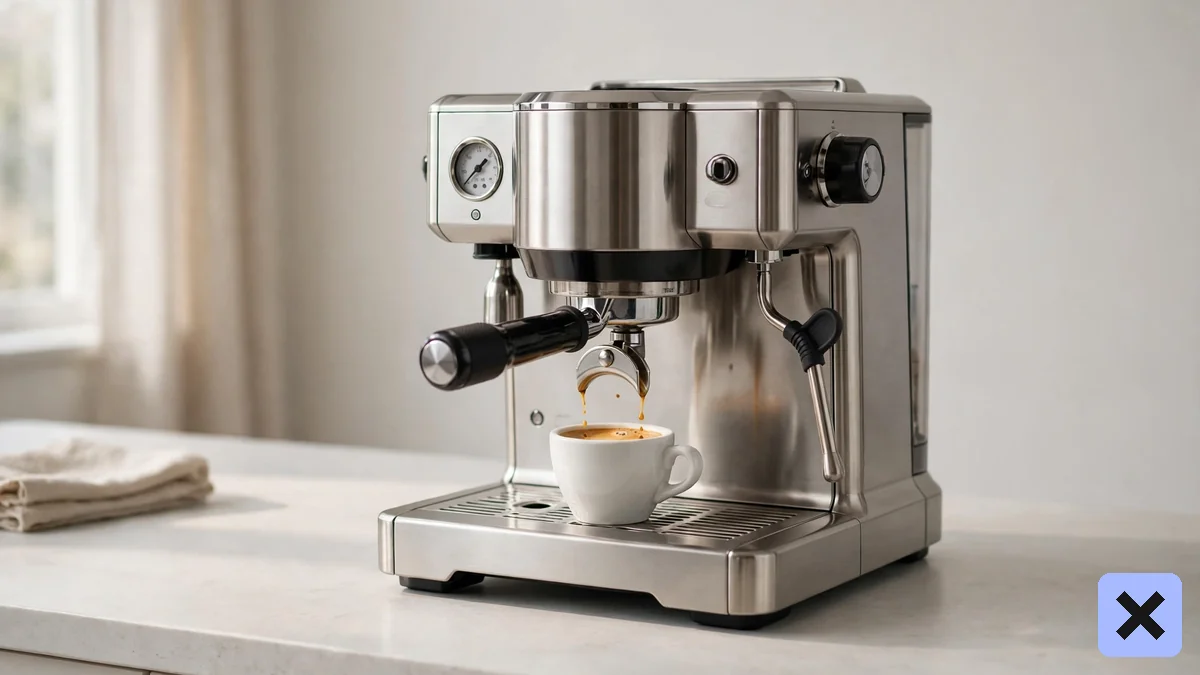
The best home espresso machines in 2026 make café-quality espresso a realistic morning routine rather than a weekend project. Machines that once cost thousands now sit on ordinary kitchen counters, and even mid-priced models have PID temperature control, pre-infusion and steam wands that texture milk properly. The gap between a good home shot and a café shot has never been smaller.
That progress makes choosing harder. A beginner-friendly machine with a built-in grinder, a hands-on semi-automatic with a 58mm portafilter, and a super-automatic that does everything at a touch all claim to be the best home espresso machine, yet they suit completely different people. Buy the wrong type and you will fight the machine every morning or pay for features you never touch.
We weighed shot quality, milk steaming, heat-up time, ease of cleaning, build quality and real-world value. The nine machines below cover every budget and style of coffee drinker, from the first-timer who wants a great latte to the hobbyist chasing the perfect extraction.
Key takeaways
- Spend at least $500 for consistently good espresso; cheaper machines struggle with temperature stability and steam power.
- A built-in grinder saves space and money, but a separate grinder gives finer control and an easier upgrade path.
- PID temperature control and pre-infusion most improve shot quality in 2026 machines.
- If you mostly drink milk coffees, prioritise steam power over extra brewing features.
- Fresh beans and a correct grind matter more than the machine once you pass the $700 mark.
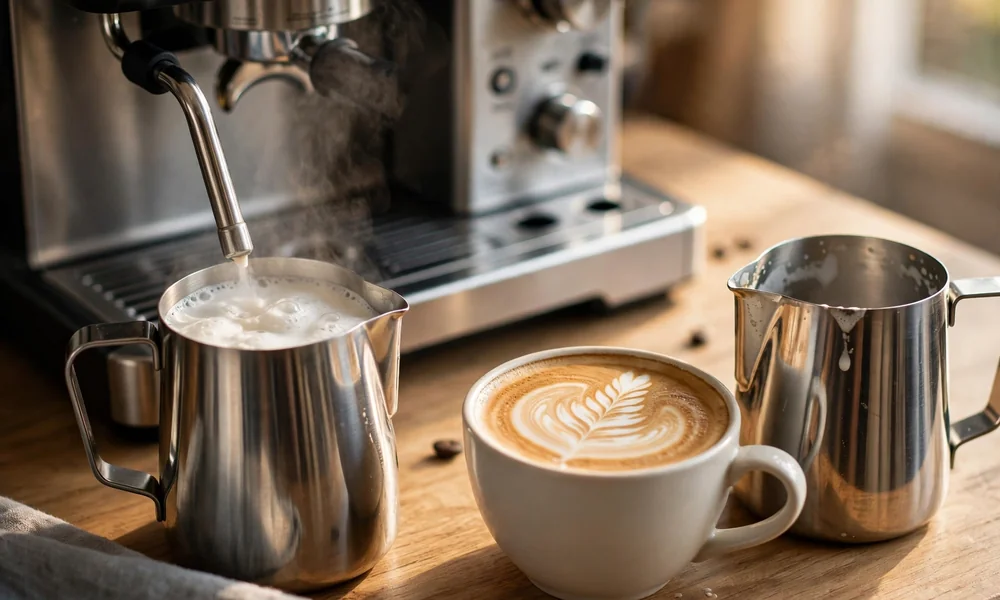 ” alt=”Steaming milk for a latte beside a home espresso machine” />
How We Chose the Best Home Espresso Machines
Every machine here produces real espresso: nine bars of pressure, a rich crema and a balanced shot when dialled in. We ruled out pod-only machines and anything that could not hold a stable brewing temperature, because those decide whether your coffee tastes like espresso or bitter brown water.
We also weighed the daily experience. Heat-up time matters on a busy morning, an awkward drip tray becomes a daily annoyance, and a slow steam wand will put you off lattes entirely. Price was judged against what you get: a $1,500 dual-boiler machine earns its place only if it outperforms a $700 rival.
The Best Home Espresso Machines at a Glance
| Machine | Best for | Boiler | Grinder | Approx. price |
|---|---|---|---|---|
| Breville Barista Express Impress | Best overall | ThermoJet | Built-in conical burr | $800 |
| Breville Bambino Plus | Best compact | ThermoJet | None | $500 |
| De’Longhi La Specialista Arte Evo | Best for lattes | Thermoblock | Built-in conical burr | $650 |
| Gaggia Classic Pro E24 | Best for hobbyists | Single boiler | None | $500 |
| Breville Dual Boiler | Best premium | Dual boiler | None | $1,600 |
| De’Longhi Dedica Maestro Plus | Best budget | Thermoblock | None | $400 |
| Breville Barista Pro | Best fast heat-up | ThermoJet | Built-in conical burr | $850 |
| Ninja Luxe Café Premier | Best all-in-one | Thermoblock | Built-in conical burr | $600 |
| Ascaso Dream PID | Best design | Thermoblock | None | $1,100 |
The 9 Best Home Espresso Machines of 2026
1. Breville Barista Express Impress — Best Overall
The Barista Express Impress is the easiest recommendation here because it removes the two hardest parts of home espresso: dosing and tamping. Its assisted tamping presses the puck with the same force every time, and the built-in conical burr grinder doses directly into the portafilter. The result is a consistent, sweet shot with very little practice.
The ThermoJet heats up in about three seconds, low-pressure pre-infusion soaks the puck before full pressure, and the steam wand textures milk well enough for latte art. At around $800 it is not cheap, but it replaces a separate grinder worth $200.
2. Breville Bambino Plus — Best Compact
The Bambino Plus is barely wider than a kettle, yet it pulls shots that embarrass machines twice its size. The same three-second ThermoJet heat-up and 54mm portafilter from Breville’s bigger machines are here, with automatic milk frothing to your chosen temperature.
It has no grinder, so you will need to buy one separately. If counter space is tight and you already own a decent grinder, though, the Bambino Plus is the best value espresso machine you can buy in 2026.
3. De’Longhi La Specialista Arte Evo — Best for Lattes
The La Specialista Arte Evo is built for milk-drink lovers. Its My LatteArt steam wand is powerful and forgiving, the built-in grinder offers eight settings, and the cold brew function is a bonus for iced coffee season. It is handsome too, with a compact footprint and an easy-lift drip tray.
Shot quality is very good rather than exceptional: the 51mm portafilter and pressurised baskets are forgiving for beginners, though tinkerers may find the ceiling lower than on a Gaggia or Breville. For households that drink mostly lattes, that trade-off is easy to accept.
4. Gaggia Classic Pro E24 — Best for Hobbyists
The Gaggia Classic Pro has been the default first serious espresso machine for decades, and the E24 update keeps it that way. A commercial-style 58mm portafilter, a three-way solenoid valve that dries the puck after brewing, and a huge modifier community mean you can grow with it for years.
It demands more than the Brevilles: a learning curve, a wait between brewing and steaming with the single boiler, and a capable grinder. But no machine at this price teaches espresso better, and few reward practice with such good coffee. The best espresso beans for home make a real difference here, because the Gaggia shows off good beans and exposes stale ones.
5. Breville Dual Boiler — Best Premium
If budget is not the constraint, the Dual Boiler is the machine to beat. Two stainless steel boilers let you pull a shot and steam milk at the same time, the PID controller holds temperature to the degree, and the over-pressure valve and shot timer help you dial in precisely.
It is large, heavy and expensive at around $1,600, and it still needs a good grinder. But for the enthusiast who makes two or three milk drinks every morning, the speed and consistency are transformative.
6. De’Longhi Dedica Maestro Plus — Best Budget
The Dedica Maestro Plus proves you do not need $700 to drink good espresso at home. At around $400 it is one of the slimmest machines available and heats quickly, and the automatic steam wand takes the guesswork out of milk. The 51mm portafilter and pressurised baskets keep things simple for newcomers.
Compromises are real: the thermoblock is less temperature-stable than a boiler, the steam is weaker than on pricier rivals, and the build feels less premium. With fresh beans it still makes a genuinely enjoyable morning espresso.
 ” alt=”Fresh coffee beans, a home grinder and a portafilter with ground coffee” />
7. Breville Barista Pro — Best Fast Heat-Up
The Barista Pro is the Barista Express Impress’s quicker, more modern sibling. The ThermoJet reaches temperature in three seconds, the LCD screen guides grind size and shot time, and the built-in grinder is fast and consistent. Cold to a finished flat white takes under two minutes.
It costs a little more than the Impress and lacks the assisted tamper, so you tamp by hand. In return you get a clearer display and a slightly faster workflow. If your mornings are rushed, the Barista Pro is the better pick.
8. Ninja Luxe Café Premier — Best All-in-One
The Ninja Luxe Café Premier is the most versatile machine here: espresso, cold brew, drip coffee and milk drinks all come from one box, and the built-in grinder adjusts for each mode. It is the only machine here that makes a proper cold brew and a hot latte without extra equipment.
Espresso purists will note the smaller portafilter and the automated approach, which limits how far you can push a shot. But for a household split between espresso, cold brew and filter coffee, no other machine covers so much ground for around $600.
9. Ascaso Dream PID — Best Design
The Ascaso Dream PID looks like nothing else here, with retro curves and a wide range of colours, and it backs up the looks with serious engineering. A PID-controlled thermoblock holds temperature precisely, the 58mm portafilter takes standard accessories, and the steam wand is strong enough for silky microfoam.
At around $1,100 it is a considered purchase with no grinder, so budget for one. What you get is a kitchen centrepiece and a genuinely capable espresso maker, built to last.
How to Choose the Right Espresso Machine
Start with your drink. Straight espresso rewards temperature control and a good grinder, so look at the Gaggia Classic Pro, the Dual Boiler or the Ascaso Dream. Milk drinks reward steam power and speed: the Barista Express Impress, the La Specialista Arte Evo or the Bambino Plus.
Next, be honest about how much effort you enjoy. Assisted-tamping machines suit people who want great coffee with minimal fuss, while manual machines suit those who enjoy the ritual and are willing to learn. Buying a manual machine when you want convenience is the most common regret in home espresso.
Finally, budget for the grinder. The best coffee grinders for home will improve your coffee more than spending the same money on a fancier machine, because grind size and freshness control extraction more than any machine feature. A $500 machine with a $300 grinder will out-brew a $900 machine fed with pre-ground coffee every time.
Espresso Machine Buying Checklist
- Measure your counter space and check the machine’s height and cup clearance.
- Decide between a built-in grinder and a separate one you can upgrade later.
- Check the water tank size and whether it lifts out for refilling.
- Look for PID control and pre-infusion if shot quality is your priority.
- Test the steam wand’s power if you drink lattes daily.
- Confirm cleaning is simple: removable drip tray, accessible group head and a descaling cycle.
 ” alt=”A home espresso machine on a kitchen shelf with two cups of espresso” />
Frequently Asked Questions
How much should I spend on a home espresso machine?
Plan on $500 to $900 for a machine that makes consistently good espresso, plus a grinder if one is not built in. Below $400, temperature stability and steam power drop off sharply. Above $1,500 you pay for speed and consistency rather than a big jump in taste.
Do I need a separate grinder?
Not if your machine has a good built-in grinder, as the Breville Barista models and the Ninja Luxe Café do. Without a grinder, a burr grinder is essential: pre-ground coffee goes stale quickly and cannot be adjusted finely enough for espresso.
What is the difference between a thermoblock and a boiler?
A thermoblock heats water on demand, so it is fast and compact but can vary in temperature. A boiler holds water at a set temperature, which is more stable but slower and bulkier. Dual boilers give you one boiler for brewing and one for steam, which is the gold standard.
How often should I clean my espresso machine?
Wipe the steam wand after every use, empty and rinse the drip tray daily, and backflush with water weekly if your machine allows it. Descale every two to three months, sooner in a hard-water area. Regular cleaning is the easiest way to keep your coffee tasting good.
Can a home machine really match café espresso?
Yes, with fresh beans, a good grinder and a little practice. Cafés still win on speed and consistency, but a well dialled-in home machine can produce a shot every bit as good as the one you buy. The best espresso cups for home help too, since a warm, properly sized cup keeps the crema intact.
Are super-automatic machines worth it?
They are worth it if convenience matters more than control. A super-automatic grinds, tamps, brews and froths at a touch, ideal for busy households. You give up the ability to fine-tune each shot, so enthusiasts usually prefer a semi-automatic.
The Bottom Line
The Breville Barista Express Impress is the best home espresso machine for most people in 2026, combining a built-in grinder, assisted tamping and fast heat-up in a package that makes great coffee easy. If you want something smaller, take the Bambino Plus; if you want the best possible coffee and enjoy the craft, take the Gaggia Classic Pro or the Breville Dual Boiler. Whichever you choose, pair it with fresh beans and a proper grinder.