Lazy Susans vs Turntables: The Kitchen Tray That Spins, Not the Record Player, in 2026
Lazy susans cause more confusion than almost any other kitchen product, and the confusion starts with the name. A lazy susan is a spinning tray that brings the back of a shelf to the front with one flick of the wrist, and in the kitchen it is the same thing as a turntable: two names for one rotating disc. A record-player turntable is something else entirely. This guide is about the kitchen tray, and it compares the main types and picks the lazy susans that end the digging through deep cupboards in 2026.
Key Takeaways
- A lazy susan and a kitchen turntable are the same product: one spinning tray, two names. A record-player turntable is different entirely.
- Measure the shelf before you buy: a tray 2 centimetres too wide is a tray you will never use.
- A raised rim stops jars sliding off mid-spin, and a non-slip base stops the tray itself from wandering.
- Two-tier trays double capacity but need at least 25 centimetres of shelf clearance.
- Plastic suits the fridge, wood suits the table, divided trays suit snacks.
Lazy Susans Compared
| Tray type | Best for | Material | Size | Watch out for |
|---|---|---|---|---|
| Single-tier plastic | Pantry, fridge | Clear plastic | 25 to 38 cm | Thin trays flex |
| Two-tier | Spices, small jars | Plastic or metal | 25 to 30 cm | Needs 25 cm clearance |
| Wood and bamboo | Table, counter | Wood, bamboo | 30 to 45 cm | Not for wet cupboards |
| Divided tray | Snacks, condiments | Plastic or wood | 30 to 38 cm | Sections too small for jars |
| Non-slip fridge tray | Fridge shelves | Plastic, silicone grip | 25 to 30 cm | Check the shelf fit |
| Corner cabinet tray | Blind corners | Plastic or wire | 45 to 70 cm | Needs exact cabinet size |
1. The Single-Tier Plastic Lazy Susan: The Pantry Workhorse
The single-tier plastic lazy susan is the tray most kitchens need first: a clear disc on a ball-bearing base that sits on a pantry shelf and spins sauces, oils and vinegars into reach. Clear plastic shows labels through the rim, and a 25-centimetre tray suits a narrow cupboard while a 38-centimetre one fits a wide walk-in shelf. It needs no installation, costs little, and solves the most common pantry fault, food hidden at the back of a deep shelf.
The weakness is flex. A thin plastic tray bends under a full load of glass jars, and a bent tray drags instead of spinning. Choose a tray with a raised rim so jars do not slide off mid-spin, a non-slip base, and a bearing that turns smoothly when loaded, not just when empty.

2. The Two-Tier Lazy Susan: Twice the Storage, Twice the Height
A two-tier lazy susan stacks a second spinning disc above the first, which doubles capacity in the same footprint. It suits spices and small jars, because the top tier holds the short jars and the bottom tier holds the taller ones. Two-tier trays hold twenty to twenty-four small jars in the footprint of a dinner plate.
The catch is height. Two-tier trays need at least 25 centimetres of shelf clearance, and many pantry shelves sit only 30 centimetres apart. Measure the gap before you order, and keep the heaviest jars on the bottom tier so the tray stays stable.
3. The Wood and Bamboo Lazy Susan: The Table Tray
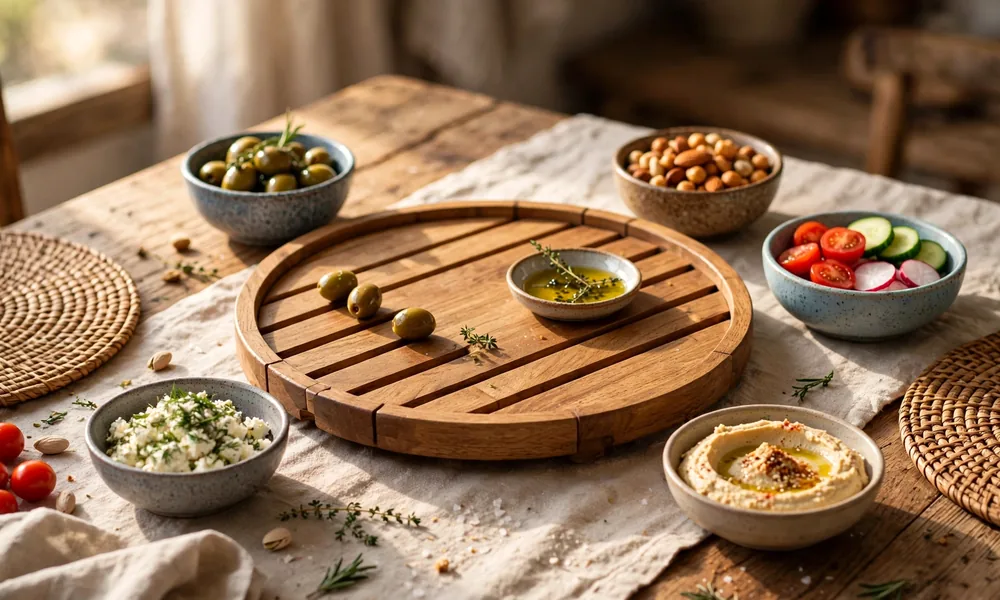
A wood or bamboo lazy susan is the tray for the dining table rather than the cupboard: a warm, solid disc that spins small bowls, sauces and condiments around the table so everyone can reach everything. Bamboo resists moisture well and suits a kitchen counter, while acacia and walnut look better on a dining table. A 30 to 45-centimetre wooden tray is the right size for a family table.
Wood is not for wet cupboards. A wooden tray in a damp pantry warps, and one left in a sink soaks up water and stains. Keep wood trays where they stay dry, wipe them clean rather than soaking them, and oil bamboo occasionally so it does not dry and crack.
4. The Divided Lazy Susan: Snacks and Condiments in Their Own Lanes
A divided lazy susan splits the disc into wedge-shaped sections, so snacks, dips or condiments each get their own lane. It suits a snack table, a drinks station or a fridge door, where a plain tray would let everything slide into one pile.
The sections are the limitation. A divided tray holds less than a plain tray of the same size, and the sections are usually too small for standard jars. Buy divided only for small things, nuts, olives, sauces in squeezy bottles, and keep a plain tray for jars.
5. The Non-Slip Fridge Lazy Susan: The Cold Cupboard Fix
A non-slip fridge lazy susan is a small plastic tray with a grippy silicone surface, made for the fridge, where bottles sweat and jars slide. It turns the back of a fridge shelf, the place where condiments go to expire, into a spinning shelf you can actually use. A 25 to 30-centimetre tray fits most fridge shelves.
Check the fit before you buy, because fridge shelves vary and a tray that overhangs the shelf edge will tip when you spin it. Measure the shelf depth and width, and leave a centimetre of clearance on each side.
6. The Corner Cabinet Lazy Susan: The Blind Corner Solution
A corner cabinet lazy susan is the big one: a 45 to 70-centimetre kidney-shaped or half-moon tray that fits inside a blind corner cupboard, the deep L-shaped space where pots and pans disappear. Some are simple trays on a pole, others are pull-out shelves that swing out of the corner.
Corner trays need exact measurements. A tray 2 centimetres too wide will not fit through the cabinet door, and a pole-mounted tray needs the cabinet height measured to the millimetre. Measure the door opening and cabinet depth, and buy the tray made for your cabinet size.
The Bearing, the Rim and the Spin: What Decides Quality
The bearing decides whether a lazy susan feels good or fights you. A ball-bearing base spins smoothly under a full load and keeps spinning with one flick, while a cheap plastic-on-plastic base drags, sticks and needs a push to move at all. Test the spin loaded, not empty: an empty tray always spins, and a full one tells the truth.
The rim decides whether things stay on the tray. A rim of 2 to 3 centimetres holds jars in place during a normal spin, while a flat tray with no rim loses a jar every time someone spins it in a hurry. A non-slip base stops the tray from wandering, and heavy items low and tall items centred keep it stable.
Sizing a Lazy Susan: Measure First, Buy Second
Sizing is the step most people skip, and it is the reason most lazy susans end up in a drawer. Measure the shelf width, depth and height, and write the numbers down. The tray should be at least 2 centimetres narrower than the shelf in every direction, so it spins freely without catching the sides, and at least 5 centimetres shorter than the shelf gap, so you can lift jars out.
For the table, the rule flips: the tray should be large enough to hold the dishes you serve, but small enough to leave room for plates around it. A 30-centimetre tray suits a table for four, a 38 to 45-centimetre tray suits a table for six or eight. If you are setting up the rest of the kitchen too, our guide to pantry organizers covers the other five organizer types, and the lazy susan is only one of them.

Cleaning and Care
A lazy susan is easy to clean, which is why it survives in kitchens where other organizers fail. Plastic trays go in the sink with warm soapy water, or in the dishwasher if the maker allows it, and a wipe with a damp cloth handles daily drips. Wood and bamboo trays should be wiped clean and never soaked, because soaking swells the grain and loosens the bearing. Check the bearing twice a year, and wipe grit and crumbs out of the bearing race, because a gritty bearing is a sticking bearing.
Mistakes That Waste a Good Lazy Susan
The most common mistake is buying before measuring, and a tray that does not fit the shelf is a tray that never gets used. The second is overloading: a tray piled two jars high topples when you spin it. The third is choosing a flat tray with no rim, which loses a jar a week. The fourth is putting a wooden tray in a damp cupboard, where it warps. The fifth is treating the lazy susan as the whole pantry solution, when it is one tool among several. Our guide to spice racks covers the dedicated options for a large collection, because a carousel is only one of five rack types.
Lazy Susan Checklist: Before You Buy
- Measure the shelf width, depth and height, and buy a tray at least 2 centimetres narrower in every direction.
- Check the bearing spins smoothly under a full load, not just when the tray is empty.
- Choose a raised rim of 2 to 3 centimetres so jars do not slide off mid-spin.
- Pick a non-slip base, especially for the fridge, where condensation makes everything slippery.
- Match the material to the room: plastic for cupboards and fridge, wood for the table.
- Keep heavy jars low and tall jars centred, and never stack jars two high.
Frequently Asked Questions
Is a lazy susan the same as a turntable?
In the kitchen, yes: two names for the same spinning tray. A record-player turntable is a different product: it plays vinyl with a platter, a tonearm and a stylus, and it has nothing to do with your pantry.
What size lazy susan do I need?
Measure the shelf first. A 25-centimetre tray suits a narrow cupboard, 30 centimetres suits a standard pantry shelf, and 38 centimetres suits a wide walk-in shelf. Leave 2 centimetres of clearance on each side.
Can a lazy susan go in the fridge?
Yes, and the fridge is one of its best uses. Choose a plastic tray with a non-slip surface, measure the shelf, and wipe it weekly, because fridge trays collect drips.
Are two-tier lazy susans worth it?
Yes, for spices and small jars, because they double capacity in the same footprint. They need at least 25 centimetres of shelf clearance, and the heaviest jars must go on the bottom tier.
How do I stop things falling off a lazy susan?
Choose a tray with a raised rim of 2 to 3 centimetres, keep heavy jars low, spin gently, and do not overload it. A non-slip base helps, but the rim does most of the work.
What is the best lazy susan for a corner cabinet?
A kidney-shaped or half-moon tray made for your cabinet size, usually 45 to 70 centimetres. Measure the door opening and the cabinet depth exactly, because a tray 2 centimetres too wide will not fit through the door.
The Bottom Line
The best lazy susans in 2026 are the ones that fit your shelves, not the ones that look best in a photograph. Measure first, choose a tray with a smooth bearing, a raised rim and a non-slip base, and match the material to the room: plastic for the pantry and the fridge, wood for the table. Do that, and the back of the cupboard stops being where food goes to be forgotten. For the rest of the kitchen, our guide to drawer organizers covers the trays and dividers that tame the junk drawer.