
Best Measuring Spoons 2026
A recipe is a promise, and a measuring spoon is the tool that keeps it. When a cake asks for a teaspoon of baking powder, it does not mean a heaped teaspoon, a shy teaspoon, or whatever your smallest spoon happens to hold. It means a level teaspoon, measured the same way every time, and the difference between that and a careless scoop is the difference between a cake that rises and one that sinks in the middle.
Most kitchens already own a set of measuring spoons, and most of those sets are wrong. The markings have worn off, the bowls are different depths, or the set was bought for a pound and never checked against anything real. These are the best measuring spoons of 2026, chosen for accuracy, honest markings, comfortable handles, and the kind of build that survives years of dishwashers and drawers.
Key Takeaways
- Accuracy comes first, because a spoon that holds ten percent too much baking powder will ruin a cake no matter how pretty the set looks.
- Stainless steel is the safest all-round choice, since it does not warp, stain, or absorb smells the way cheap plastic does.
- Look for engraved or stamped markings, because printed numbers wash off within months and leave you guessing.
- Buy the set for the cooking you actually do, because a baker needs a half-teaspoon and a pinch measure, while a cook who seasons by eye needs sturdy everyday spoons.
Measuring Spoons 2026 at a Glance
| Best for | Spoon type | Sizes included | Standout strength |
|---|---|---|---|
| Best overall | Stainless steel, long handle | 1 tbsp to 1/4 tsp | Accurate, durable, and easy to level |
| Best for baking | Stainless steel, narrow bowl | 1 tbsp to 1/8 tsp | Reaches into spice jars and small tins |
| Best for small hands | Short handle, wide bowl | 1 tbsp to 1/4 tsp | Easy grip and steady in the hand |
| Best for sticky ingredients | Silicone-coated steel | 1 tbsp to 1/2 tsp | Honey and syrup slide straight off |
| Best budget set | Thick moulded plastic | 1 tbsp to 1/4 tsp | Cheap, light, and honest for the price |
| Best for tiny amounts | Mini spoons, pinch and dash | Pinch to 1/8 tsp | Measures what a normal set cannot |
What a Measuring Spoon Is Really For
A measuring spoon does one job, and it does it quietly: it delivers the same amount every single time. That sounds simple until you remember how much of cooking depends on small quantities. A teaspoon of salt in a soup is seasoning. Two teaspoons is a different soup. A tablespoon of baking soda in a batter is lift. Two tablespoons is a bitter, soapy cake that no amount of icing can save.
It helps to know where a spoon ends and its neighbours begin. A measuring cup handles flour, sugar, and liquids in bulk, and the two tools work as a pair rather than as rivals. A kitchen scale is more accurate than either of them, and our guide to the best kitchen scales of 2026 covers weighing for bakers who want to stop guessing altogether. But a scale cannot measure half a teaspoon of vanilla into a bowl that is already on the hob, and that is where a good spoon earns its place.

The Sizes That Matter
A standard set runs from one tablespoon down to a quarter teaspoon, and that range covers most recipes. The tablespoon measures oils, sauces, and larger amounts of dry goods. The teaspoon is the workhorse, used for salt, spices, baking powder, and flavourings. The half teaspoon and quarter teaspoon handle the small, strong ingredients where a little extra changes everything.
Materials: What Lasts and What Does Not
Stainless steel is the default for a reason. It is heavy enough to feel steady, it does not bend under a thick paste, it survives the dishwasher without warping, and it does not hold the smell of the last thing it measured. Good steel spoons have their sizes stamped into the handle, so the markings cannot wash off, and the bowls keep their shape for years. The only real drawback is that steel can be cold and slippery when your hands are wet, so look for handles with a slight texture or a flattened end.
Plastic is the budget option, and it is not always a bad one. Thick, moulded plastic spoons are light, cheap, and kind to non-stick pans, and a well-made set can be surprisingly accurate. The problem is the thin, flimsy kind: the bowls flex when you press them into a firm ingredient, the handles bend, and the printed markings fade after a few dozen washes. If you buy plastic, buy the thickest set you can find, and treat the markings as temporary.

Accuracy: Why Cheap Spoons Lie
Here is an uncomfortable truth: many cheap measuring spoons are not the size they claim to be. Independent tests have repeatedly found sets where the tablespoon holds ten or fifteen percent more or less than it should, and where the spoons in a single set do not even agree with each other. A quarter teaspoon that holds a third of a teaspoon is not a bargain, it is a broken tool.
You can test a set at home in two minutes. Fill the tablespoon with water and pour it into a measuring jug, or weigh it on a scale: a level tablespoon of water weighs fifteen grams, and a level teaspoon weighs five. If your spoon is more than a gram out, it is lying to you. Do the test with every spoon in the set, because one accurate spoon does not prove the rest.
Handles, Rings, and Storage
The handle is where cheap sets give themselves away. A short handle looks tidy in the drawer, but it cannot reach the bottom of a tall spice jar, and your knuckles end up dusted in paprika. A long handle reaches anywhere, but it can make the spoon feel unbalanced if the bowl is heavy. The sweet spot is a handle long enough to reach into a jar with room to spare, and flat enough to rest on a worktop without rolling.
Most sets come on a ring, and the ring is worth inspecting. A flimsy ring bends open in the drawer and drops spoons one by one. A good ring is springy, opens with a firm pull, and snaps shut with a click. Some cooks remove the ring altogether and store the spoons loose in a drawer divider, which is fine as long as every spoon is marked, because an unmarked loose spoon is a guessing game.
How to Measure Properly
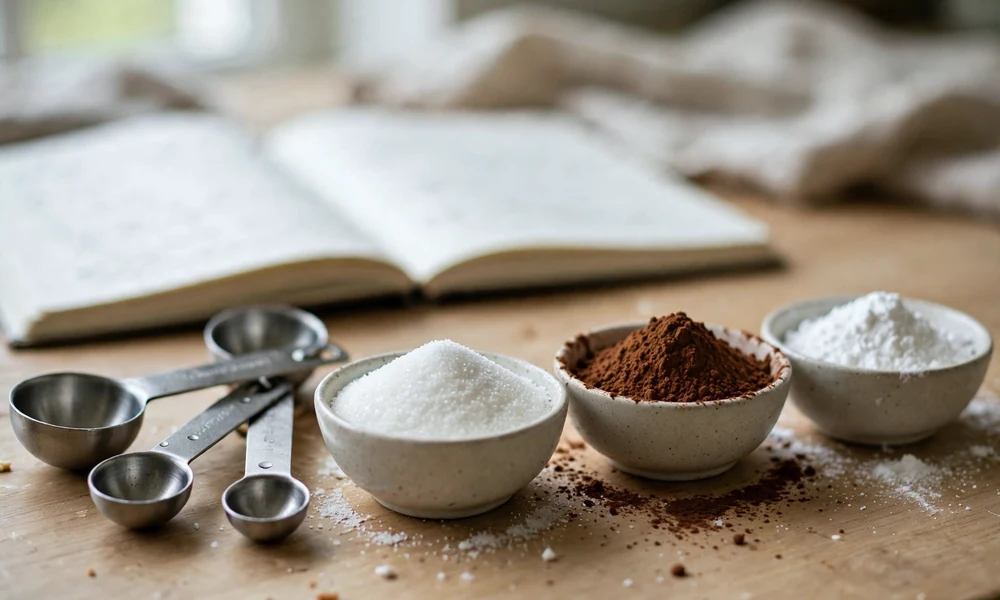
Technique matters as much as the tool. For dry ingredients, dip the spoon into the container and overfill it slightly, then level it with the straight back of a knife. Do not tap the spoon, do not shake it, and do not press the ingredient down, because packing changes the amount. A level spoon is a flat spoon, and the knife is the only honest way to get there.
For liquids, fill the spoon to the brim and hold it over the bowl, not over the worktop. Vanilla, oil, and lemon juice are all measured at eye level, because looking down at a spoon from above makes it look fuller than it is. If you spill a little, wipe the spoon and start again rather than topping it up, because a topped-up spoon is never level.
For sticky ingredients, the trick is a thin film of oil. Wipe the inside of the spoon with a drop of neutral oil before measuring honey or syrup, and the whole measure slides out cleanly. It adds nothing you can taste, and it saves the scraping and the waste. This is the one place where a second, silicone-coated set genuinely earns its keep.
Measure over the bowl you are cooking in, and measure the dry ingredients before the wet ones, so a damp spoon never clumps the flour. And when a recipe gives you a choice between weighing and spooning, remember that the spoon is for speed and the scale is for precision. Once the batter is in the bowl, a good whisk does the rest, and our guide to the best whisks of 2026 covers the tool that turns those careful measures into a smooth, even mix.
Care and Cleaning
Stainless steel spoons are the easiest to care for: they go in the dishwasher, they come out clean, and they do not need drying. The one exception is a set with wooden handles, which should be washed by hand and dried straight away, since a dishwasher will crack the wood within a year.
Dry the set before it goes back in the drawer. Water left in the bowls leaves spots on steel and encourages smells in plastic, and a damp ring rusts even when the spoons do not. It takes ten seconds with a tea towel, and it is the difference between a set that lasts a decade and a set that looks tired within a year.
Mistakes Worth Avoiding
The most common mistake is using a measuring spoon as a serving spoon. The two look alike, and the drawer is full of both, but a tablespoon from the cutlery drawer is not a tablespoon measure. Cutlery spoons vary wildly in size, and the one you eat soup with can hold almost twice what a measuring tablespoon holds. Keep the measuring set separate, and keep the cutlery out of the recipe.
The second mistake is measuring over the mixing bowl when the ingredient is salt. A slip of the hand drops a whole spoonful into the batter, and there is no way to fish it out. Measure salt and baking powder over the worktop or over a small dish, so a slip costs you a wipe rather than a ruined batch. The same goes for anything you cannot easily remove once it lands.
What to Buy
Start with a stainless steel set that runs from one tablespoon to a quarter teaspoon, with the sizes stamped into long, flat handles. That set will handle almost everything a home cook needs, from a weeknight stir-fry to a birthday cake, and it will still be accurate in five years. Add a mini set with an eighth teaspoon and a pinch measure if you bake with strong spices, and a silicone-coated spoon if you work with honey or syrup often.
Finally, remember that a measuring spoon is only as good as the rest of the prep. Accurate measures go into a bowl that is the right size for the job, and our guide to the best mixing bowls of 2026 covers the bowls that make those careful measures easy to mix, pour, and scrape. Get the spoon right, get the bowl right, and the recipe takes care of itself.
The best measuring spoons of 2026 are not the prettiest, the cheapest, or the most expensive. They are the ones that hold the amount they claim to hold, level cleanly, read clearly after a hundred washes, and sit comfortably in your hand when you are in a hurry. Buy that set, test it with water on a scale, and keep it where you can reach it. Your recipes will start working the way they were written.


