A Guide to Paper Trimmers That Cut Square Every Time in 2026
The best paper trimmers in 2026 are the quiet workhorses of the home office and the craft table: a flat base, a straight guide and a blade that turns a wobbly hand-cut edge into a clean, square line in one pass. A good paper trimmer saves the print job that scissors would ruin, squares up a stack of invitations, and trims a photograph to fit its frame. A bad one drifts off the line and leaves every sheet out of square. Choosing the right one means matching it to the paper you actually cut.
A paper trimmer earns its place the moment you need more than one sheet to look identical. Scissors follow your hand imperfectly, so ten cut sheets come out ten slightly different sizes. A trimmer fixes the paper against a guide and runs the blade along a rail, so the tenth sheet matches the first. That repeatability matters for invitations, flyers and photographs.
Key Takeaways
- A guillotine suits thick stacks and heavy card; a rotary suits everyday paper and photographs, because the rolling blade cuts cleanly without lifting the sheet.
- Cut length matters most: buy a trimmer that handles your largest sheet with room to spare, or every wide cut becomes two cuts and a join.
- A clear guide and a firm clamp decide whether a cut comes out square, because a sheet that shifts by a millimetre ruins the edge.
- Sharp, replaceable blades are the whole game: a dull blade tears fibres instead of slicing them, and a trimmer with blades you cannot buy is disposable.
- Keep fingers behind the guard and store a guillotine latched shut, because a trimmer blade is sharper than it looks.
What a Paper Trimmer Actually Is
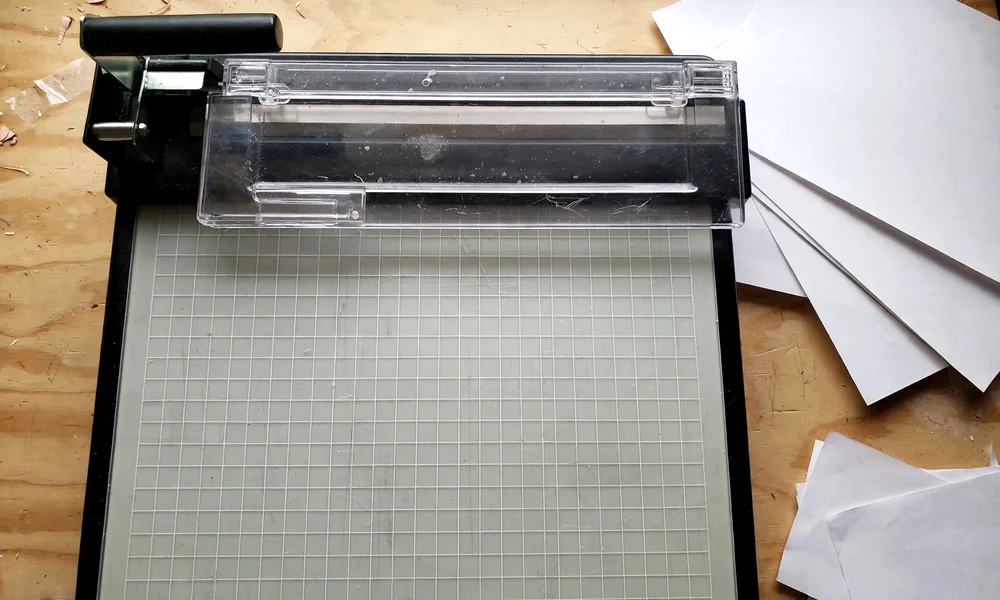
A paper trimmer is a bench tool with a flat base, a measuring grid, a guide, and a blade that moves in a fixed straight line. You square one edge against the guide, hold the sheet still, and run the blade across it. The base keeps the paper flat, the guide keeps it square, and the blade path keeps the cut straight. The base is printed with a grid in centimetres and inches; a good grid does not wear off, and the base should sit flat without rocking.
Guillotine, Rotary and Stack Trimmers
Guillotine Trimmers
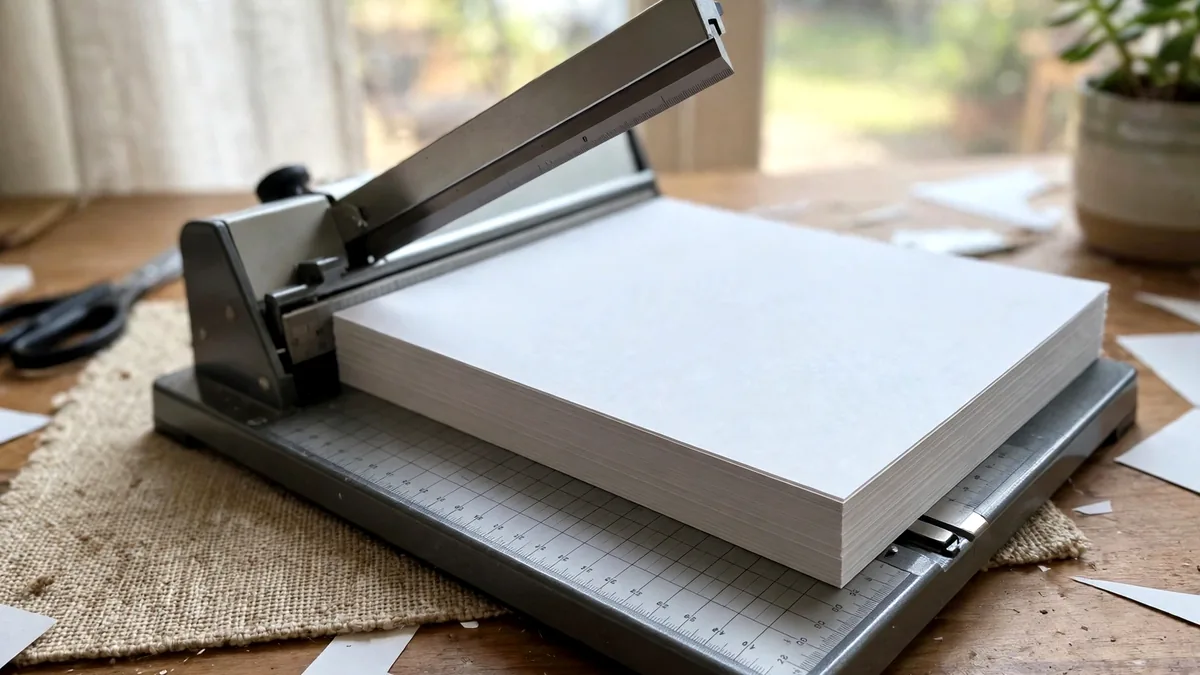
A guillotine trimmer is the right choice for card, mount board, or stacks of ten or more sheets at once. The long lever cuts thick material cleanly, and the hinged blade keeps the cut line true. Look for a blade that locks down for storage, a finger guard, and a clamp that holds the stack still. The best guillotines also have a sliding backstop, so repeated cuts land in the same place.
Rotary Trimmers
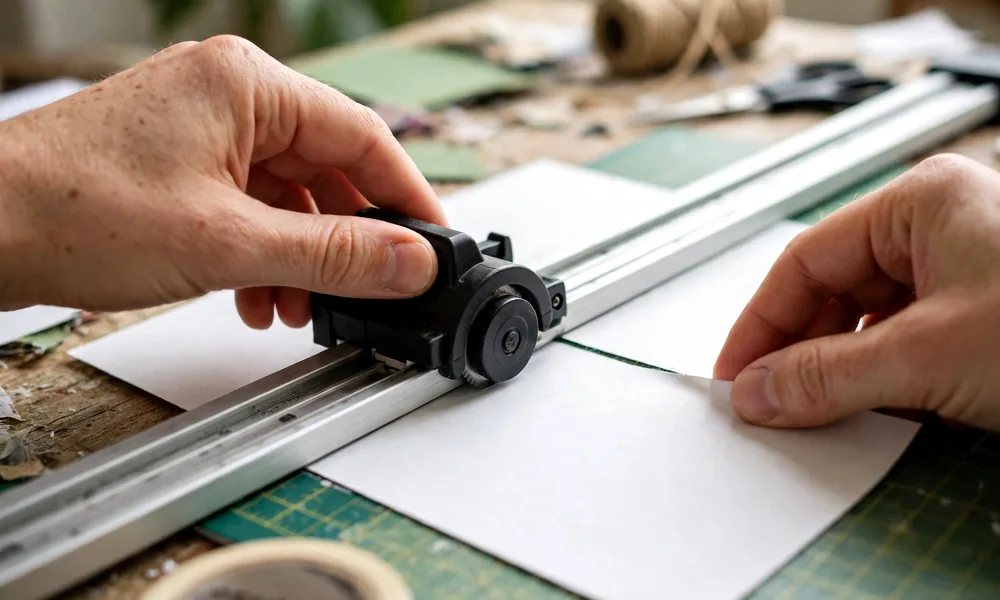
A rotary trimmer has a small round blade inside a sliding head that runs along a rail. You push the head from one end to the other, and the blade rolls through the paper in a single smooth pass. It is the safest type for a busy household, because the blade stays inside the head, and it gives the cleanest edge on ordinary paper and photographs. It cuts fewer sheets at once, usually one to ten, but for everyday trimming it is hard to beat.
Stack and Desktop Trimmers
Stack trimmers are built for volume: a wide base, a strong clamp, and a blade that cuts twenty or more sheets in one pass. They suit a home office that prints and trims in bulk. They are heavier and cost more, so they only make sense if you genuinely trim in quantity. For most homes, a rotary or a small guillotine covers everything.
Paper Trimmers vs the Other Cutting Tools
The nearest neighbours are worth knowing, because each one cuts paper differently and fails at the job the trimmer does best. A rotary cutter for fabric rolls a circular blade through cloth, and it has no guide for squaring a sheet of A4. Our guide to the best rotary cutters of 2026 covers that tool. A craft knife is the opposite of a trimmer: a slim, freehand blade for curves and fine detail, covered in our guide to the best craft knives of 2026. Scissors follow your hand rather than a guide, so a long straight cut drifts; our guide to the best scissors of 2026 covers the pairs worth owning.
How We Judged the Best Paper Trimmers
We judged every trimmer the way it gets used: trimming printed A4 sheets, squaring photographs, cutting card for invitations, and trimming worksheets to the same size. Accuracy came first: a trimmer that cuts square on the fiftieth sheet beats one with a longer blade that drifts. Next came the guide and the clamp, because a trimmer is only as accurate as the paper stays still. Then came blade quality, spares, capacity, safety, build and value: a sharp blade, spares that are easy to buy, a base that stays flat, and a price that matches the years of use.
The Best Paper Trimmers of 2026
Five trimmers stood out in 2026, covering every budget and every kind of paper cutting. All share the same qualities: a cut that stays square, a guide you can trust, a blade you can replace, and a base that stays put.
| Trimmer | Type | Best for | Cut length |
|---|---|---|---|
| Everyday Rotary | Rotary | Paper and photos | A4 |
| Heavy Guillotine | Guillotine | Card and stacks | A3 |
| Compact Desktop | Rotary | Small desks | A4 |
| Wide Rotary | Rotary | Posters and A3 | A3 |
| Office Stack | Stack | Bulk trimming | A3 |
The Everyday Rotary
The everyday rotary is the trimmer most homes should buy first. Its head runs smoothly, the blade stays guarded inside it, and it cuts printer paper or a photograph with a clean edge. The backstop locks, the base has rubber feet, and it handles up to ten sheets at once. Spare blades are cheap and widely available.
The Heavy Guillotine
The heavy guillotine is the workhorse for card and stacks. Its long blade cuts heavy card and a thick stack in one firm stroke, and the pressure bar holds the paper flat, so the edge stays square. The blade locks down for storage and the guard covers the cutting edge. It is bigger than a rotary, but for card-making it earns its space.
The Compact Desktop
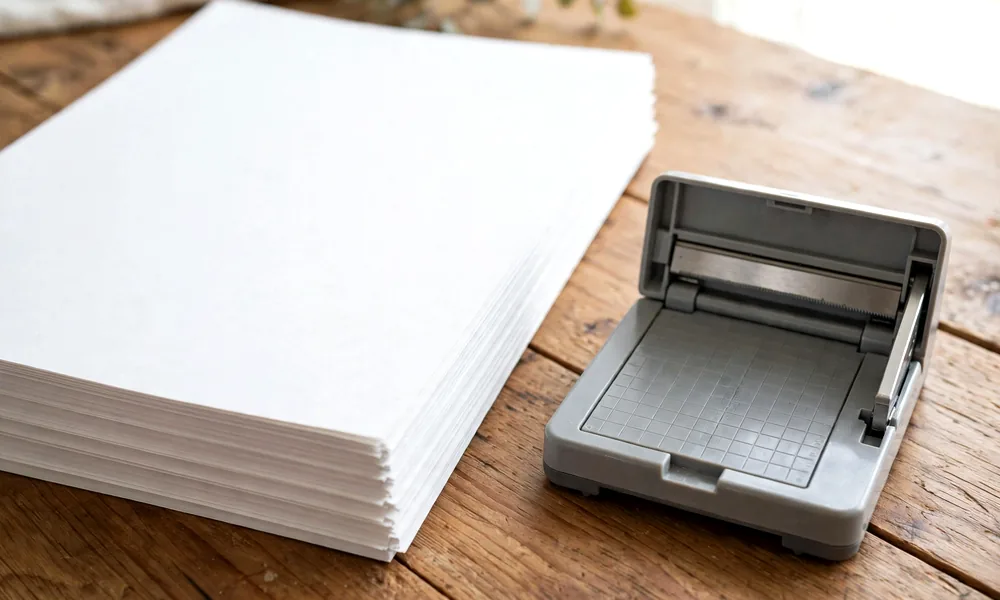
The compact desktop trimmer is a small rotary built for a crowded desk. It cuts A4 and smaller, fits in a drawer, and is light enough to carry to the kitchen table. Its cut is just as clean as its full-size sibling. The trade-off is capacity: it handles fewer sheets at once and cannot cut A3.
The Wide Rotary
The wide rotary is the choice for A3 paper, posters and large photographs. Its longer rail and wider base handle sheets a standard trimmer cannot, and the head runs the full length without wobbling, so a long cut stays straight. It costs more than an A4 model, but if you print large, it trims a full sheet in one pass.
The Office Stack
The office stack trimmer is built for volume: a wide base, a strong clamp and a blade that cuts twenty or more sheets in one pass. It suits a home office that prints flyers or worksheets in batches, and keeps every sheet the same size. It is the heaviest type here, so it only makes sense when trimming is a regular job.
Cut Length, Capacity and Paper Weight
Cut length is the first number to check. A4 paper is 297 millimetres long, so an A4 trimmer needs a cut length of at least 300 millimetres, and a little spare is better, because a blade that just reaches the end leaves a ragged corner. A3 is 420 millimetres, so an A3 trimmer needs at least 430. Capacity is the sheets cut cleanly in one pass, quoted for ordinary 80 gsm paper: rotary trimmers manage five to ten, guillotines ten to thirty, and stack trimmers twenty or more. Thick card counts as several sheets, so a trimmer rated for ten sheets of paper may only manage two or three of heavy card.
Getting a Square Cut Every Time
A square cut starts before the blade moves. Square one edge against the guide, not the grid lines, because the guide is the fixed reference. Push the sheet into the corner where the guide meets the backstop, hold it flat with your free hand well away from the blade path, and check the paper has not lifted at the far end. Then cut in one smooth, steady motion: a rotary head pushed evenly, or a guillotine blade brought down firmly. A slow, jerky cut tears fibres; a single confident pass slices them. When a cut comes out wrong, the paper almost certainly moved: check the clamp and the guide, then cut a test sheet.
Safety and Looking After Your Trimmer
A paper trimmer blade is sharper than it looks, so treat it like a kitchen knife. Keep your free hand on the paper, not near the blade path, and never reach across the cutting line while the blade is moving. On a guillotine, keep the blade latched down when not in use and store it where children cannot reach it. On a rotary, replace the blade the moment it starts tearing instead of slicing. Wipe the base clean after each session, keep the rail free of dust, and store the trimmer flat, because a warped base will never cut square again.
Before You Buy: The Checklist
- Cut length covers your largest sheet with room to spare.
- The guide and backstop lock firmly and the grid reads clearly.
- The clamp holds a stack flat without marking it or letting it shift.
- The blade is sharp, guarded, and replaceable, with spares you can actually buy.
- Capacity matches your real workload, counting heavy card as several sheets.
- The base sits flat, stays put, and the trimmer stores safely with its blade latched.
Frequently Asked Questions
What is the difference between a guillotine and a rotary paper trimmer?
A guillotine swings a long hinged blade down through paper, suiting thick card and stacks, while a rotary slides a guarded round blade along a rail, suiting everyday paper and photographs. The guillotine cuts more at once; the rotary cuts more safely.
How many sheets can a paper trimmer cut at once?
A rotary usually cuts five to ten sheets, a guillotine ten to thirty, and a stack trimmer twenty or more. Heavy card counts as several sheets, so cut fewer at once when the paper is thick.
Can a paper trimmer cut card?
Yes, but choose the right type. A guillotine handles heavy card well, while a small rotary may only manage one or two sheets cleanly. Keep the blade sharp.
Why are my cuts coming out crooked?
The paper is almost certainly moving. Square the sheet against the guide, hold it flat, and check the backstop has not slipped. A dull blade can also drag the paper.
Are paper trimmers safe to use around children?
A rotary with a guarded blade is the safest choice for a family home. A guillotine needs its blade latched down and stored out of reach.
How often should I replace the blade?
Replace it when the cut stops feeling effortless: torn fibres or a ragged edge mean the blade is dull. A rotary blade lasts several months in a household that trims a few times a week.
Bottom Line
The best paper trimmer for most homes is a rotary trimmer with a clear guide, a firm clamp and replaceable blades, because it cuts everyday paper and photographs cleanly and safely. If you cut heavy card or trim in bulk, step up to a guillotine or a stack trimmer with the cut length your largest sheet demands. Buy for the paper you actually cut, keep the blade sharp, and square every sheet against the guide.


