
A phone tripod is the smallest upgrade that makes the biggest difference to what your phone camera can do. Phones now shoot genuinely good video and stills, but a hand-held phone still shakes, still drifts, and still ends up propped against a coffee mug at a bad angle. A good phone tripod fixes all three problems at once: it holds the phone exactly where you put it, keeps it still while the shutter is open, and frees both of your hands for the shot itself. The best ones cost less than a night out, fold small enough to live in a jacket pocket, and get used far more often than the camera gear gathering dust at home.
Key Takeaways
- A tabletop mini tripod is the best first buy: cheap, pocketable, and right for desks, video calls, timelapses, and night shots.
- Flexible-leg tripods are the most versatile outdoors, wrapping around railings, fences, and branches where no flat surface exists.
- A selfie-stick tripod is the best choice for filming yourself walking, talking, or travelling, doubling as a handheld grip.
- Check the clamp before anything else: it must open wide enough for your phone in its case and grip firmly without pressing the side buttons.
- Weight matters more than height. A tripod that fits in a coat pocket gets carried; a tall one that needs its own bag gets left behind.
Phone Tripods 2026 at a Glance
| Type | Best for | Folded size | Typical weight |
|---|---|---|---|
| Tabletop mini tripod | Desks, video calls, timelapses | 15 to 20 cm | 0.15 to 0.4 kg |
| Flexible-leg tripod | Outdoors, railings, uneven ground | 20 to 30 cm | 0.25 to 0.5 kg |
| Selfie-stick tripod | Vlogging, travel, filming yourself | 20 to 30 cm | 0.2 to 0.45 kg |
| Phone clamp and mount | Attaching a phone to full-size tripods | Under 10 cm | Under 0.1 kg |
How We Picked the Best Phone Tripods
We judged every phone tripod on stability first, because a stand that wobbles is worse than no stand at all. We tested each one with a large phone in a slim case, checking that the clamp held firm when the phone was tilted upright for video calls and sideways for video. We checked how the legs locked, how far the head tilted, and whether the whole thing stayed put on a smooth desk when nudged. We also carried each model around for a week, in pockets and small bags, to find out which ones actually travel well and which ones only claim to. If you already own a full-size stand, our guide to the best tripods of 2026 covers the bigger end of the range, including models that accept a phone clamp for double duty.
Best Overall: A Tabletop Mini Tripod
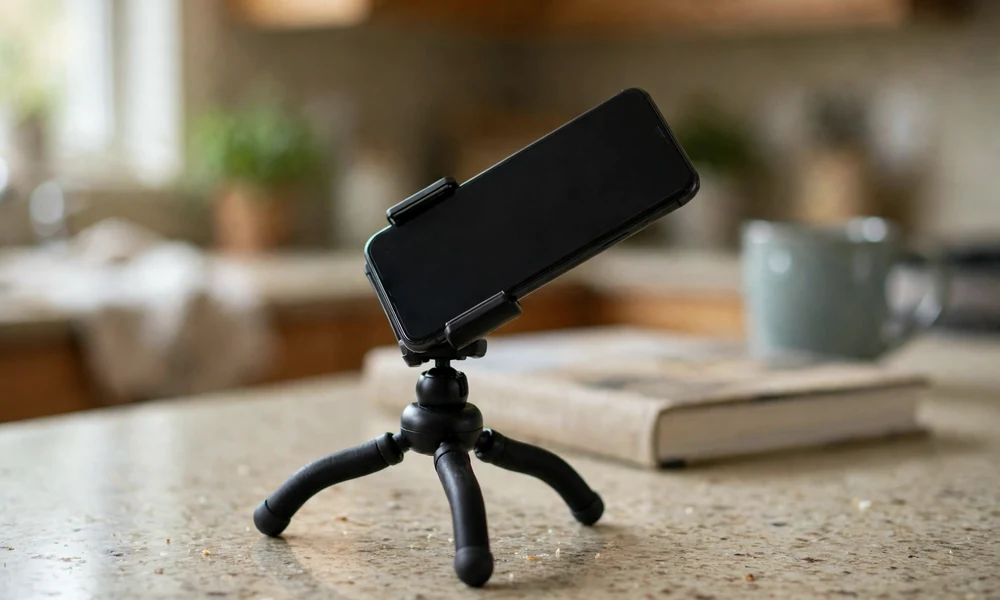
The tabletop mini is the phone tripod most people should buy first. It stands about fifteen to twenty centimetres tall, folds down to the size of a large pen, and weighs less than a phone charger. Set it on a desk and your phone sits at the perfect height for a video call, steady and at eye level instead of staring up your nose from a stack of books. Set it on a wall or a windowsill and it holds still for long-exposure night shots and timelapses that would be impossible hand-held.
Look for three things. First, legs that spread wide and lock firmly, with rubber feet that grip a smooth desk. Second, a ball head that tilts and turns smoothly and locks with a single twist, so you can switch from upright to sideways in seconds. Third, a clamp that opens to at least nine centimetres, wide enough for the largest phones in their cases, with soft pads that grip without scratching. Metal legs beat plastic ones here: they feel better, last longer, and hold a heavy phone without slowly sagging during a long call. A mini tripod with a short centre column is a bonus, adding a few centimetres of height for calls without making the folded package any bigger.
Best for Outdoors: A Flexible-Leg Tripod
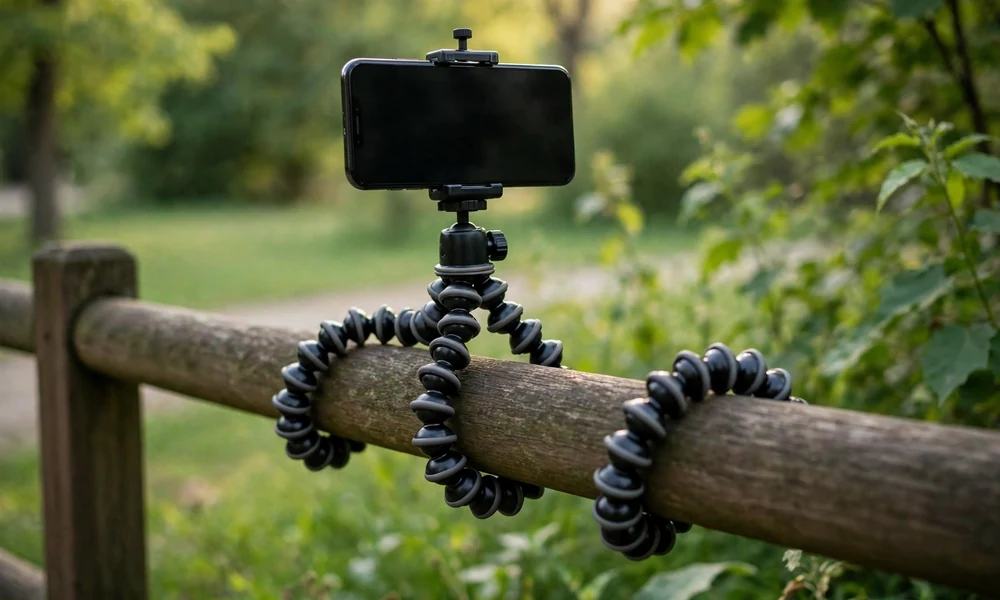
Flexible-leg tripods are the ones with segmented, bendable legs that wrap around railings, fence posts, tree branches, and bicycle handlebars. Outdoors, where flat surfaces are rare and the best viewpoint is often halfway up a fence, they are the most useful phone tripods you can own. Wrapped tight, they hold a phone rock-steady for a timelapse of a sunset; stood on three bent legs, they cope with sloping, rocky ground that would defeat a rigid mini tripod.
Best for Filming Yourself: A Selfie-Stick Tripod
A selfie-stick tripod is two tools in one: an extendable stick for filming yourself at arm’s length, and a small tripod base that folds out when you want to set the phone down. For vlogging, travel videos, and anyone who films themselves walking and talking, it is the obvious pick. Extended, it holds the phone a metre or more away, giving a natural framing that a hand-held phone at arm’s length cannot match. Folded down, it stands on a table for a static shot, a video call, or a group photo with everyone in it.
The quality of the stick itself decides whether the whole thing works. It should extend smoothly, lock firmly at any length, and not flex or wobble when fully extended with a heavy phone on top. A Bluetooth remote shutter, built into the handle or included as a small separate clicker, is worth having: it lets you start and stop recording without walking back to the phone. Check the tripod base, too. Some models have legs so short they only work on a perfectly flat table; the better ones splay wide and have rubber feet, holding the phone steady even at full extension indoors.
Phone Clamps and Mounts: The Smallest Upgrade
Sometimes the tripod is not the problem; the mount is. A good phone clamp turns almost any tripod into a phone tripod, and it costs less than lunch. A spring-loaded clamp with soft rubber pads grips the phone on its long edges, screws onto the standard quarter-inch thread found on nearly every tripod, and adds almost no weight to your bag. If you already own a full-size tripod for a camera, a clamp is all you need to shoot with your phone on it, steadier in wind and taller than any mini stand. It is also the most flexible option if you shoot with both a phone and a camera, since one tripod then serves both.
Clamp shopping comes down to width and padding. The clamp must open wide enough for your phone in its case, and the pads must grip firmly without pressing the volume or power buttons. Cold shoe mounts are a useful extra: a small slot on top of the clamp that holds a microphone or a small light, turning a bare phone into a proper filming rig. A sturdy case helps here too, since a good grip makes the phone easier to clamp and less likely to slip; our guide to the best phone cases of 2026 covers cases that protect the phone without making it too bulky to mount.
Phone Tripods for Vlogging and Content Creation
If you make videos regularly, a phone tripod stops being an accessory and becomes part of your setup. The pattern is the same whether you film cooking, workouts, tutorials, or travel: the phone needs to sit still, at the right height, at the right angle, take after take. A tabletop mini covers the desk shots, a flexible-leg model covers the awkward locations, and a selfie-stick tripod covers the walking pieces. Many creators end up owning two of the three, and that is a sensible kit rather than an extravagance.

Lighting matters as much as stability, and it is the part beginners skip. A phone on a tripod in a dim room still produces dim, noisy video. A small ring light or a window behind the camera changes the result more than any camera setting, and it works best when the phone is held still on a tripod rather than waved around. Our guide to the best ring lights of 2026 covers lights that pair well with a phone tripod, including models that clip onto the tripod itself. Sound is the other half of the equation: a phone tripod with a cold shoe mount holds a small microphone, and that one addition lifts the audio from echoey room sound to something worth listening to.
Getting Steady Shots: Habits That Matter
Even the best phone tripod needs good habits. Set the legs on firm ground and spread them wide before extending anything, because a tall, narrow tripod is a wobbly one. Keep the phone’s weight centred over the legs, not leaning out to one side. In wind, lower the centre column and shelter the setup behind your body or a bag. For photos, use the timer or a remote shutter so your finger never touches the phone at the moment of the shot; even a light tap can blur a long exposure.
Your Phone Tripod Buying Checklist
- Clamp width: opens to at least nine centimetres, with soft pads that clear your phone’s side buttons.
- Weight capacity: rated above your phone’s weight with its case on, with a little margin to spare.
- Head: a ball head that tilts, turns, and locks firmly with one control, switching upright to sideways in seconds.
- Legs: wide-spreading with rubber feet for a mini tripod, stiff bendable joints for a flexible-leg model, and a locking stick for a selfie-stick tripod.
- Folded size: small enough for the bag or pocket you actually carry, not the one you wish you carried.
- Thread: a standard quarter-inch thread, so clamps, lights, and microphones all fit.
- Build: metal joints and clamp over plastic wherever you can get them, especially at the top of the stand.
Frequently Asked Questions
Do I need a phone tripod if my phone has stabilisation?
Stabilisation smooths small shakes while you walk, but it cannot hold a phone still for a long exposure, a timelapse, or a video call. A tripod does the job stabilisation cannot: it keeps the phone exactly where you put it, hands-free, for as long as you need.
Can I use a phone tripod with a case on?
Yes, if the clamp opens wide enough. Measure your phone in its case, then check the clamp’s maximum width before buying. Slim cases are rarely a problem; thick rugged cases need a wider clamp, so check first.
Are cheap phone tripods worth buying?
The very cheapest ones usually are not. Thin plastic legs, a slipping clamp, and a head that will not lock make for a frustrating stand that gets abandoned. A mid-priced model with metal joints and a proper ball head costs little more and lasts far longer.
The Bottom Line
The best phone tripod is the one you actually carry, and that means small, light, and simple. A tabletop mini is the best first buy for most people, a flexible-leg model is the best for the outdoors, and a selfie-stick tripod is the best for filming yourself. Buy for the clamp and the build quality, not for extra features, and spend the money you save on a light or a microphone if you make videos. Your phone is already a good camera. A good tripod is what lets it show that.


