A child’s binoculars should be light enough to carry, tough enough to survive being dropped, and simple enough that a child can focus them alone and see something wonderful on the first try. The worst binoculars for kids in 2026 fail at it in ways that leave a child bored, frustrated, or carrying a pair that is far too heavy for them. They are too big for small hands, too dim to show anything, or too fragile to survive a single fall. Parents buy them hoping to spark a love of birds, nature, and the outdoors. What they get is a pair that fogs, a pair that will not focus, or a pair that ends up forgotten in a drawer.

Too Heavy for Small Hands
A child’s binoculars are often just small adult binoculars, and the worst ones are far too heavy for the child carrying them. A pair that weighs 800 grams feels fine to an adult for five minutes and heavy to a child after three, and a child who is tired of carrying the binoculars will stop carrying them, which means they will stop using them. The weight also makes the view shake, because small arms cannot hold a heavy pair steady, so the birds jump around in the view and the child cannot follow them. A pair that is too heavy is a pair that teaches a child that birdwatching is hard work, when it should feel like play.
Look for a pair that weighs under 400 grams, with a compact body a child can hold in both hands without stretching. A good kids pair uses a smaller front lens, usually 25 or 30 millimetres, which keeps the weight down while still giving a bright view in daylight. Let the child hold the pair for ten minutes in the shop, and watch whether their arms drop or they keep lifting it happily. A pair that is light enough to carry all afternoon is a pair that will be used, and a pair that is too heavy will be left at home after the first walk.
Focus Wheels Children Cannot Turn
A child has to focus the binoculars themselves, and the worst pairs make it impossible. A focus wheel that is stiff, tiny, or buried between the barrels cannot be turned by small fingers, so the view stays blurry and the child gives up. The problem is worst on cheap pairs, where the wheel is plastic, gritty, and needs two hands to move, and on pairs where the focus moves so fast that the smallest turn overshoots the sharp point. A pair that a child cannot focus is a pair that shows them nothing but a blur, and a child who sees only a blur will decide that binoculars do not work and stop trying.
Test the focus wheel before you buy, and let the child try it: it should turn smoothly with one finger, with a little resistance but no sticking, and it should take a reasonable turn to go from near to far. A good kids pair has a large, easy wheel that a child can find without looking, and a focus that moves slowly enough to land on the sharp point. Check that the eyecups twist down easily too, because a child who wears glasses needs to see the whole view. A pair that a child can focus alone is a pair that rewards them, and a pair they cannot focus is a pair that will frustrate them out of the hobby.
Eye Relief That Does Not Fit a Child
A child’s eyes sit closer together than an adult’s, and the worst kids binoculars ignore that completely. The barrels will not close narrow enough, so the child sees two overlapping circles instead of one clear view, and the eyecups are too wide or too hard, so the child cannot get their eyes close enough to see the whole field. The problem is worst on pairs that are simply scaled-down adult binoculars, where the hinge stops before the barrels are close enough for a child’s face. A child who sees two circles is a child who cannot watch birds, however good the glass is, because the binoculars were never made for their face.
Check the hinge before you buy: close the barrels as far as they will go and measure the gap, because a child needs a much narrower setting than an adult. Look for a pair made for children, with a hinge that closes to about 50 millimetres, soft eyecups that sit comfortably, and a short eye relief that suits a small face. Let the child look through the pair in the shop and ask what they see: one clear circle means the pair fits, and two overlapping circles means it does not. A pair that fits a child’s face is a pair that shows them the world, and a pair that does not is a pair that will never work for them.
Dim Views That Bore a Child
A child needs a bright, clear view to stay interested, and the worst kids binoculars give them a dim, narrow one. A tiny front lens with cheap, uncoated glass gathers so little light that the view is dark even on a bright day, and the field of view is so narrow that finding a bird feels like looking through a straw. The problem is worst on toy binoculars sold as real ones, where the lenses are plastic, the prisms are poor, and the view is worse than the naked eye. A child who looks through a dim pair and sees less than they can see without it will decide that binoculars are pointless, and the hobby ends before it starts.

Look for a pair with real glass lenses, fully coated if you can find it, and a front lens of at least 25 millimetres, which gathers enough light for a bright daytime view. Test the pair in the shop by looking at a distant sign: the letters should be sharp, the colours true, and the view wide enough to find things easily. Avoid any pair with plastic lenses, because plastic scratches on the first grain of dust and fogs in a way no cleaner will fix. A pair that shows a bright, wide view is a pair that hooks a child, and a pair that shows a dim tunnel is a pair that will bore them. If the grown-ups need a pair too, our guide to the binoculars that make birdwatching worth it covers the full-size pairs that suit adult hands.
Drops That Break Them
A child’s binoculars will be dropped, and the worst ones break the first time it happens. A pair with a thin plastic body cracks when it hits the ground, the hinge snaps, or a lens pops out of its mount, and a pair that breaks on the first drop is a pair that was never made for a child. The problem is worst on cheap pairs, where the body is hollow, the armour is thin, and the lenses are held in by friction rather than a proper mount. A child who breaks their binoculars on the first outing learns that binoculars are fragile, and a parent who has to buy a replacement learns that cheap pairs cost more in the end.
Look for a pair with a rubber-armoured body, which absorbs the shock of a fall, and a proper strap that a child can wear around their neck, so the pair does not hit the ground in the first place. Check that the hinge feels solid and the lenses sit firmly in their mounts, with no rattle when you shake the pair gently. A good kids pair survives being dropped on grass and bumped against a fence, because it was built for the way children actually use things. A pair that survives a drop is a pair that keeps working, and a pair that breaks is a pair that was never meant for a child. For the wider picture, our comparison of the best and worst binoculars of 2026 explains the same glass and build lessons for grown-up pairs.
Straps and Cases That Get Lost
A child’s binoculars need a strap and a case, and the worst ones come with neither, or with ones that do not work. A strap that is too long lets the pair swing and bang against the child’s chest, a strap that is too thin cuts into the neck, and a strap that cannot be adjusted will not fit a growing child. The case is often just as bad: too big, too flimsy, or with a clasp a child cannot open, so the binoculars end up loose in a bag, where they get scratched and knocked. A pair with no strap and no case is a pair that will be lost or damaged, however good the glass is, because a child cannot carry binoculars safely without them.
Look for a pair with a wide, padded neck strap that adjusts to fit a child, and a case that is easy to open, protects the lenses, and fits in a small backpack. Teach the child to wear the strap around their neck whenever the binoculars are out of the case, and to put the lens caps on when they are finished, because a lens cap is the cheapest protection a pair can have. A pair with a good strap and case stays safe and stays with the child, and a pair without them will be lost or scratched within a month. If the sky is the next interest, our guide to the best telescopes for beginners of 2026 covers the telescopes that suit a family just starting out.
What to Buy Instead
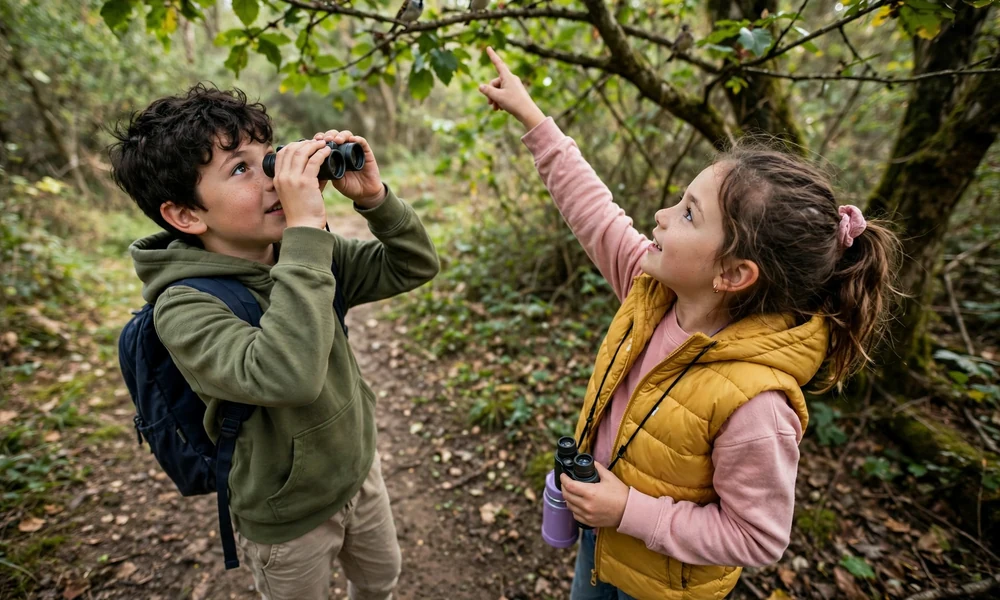
The binoculars for kids worth buying share a short list of features, and none of them is expensive on its own. A pair under 400 grams, with real glass lenses and a front lens of at least 25 millimetres. A focus wheel a child can turn with one finger, a hinge that closes narrow enough for a child’s face, and a rubber-armoured body that survives a drop. A wide, padded strap and a case that fits in a backpack. If a pair fails any one of those checks, keep looking.
Fit matters as much as build, and the pair should suit the child in front of you rather than the child in the photograph. Let the child hold the pair for ten minutes, focus it themselves, and tell you what they see. A pair that fits the child is a pair that gets carried on every walk, and a pair that fights them will be left in a drawer. Buy the pair for the child you have, and let them choose the colour if they want to.
The Bottom Line
The worst binoculars for kids in 2026 share a pattern: too heavy for small hands, focus wheels children cannot turn, eye relief that does not fit a child, dim views that bore a child, drops that break them, and straps and cases that get lost. Avoid those six failures and you avoid almost every kids-binocular regret. Let the child hold the pair, focus it, and tell you what they see. Do that, and the pair you buy will be the one that sparks a love of the outdoors, not the one that ends up forgotten in a drawer.