Best Telescopes for Beginners 2026
The first time you point a telescope at the Moon, the familiar white disc stops being flat. Craters appear along the edge where sunlight falls sideways, mountains cast long shadows, and the dark patches you have seen all your life turn into wide plains of old lava. It is a small moment, and it is the reason so many people keep a telescope by the back door for years.
The trouble is that the first telescope is also the easiest one to buy badly. Boxes promise impossible magnification, tripods wobble at the slightest touch, and a telescope that looks impressive in a shop can be almost unusable under a real sky. This guide stays with the best telescopes for beginners in 2026: simple to set up, steady to use, and bright enough for the Moon and the planets.
Key Takeaways
- Aperture matters more than magnification: a wider lens or mirror gathers the light that makes faint objects visible.
- A steady mount matters as much as good glass, because a shaking image hides detail no matter how fine the optics are.
- Ignore any box promising 500x or 600x magnification, since no small beginner telescope can use that power well.
- A Dobsonian reflector gives most beginners the brightest view for the money, while a compact refractor suits small spaces.
- Tabletop and children’s telescopes work when they are built solidly, with a proper eyepiece and a mount that stays put.
How We Judged
We judged every telescope the way a beginner will actually use it, on a normal evening, in a garden or on a balcony, with no special knowledge and no extra equipment. The first test was setup: could one person carry the telescope outside, put it together without tools, and be looking at the Moon within ten minutes? A telescope that needs a long assembly session on its first night is already failing.
The second test was the view, then the mount and the eyepieces. We looked at the Moon, Jupiter, and Saturn, because those sights decide whether a beginner comes back for a second night. A good telescope shows the Moon with crisp edges, Jupiter with its cloud bands and moons, and Saturn with its rings plainly visible. We also touched the telescope while looking through it: a good mount settles within a second or two. Finally, we weighed portability and value, because a telescope that lives in a cupboard is not a good beginner telescope. For a wider look at the same trade-offs, our best and worst telescopes of 2026 sets the best picks against the models to avoid.

Best Overall: A Dobsonian Reflector
If you have the space to store it and a garden to use it in, a Dobsonian reflector is the best overall beginner telescope in 2026. The design is simple: a large mirror sits in a tube, and the tube sits in a plain wooden rocker box that you push by hand. Almost all of the money goes into the mirror, so a 150mm or 200mm Dobsonian gathers far more light than any other telescope at the same price.
Pointing a Dobsonian feels natural within minutes. You push the tube up, down, left, or right, and it stays where you leave it. The Moon is spectacular, Jupiter shows its bands and moons, Saturn shows its rings, and on a dark night you can find dozens of star clusters. The only real drawback is size: a 200mm Dobsonian needs car space and a place to live. If you have the room, nothing else comes close for the price.
Best Refractor: A Compact Telescope on a Solid Mount
Not everyone has room for a large reflector, and the best refractor for beginners is a compact telescope with an 80mm to 100mm lens on a solid alt-azimuth mount. It is light enough to carry outside in one trip, quick to set up, and it gives sharp, high-contrast views of the Moon, the planets, and double stars. For a balcony, a small garden, or a family that wants to look at the sky without a big commitment, this is the right choice.
Refractors have a particular strength: their sealed tube keeps dust out, their optics need little maintenance, and the image is clean and contrasty. The Moon looks etched rather than washed out, and a good compact refractor also works well in daylight for watching birds or distant hills. The warning is the mount. Many cheap refractors are sold with thin, wobbly tripods that undo all the good work of the lens, so check that the tripod feels solid and the telescope settles quickly after you touch it.
Best Tabletop: A Small Telescope That Stays Put
A tabletop telescope is the best choice when storage space is tight and you want something you can set on a garden table, a wall, or a sturdy stool and use within a minute. The best tabletop models in 2026 are short reflectors with a wide mirror, a simple base, and a low centre of gravity, so they sit firmly and do not topple when you lean in to look through the eyepiece.
What makes a tabletop telescope work is not its size but its stability. The tube is short, so it is easy to aim, and the wide field of view makes finding the Moon and bright planets straightforward. You will not see the faintest galaxies, but you will see the Moon in fine detail and Jupiter’s moons lined up beside it. Choose a model with a proper eyepiece and a smooth focuser, and avoid anything that feels like a toy.
Best for Kids: A Simple Telescope They Can Use Alone
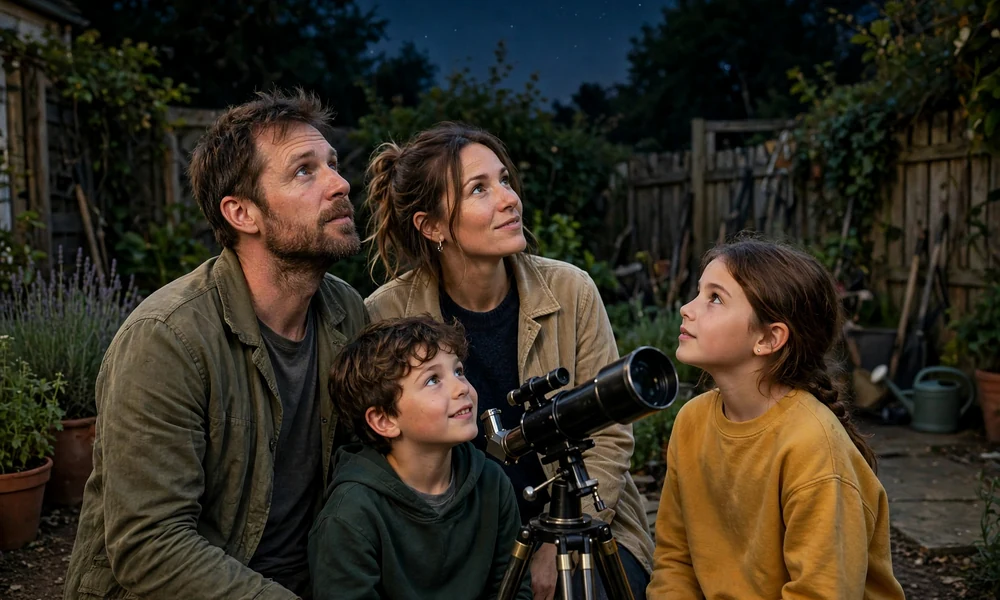
The best telescope for kids is not the cheapest one, and it is not the most powerful one. It is the simplest one a child can set up and aim without an adult standing over them, and the one that shows something impressive on the very first try. That means a short tube, a low mount they can reach, a wide field of view so finding the Moon is easy, and an eyepiece that is comfortable for small eyes.
Kids lose patience quickly with fiddly equipment, so the details matter. A telescope with a red-dot finder is much easier for a child than a tiny finder scope that needs careful alignment, and a mount that moves smoothly by hand is better than one with stiff knobs. Two eyepieces are enough: one low-power eyepiece for finding things, and one higher-power eyepiece for a closer look at the Moon. Keep evenings short and shared, and stop while it is still fun.
Best Budget: The Most Sky for the Least Money
The best budget telescope for beginners in 2026 is the one that spends its price on glass and a solid mount, and on nothing else. That usually means a small Dobsonian or a short refractor with a single good eyepiece, a simple mount, and no electronic gadgets. Go-to computer mounts, motorised tracking, and boxes of coloured filters all sound exciting, but they add cost and complexity, and they do nothing for the view on your first night.
At the budget end, the traps are easy to spot once you know them. A telescope that promises 600x magnification from a 50mm lens is not a bargain; it is a warning. A tripod made of thin plastic will shake so much that the Moon jumps out of view every time you touch the focuser. Buy the largest aperture you can afford in a design you can carry, and add one better eyepiece later if the hobby takes hold.
What to Look for When Choosing
Aperture comes first, because it decides how much light your telescope gathers. Light is everything in astronomy: the Moon is bright enough for almost any telescope, but planets, star clusters, and nebulae are faint, and only a wide lens or mirror can pull them out of the dark. A 70mm telescope gathers far less light than a 150mm one, and the difference is visible in seconds. Choose the widest aperture you can store and carry comfortably, and do not trade it away for a higher magnification number.
The mount comes second, and it is the part beginners most often overlook. A telescope is useless if it will not stay where you point it, and a good mount is solid, smooth, and damped, so the image settles within a second or two after you touch the telescope. Test it in the shop if you can: push the tube gently, let go, and watch how long the shake lasts. A thin tripod with plastic joints usually fails this test. The mount is not an accessory; it is half the telescope.
Eyepieces, setup, and portability decide whether the telescope gets used at all. A low-power eyepiece, around 25mm, gives a wide, bright view that makes finding objects easy, and it is the eyepiece you will use most often. A higher-power eyepiece, around 10mm, gives a closer look at the Moon and planets, and two good eyepieces are better than five poor ones. Think honestly about where you will store the telescope and how far you will carry it: a telescope that needs ten minutes of assembly will be used far less than one that needs one minute.
First Nights, Care, and Mistakes to Avoid
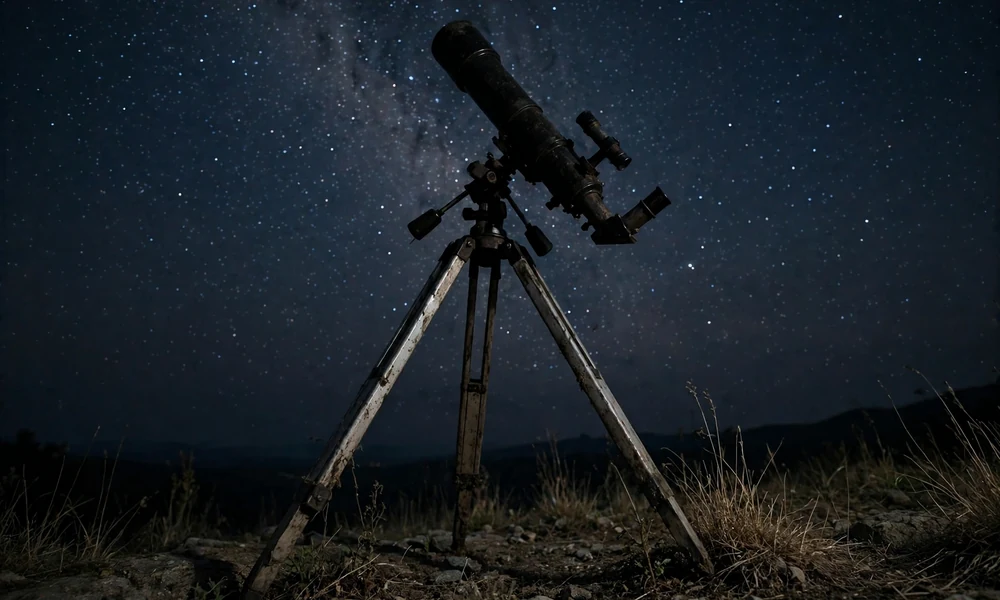
Your first night should be simple. Set the telescope up in daylight first, so you know how the mount moves and how the focuser feels before it is dark. Start with the Moon, because it is bright, easy to find, and spectacular through even a small telescope. Use your lowest-power eyepiece first, find the Moon, centre it, and only then switch to a higher-power eyepiece for a closer look. Then try Jupiter, which is bright enough to find with the naked eye, and look for its four bright moons in a line beside it.
Give your eyes time to adjust to the dark, and give the telescope time to cool down to the outside temperature. A telescope brought straight from a warm house will show a shimmering, unsteady image until its optics match the night air, so set it outside twenty minutes before you plan to observe. Avoid looking over rooftops, where warm air blurs the view, and avoid bright white lights, which ruin your night vision for many minutes. A dim red torch is the one accessory worth owning from the start.
Care is simple but worth doing. Keep the lens caps on when the telescope is not in use, store it somewhere dry, and never clean the lens or mirror with a dry cloth, which can scratch the coating. If dust settles, blow it off gently or leave it alone. The mistakes to avoid are the ones that end hobbies: do not buy on magnification, do not buy a telescope with a flimsy tripod, and do not expect to see the coloured photographs from astronomy books. Never look at the Sun through a telescope without a proper solar filter made for that purpose. If you want to enjoy the sky in daylight as well, a good pair of binoculars for birdwatching is a safer companion.
Closing
A beginner telescope should do one thing well: make the night sky easy to reach. Choose a solid mount, a sensible aperture, and a design you can carry outside without thinking twice, and the Moon, Jupiter, and Saturn will be waiting for you on the first clear night. For a different kind of outdoor gear, our best and worst drones of 2026 weighs the same trade-offs between portability and performance. Start simple, look up often, and let the sky do the rest.