The best pie carriers in 2026 are the ones that treat a finished pie like the fragile thing it is. A pie carrier is a lidded, handled box built to move a whole pie from your kitchen to someone else’s table without sliding, squashing or spilling it.
Key takeaways
- A pie carrier is a transport box, not a baking dish: it needs a locking lid, a handle and a flat base, and it should never go in the oven.
- Measure your pie dish first, including the height of the crust, then buy a carrier with a finger’s width of clearance above it.
- Hard carriers with latching lids protect a pie best in the car; soft carriers are lighter and fold flat, but only work if the base stays rigid.
- A 9-inch round carrier suits most home bakers, while deep-dish and square carriers exist for taller fruit pies and slab pies.
- The lid must clear the top of the pie without touching it, and the base must hold the dish still so the pie cannot slide.
A pie carrier is not a pie dish
The two live in the same cupboard and both hold a pie, but they do opposite jobs. A pie dish is where a pie is baked and served: its material, rim and depth decide how the crust browns, and it goes into a hot oven. A pie carrier never sees the oven. It is a box that a baked pie, still sitting in its dish, travels inside. If you want the baking side first, our guide to the best pie dishes for a golden crust explains how ceramic, glass and metal dishes change the bake.
A pie carrier is not a cake carrier either. A cake is lifted out of its tin and set on a board, so a cake carrier is built around a flat plate and a tall dome that clears frosting. A pie stays in its dish, so a pie carrier is built around the dish itself, with a base that grips the dish and a lid that clears a domed crust. A cake carrier bought for a pie will often be too tall and too loose, letting the dish slide, while a pie carrier bought for a cake will usually be too shallow for the frosting.
What makes a pie carrier work
A good pie carrier is judged on four things, all tested on the journey. The lid must close firmly and stay closed when the carrier is picked up or jolted by a speed bump; latches that click beat lids that simply rest on top. The handle should keep the carrier level,. The base should be flat, rigid and slightly grippy, with a shallow recess that stops the dish from sliding; a base that flexes lets the dish tilt. Finally, the lid must clear the highest point of the pie, whether that is a lattice crust, a meringue peak or whipped cream.
The main types of pie carrier
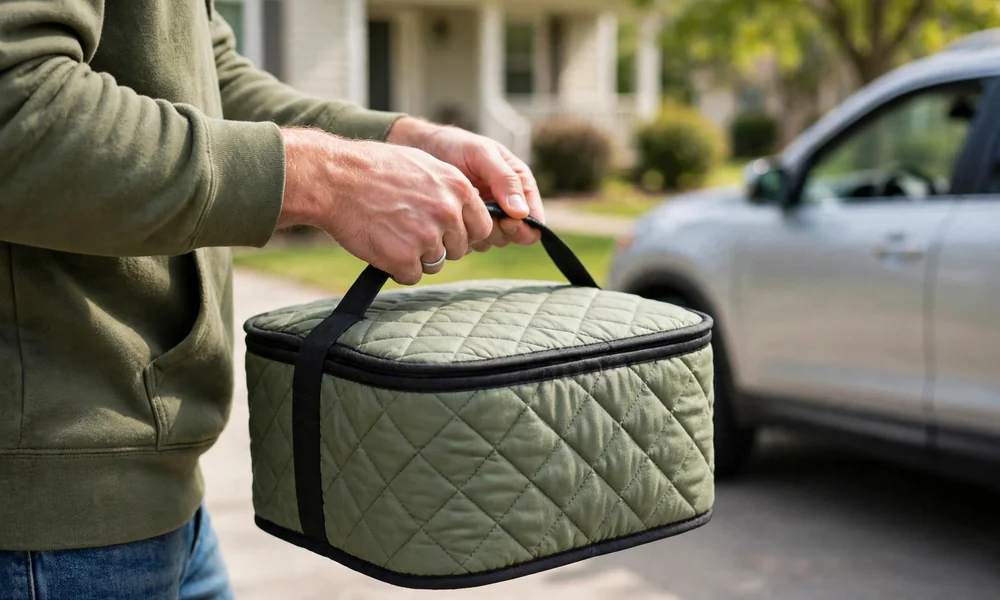
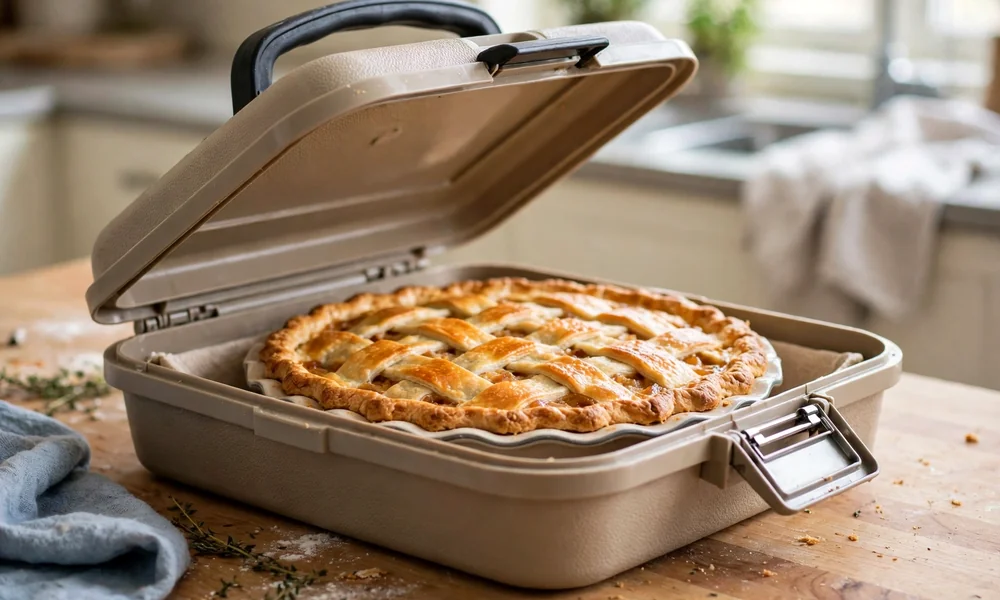
Hard carriers are the most common: a rigid plastic base with a clear or solid lidded dome, latches on the sides and a handle on top. They protect the pie from bumps and from anything stacked on top of it, and a clear lid lets you see the pie without opening the box. Their weakness is storage: a hard carrier is the same size empty as it is full. Soft carriers are fabric boxes with a rigid insert in the base and a zip or flap lid, often insulated. They fold flat when empty and weigh almost nothing, but a soft lid can sag onto a tall pie. Deep-dish carriers are hard carriers with a taller lid and a deeper base, built for fruit pies with a generous filling. Square and slab carriers are built for rectangular pies, which serve more people than round ones, and a round carrier cannot hold a square pie without wasting space and letting it slide.
| Type | Best for | Lid clearance | Weak point |
|---|---|---|---|
| Hard lidded carrier | Everyday round pies, car trips | Good, dome clears lattice | Bulky to store when empty |
| Soft insulated carrier | Flat pies, public transport | Fair, lid can sag | Soft lid may touch a tall pie |
| Deep-dish carrier | Tall fruit pies, deep dishes | Best, extra height built in | Too tall for standard pies |
| Square or slab carrier | Rectangular slab pies | Good, matched to the dish | Useless for a round pie |
| Carrier with serving plate | Arriving and serving in one | Good, plate is the base | Flimsy base flexes when cut |
The best pie carriers of 2026
The strongest pie carriers of 2026 fall into clear groups, and the best choice is the one that matches your dish and your journey.
Best overall: a hard lidded carrier for a 9-inch pie
A hard carrier sized for a standard 9-inch round pie is the best pie carrier for most people in 2026. Look for a rigid base with a shallow recess that holds the dish still, a clear dome lid that clears a lattice crust, latches on at least two sides, and a handle that locks upright.
Best for tall pies: a deep-dish carrier
If you bake deep-dish fruit pies, a standard carrier will press its lid onto the crust, so the deep-dish version is the right buy. It has a taller dome and a deeper base, with the same latches and handle as the standard version, and it fits a 9-inch deep dish with a filling piled above the rim.
Best soft carrier: an insulated carrier with a rigid base
A soft insulated carrier is the best choice if you walk, cycle or take the bus with a pie, because it weighs almost nothing and folds flat when it is empty. The one feature that decides whether it works is the base: it must have a rigid insert that stays flat under the weight of a full dish, or the pie will tilt and the filling will slide to one side.
Best for a crowd: a square slab carrier
A square carrier is the best pie carrier for anyone who bakes slab pies for a crowd, because a rectangular pie in a round carrier wastes space and slides around. The best square carriers have a rectangular base that matches a standard slab dish, a lid that clears the top without touching it, and latches on the long sides so the lid cannot lift at one end.
Best budget: a simple latching carrier without extras
The best budget pie carrier is a simple hard carrier with a latching lid and a handle, and nothing else. You do not need a built-in server, a cutting board in the lid, or a set of matching containers to carry a pie safely,. A plain carrier that does those three things well will outlast a fancy one that does them badly, and it costs about half as much.
How to measure your pie before you buy a carrier
Most pie carrier returns happen for one reason: the carrier does not fit the dish. Measure the diameter of the dish at its widest point, usually the rim, and add a centimetre on each side. Then measure the height from the base of the dish to the highest point of the pie, whether that is the top of a lattice, the peak of a meringue, or the dome of a fruit filling. The carrier’s internal height must be greater than that measurement, not equal to it, because a lid that just touches the pie will mark it. If you bake in a dish with handles, measure across the handles too.
Carrying a pie without ruining it
Even the best carrier cannot save a pie that is carried badly. Let the pie cool completely before you put the lid on, because a warm pie steams inside a closed carrier, and the steam softens the crust and fogs the lid. Set the carrier on a flat surface in the car, ideally the boot floor or the footwell, rather than on a seat, because a seat slopes and a sloping carrier lets the filling slide. When you arrive, carry the box by its handle with your other hand underneath the base, set it down on a flat surface, and lift the lid straight up rather than sliding it.

What to look for when you buy one
Judge a pie carrier the way you will actually use it: packed in the kitchen, carried to the car, driven to someone else’s house, and opened at a table full of people. The lid should latch with a firm click and stay shut when you lift the carrier by the handle and give it a gentle shake. The base should be rigid enough that it does not flex when you pick the carrier up with a full pie inside. If you bake cakes as well as pies, our guide to the best cake pans for even bakes covers the tin the cake comes from, and our guide to cake stands that make bakes look bakery-worthy covers how to present a cake once it arrives.
Checklist: before you buy a pie carrier
- Measure your pie dish at its widest point, including handles, and buy a carrier with room to spare.
- Measure the height of the pie at its highest point and check the lid clears it with room to spare.
- Test the latches: they should click shut and stay shut when you lift the carrier by the handle.
- Check the base is rigid and grippy, so the dish cannot slide or tilt on the journey.
- Make sure the handle locks upright and keeps the carrier level when you carry it.
- Confirm the carrier fits where you will store it, because a hard carrier does not fold flat.
Frequently asked questions
Can I put a pie carrier in the oven?
No. A pie carrier is a transport box, not a baking dish, and it is made of plastic or fabric that will melt or burn in an oven. Bake the pie in its dish, let it cool, and only then put the dish inside the carrier.
What size pie carrier do I need for a 9-inch pie?
A carrier made for a 9-inch pie is the right size for most home bakers, but measure your dish first, because a 9-inch ceramic dish and a 9-inch glass dish are slightly different widths.
Will a pie carrier keep a pie warm?
A carrier keeps a pie covered and still, but it is not an oven and it will not keep a pie hot for long. A pie is best carried at room temperature and served as it is.
Can I carry a cream pie in a pie carrier?
Yes, if the carrier is tall enough to clear the topping without touching it. Cream pies and meringue pies need more lid clearance than fruit pies, so measure the highest point of the topping first.
Is a cake carrier the same as a pie carrier?
No. A cake carrier is built around a flat plate and a tall dome for frosting, while a pie carrier is built around the pie dish itself, with a base that grips the dish and a lid that clears a domed crust.
How do I clean a pie carrier?
Wash the base and lid in warm soapy water and dry them fully before you store the carrier, because a damp carrier will smell.
The bottom line
The best pie carrier is the one that fits your dish, locks shut, and keeps the pie level from your kitchen to the table. A hard lidded carrier for a 9-inch pie suits most bakers, a deep-dish carrier suits tall fruit pies, and a soft carrier with a rigid base suits anyone who walks with a pie. Measure the dish and the height of the pie before you buy, and let the pie cool before you close the lid.