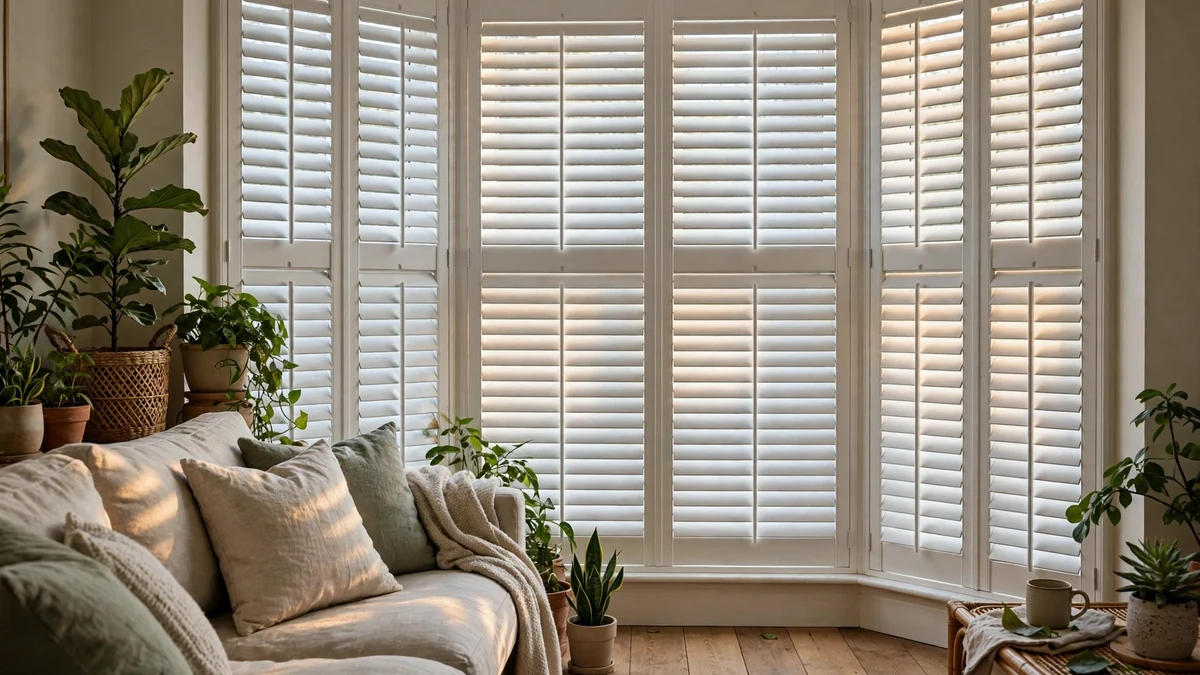
Shutters are the window covering that behaves like furniture. Unlike a blind that rolls away or a curtain that hangs to one side, a shutter stays put, frames the window, and changes the light with a small turn of a rod. The best shutters of 2026 open and close smoothly, hold their angle without sagging, keep a room private without turning it dark, and still look right years after fitting. This guide compares the shutter types that earn their place in a home, from full-height plantation panels to small cafe-style shutters, and explains which material, louvre size and fitting style suits each room.
Our verdict
The best shutters overall are full-height plantation shutters in painted hardwood or high-quality faux wood, with wide louvres and a hidden tilt rod. They suit most living rooms and bedrooms and add a finished, built-in look. For bathrooms and kitchens, faux wood wins because it shrugs off steam and splashes. For a period cottage or a sunny facade, solid exterior shutters are the pick.
1. Full-height plantation shutters
Full-height plantation shutters are the classic choice and the best starting point for most rooms. One tall panel covers the whole window, with louvres that tilt together from a central rod or a hidden mechanism. In a living room they make a wide window feel calm and ordered, and in a bedroom they give complete privacy at night while letting in soft light by day. Wide louvres, around 76 or 89 millimetres, look modern and admit more light than narrow ones. The frame matters as much as the panel: a good frame hides uneven plaster, keeps the panel square, and stops draughts. Look for firm hinges, a tilt rod that moves without sticking, and a smooth finish. If you are weighing lighter dressings, our guide to the best blinds of 2026 compares slimmer options that sit behind or beside shutters.
2. Tier-on-tier shutters
Tier-on-tier shutters split the window into two stacked sections that open independently. The top half can stay open for light while the bottom half stays closed for privacy, which is exactly what a street-facing living room or ground-floor bedroom needs. You can let the sky in and still walk past the window in comfort. The design costs more than a single full-height panel, because there are more panels, hinges and frames, but the flexibility is worth it on a window facing a pavement or a neighbour. The split usually sits near the window catch, and a good fitter lines it up so it looks deliberate. Check that both tiers close flush and that the top tier does not drift open on its own.
3. Cafe-style shutters
Cafe-style shutters cover only the lower half of a window, leaving the top open to the sky. They suit kitchens, dining rooms and street-facing windows where privacy matters at eye level but light is welcome above. A cook can work at the counter without feeling watched, and a dining table stays private while the room keeps its daylight. They are also one of the cheapest shutter styles, because they use less material and fewer panels, which makes them a sensible first step if you are trying shutters in one room before committing to the whole house. The main thing to get right is the height: too low and they do nothing, too high and they block the view. Most fitters set the top rail near eye level from outside.

4. Faux wood shutters for bathrooms and kitchens
Faux wood shutters are made from a dense, moisture-resistant material that looks like painted wood but behaves far better in damp rooms. In a bathroom they survive steam without swelling or warping, and in a kitchen they wipe clean after cooking splashes. That is why they are the best shutter for wet rooms, even though solid wood looks slightly warmer up close. The best faux wood panels feel heavy and rigid, not hollow, and their joints stay tight after years of daily use. Cheaper versions can look plasticky in bright light, so check a sample in daylight before ordering a whole room. Faux wood also suits a conservatory or a south-facing window, because it resists the sun-bleaching that fades a painted finish over time.
5. Solid wood shutters
Solid wood shutters are the premium choice, and the difference is easy to feel. The panels have weight, the grain shows faintly through a stain, and the shutter sounds solid when it closes. Hardwoods such as basswood and poplar are the usual choices: light enough to hang well, stable enough to stay flat, and smooth enough to paint or stain cleanly. Wood suits bedrooms and living rooms where the temperature is steady, and it is the best option for a stained finish that matches wooden furniture or floors. It is not right for a steamy bathroom, and it needs a little more care than faux wood, but in a dry room it lasts for decades. Look for kiln-dried timber, which is far less likely to warp.
6. Exterior louvred shutters
Exterior louvred shutters sit outside the window, hinged to the wall so they can swing open or closed. They shade the glass, cut glare, and give a house a strong, finished face, especially on a cottage, a coastal home or a period property. Fixed louvres let air through while blocking direct sun, and operable louvres tilt like interior shutters. The material matters outdoors: cedar ages gracefully, aluminium stays light and rust-free, and vinyl is the lowest-maintenance option. Whatever the material, the fixings must be solid, because an exterior shutter catches the wind. Check that the hinges are rated for outdoor use and that a stay or latch holds the panels open on a breezy day.
7. Solid panel exterior shutters
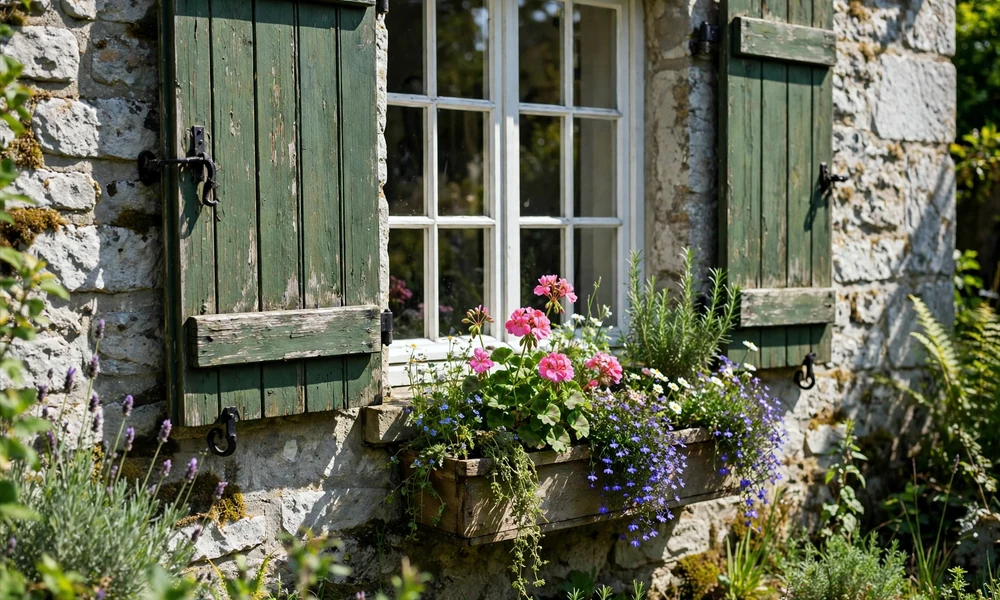
Solid panel exterior shutters, also called board-and-batten shutters, have no louvres at all. They are made from vertical boards held together by horizontal battens, and they close over the window like a door. They suit farmhouses, barns and cottages, and they are the most protective exterior shutter: closed, they shield the glass from wind, rain and flying debris, and they darken a room completely. They are heavier than louvred shutters, so the hinges and wall fixings need to be stronger, and one person should still be able to open and close them without a struggle. Painted in a strong colour, such as deep green, navy or black, they give a plain facade a clear identity.
8. Shutters for bay and shaped windows
Bay windows and shaped windows are where a good shutter maker earns their fee. A bay needs panels that follow the angles of the window, with frames that meet neatly at each corner and hinges that let each section open without catching the next. Arched and circular windows need shaped panels, which cost more but transform a feature window from a problem into a highlight. The key is a careful survey: the fitter should measure every angle, check that the panels clear the window handles, and confirm the frames will sit square on walls that are rarely perfectly straight. A bay fitted with shutters feels more like a room within a room. For softer dressing ideas beside a bay shutter, see our guide to the best curtains of 2026.
How to choose the right shutters
Start with the room. A bathroom or kitchen needs moisture resistance, so faux wood or vinyl is the safe choice. A bedroom needs privacy and darkness, so full-height or tier-on-tier panels with a good close are best. A living room needs light control and looks, so wide louvres and a clean finish matter most. Next, look at the window. A deep recess suits an inside mount, where the shutter sits within the opening for a neat, built-in look. A shallow recess needs an outside mount, where the frame sits on the wall around the window. Measure width and height in three places, because windows are rarely square, and use the smallest measurement.
Materials compared
Wood is the most beautiful and the most expensive, and it suits dry rooms where its warmth can be appreciated. Faux wood is the most practical all-rounder: it looks close to wood, resists moisture and sun, and costs less. Vinyl is the cheapest and easiest to maintain, but it can look plain in a formal room. Aluminium is the best exterior option for a modern house, because it is light, strong and rust-free, though it can feel cold indoors. Whichever material you choose, check the warranty: a good maker stands behind their shutters for at least five years, and many offer ten or more.
Measuring, fitting and care
Good measuring is half the job. Measure the width at the top, middle and bottom, and the height on the left, middle and right, then use the smallest figure for each. Decide between an inside mount and an outside mount before you order, because the frame is different for each. Fitting is straightforward for a confident DIYer on a standard rectangular window, but a bay, an arch or a large panel is a job for a professional. For cleaning, dust the louvres weekly with a dry cloth, working from the top down. For a deeper clean, wipe each louvre with a damp cloth and a little mild soap, then dry it straight away so water does not sit in the joints.
Mistakes to avoid
The most common mistake is ordering the wrong louvre size. Narrow louvres on a large window look fussy and let in less light, while very wide louvres on a small window look out of proportion. The second mistake is ignoring the handles: a shutter that cannot open fully because it hits the window handle is a daily annoyance. The third is choosing wood for a bathroom, where steam will eventually warp it. The fourth is measuring only once, or measuring the frame instead of the opening. If you are comparing window coverings more broadly, a thin film can add privacy without a new fitting, as explained in our guide to the best window film of 2026.

Frequently asked questions
Are shutters better than blinds? Shutters are more durable and more insulating, and they add value to a home, but they cost more and are a permanent fitting. Blinds are cheaper, easier to change, and better for a room where you want a soft fabric look.
Do shutters keep a room warm? Yes, a closed shutter adds insulation and reduces draughts around the window, especially when fitted with a frame that seals the edges. It will not replace proper insulation, but it makes a noticeable difference on a cold night.
Can shutters be fitted on any window? Almost any window can take a shutter, including bays, arches and circles, but shaped windows cost more and need a specialist maker. Very small windows may suit a single panel rather than a pair.
The bottom line
The best shutters are the ones that fit the room, the window and the way you live. Full-height plantation shutters are the safest all-round choice, tier-on-tier shutters are the most flexible for a street-facing room, cafe shutters are the cheapest way to add privacy, and faux wood is the right call for a bathroom or kitchen. Exterior shutters change the look of a house and protect the glass, but they need solid fixings and weatherproof materials. Measure carefully, choose the material for the room rather than the price tag, and buy from a maker who will survey, fit and guarantee the work.


