Best Lawn Spreaders That Feed and Seed Evenly in 2026
A lawn spreader is the tool that decides whether your lawn gets fed evenly or ends up striped like a football pitch. Scatter seed or fertiliser by hand and it lands in clumps: thick green patches beside pale, hungry grass. A good spreader meters the flow, throws it in a steady pattern, and lets you cover a whole lawn in one calm pass. The best lawn spreaders of 2026 do that job without clogging, without tipping over, and without dumping half the hopper in one spot when you turn.
We tested spreaders on family lawns of every size, from small town gardens to long suburban plots, with grass seed, granular fertiliser, and lawn sand. These are the spreaders that earned their place, chosen for even coverage, honest capacity, and build that survives a season of damp granules and rough ground.
Key Takeaways
- Broadcast spreaders cover large lawns fast with a wide fan of granules; drop spreaders place material in a precise strip and suit edges and narrow lawns.
- Even coverage comes from the rate dial and your walking speed together: set the dial to the bag, then walk at a steady pace and overlap each pass by a third.
- Hopper capacity decides how often you stop to refill: a 20-litre hopper covers roughly 500 square metres of fertiliser in one fill.
- Plastic hoppers resist rust from fertiliser salts; steel frames and pneumatic tyres last longer on rough ground.
- Calibrate on a driveway first: spread a measured amount over a known area and check the rate before you touch the lawn.
Lawn Spreaders 2026 at a Glance
| Best for | Spreader type | Capacity | Standout strength |
|---|---|---|---|
| Best overall | Wheeled broadcast | 20 litres | Even fan, big lawns |
| Best drop | Wheeled drop | 15 litres | Precise strip, no waste |
| Best handheld | Handheld crank | 3 litres | Small lawns, tight spots |
| Best for large lawns | Tow-behind broadcast | 45 litres | Covers acres without refills |
| Best budget | Small wheeled broadcast | 12 litres | Cheap, light, simple |
| Best for seed | Wheeled broadcast, fine dial | 20 litres | Gentle rate for light seed |
How We Picked the Best Lawn Spreaders
We judged every spreader on evenness first: one that threw stripes was out, however big its hopper, because stripes are the whole failure. We spread dyed fertiliser on pale grass so the pattern showed, and we checked whether the edges of each pass overlapped cleanly.
1. Best Overall: The Wheeled Broadcast Spreader That Covers Evenly
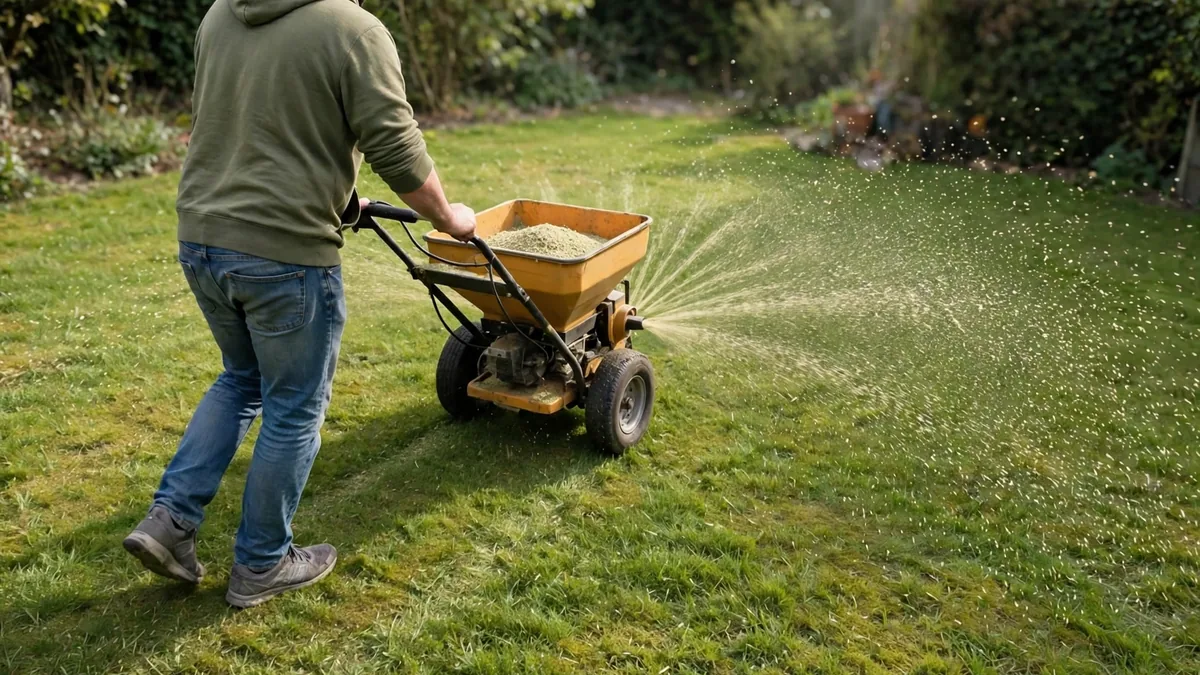
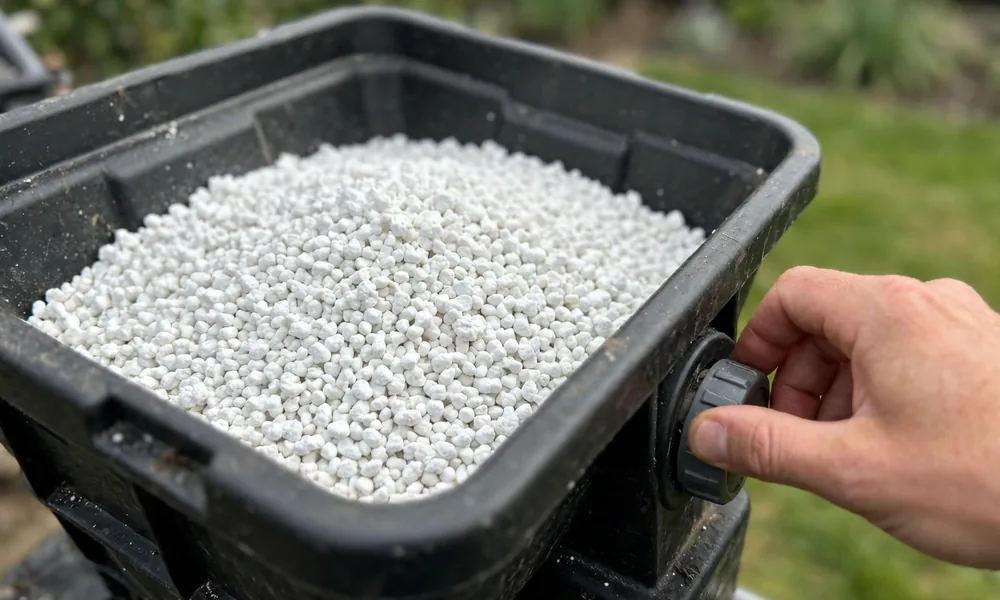
The best overall lawn spreader is a wheeled broadcast model with a 20-litre plastic hopper, a spinning impeller, and a rate dial you can set with one hand. You push it at a steady walking pace and the impeller throws granules in a wide fan, roughly three metres across, so a medium lawn takes ten minutes and one refill at most.
The hopper is big enough for a real lawn without being so heavy that it tips on a slope, and the plastic resists the fertiliser salts that rust a steel hopper from the inside.
2. Best Drop: Precise Lines With No Waste
A drop spreader does not throw granules at all: it drops them straight down through a slot in the base, in a strip exactly as wide as the machine. That precision is its whole point. Along a path, beside a flower bed, or on a narrow strip of lawn, a broadcast spreader wastes half its load on the paving; a drop spreader puts every granule on the grass.
The best drop spreader we found has a 15-litre hopper, a wide slot with an agitator that keeps granules moving, and wheels that turn the feed mechanism as you push, so the flow stops when you stop.
3. Best Handheld: The Crank Spreader for Small Lawns
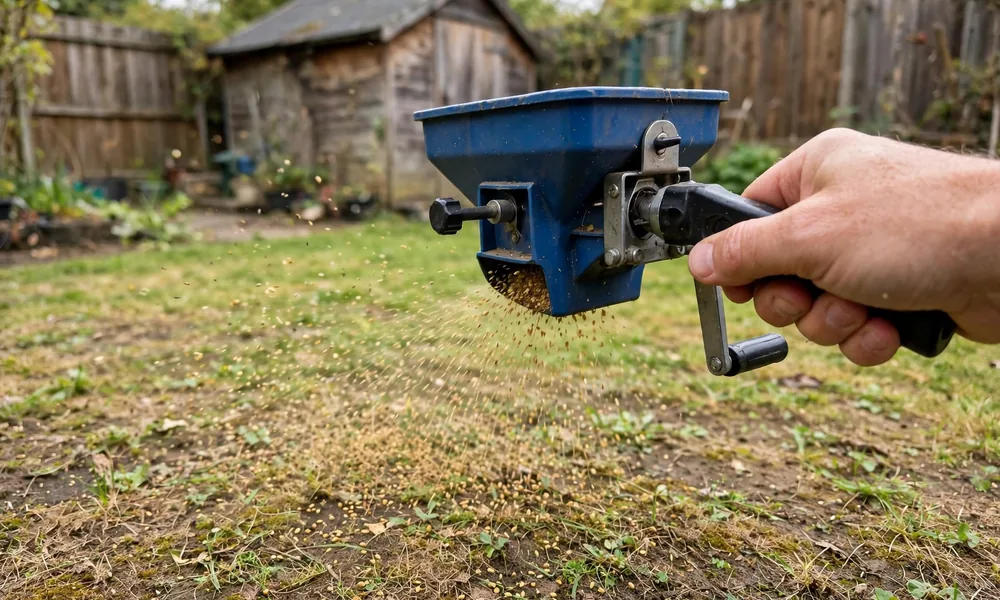
Not every lawn needs a wheeled machine. A handheld crank spreader holds about three litres, hangs from a strap, and throws granules with a small impeller you turn by hand. It suits a small town garden, a front lawn, or the awkward corners a wheeled spreader cannot reach.
The best handheld we found has a comfortable strap, a crank that turns smoothly without jamming, and a dial that actually throttles the flow instead of merely opening or closing it. The hopper is shaped so the last granules fall into the impeller instead of hiding in a corner, and the whole thing weighs under a kilo when empty.
4. Best for Large Lawns: The Tow-Behind Broadcast Spreader
A tow-behind spreader is for lawns measured in acres rather than square metres. It hitches to a ride-on mower or a small tractor, carries 45 litres or more, and throws a fan four or five metres wide, so a big lawn takes a handful of passes.
The best tow-behind we found has a steel frame that does not flex under a full hopper, a hitch that fits a standard tow pin, and a flow gate you can open and shut from the mower seat with a pull cord. The impeller is driven by the wheels, so the spread rate stays tied to your speed, and the hopper has a rain cover for days when the weather turns mid-job.

5. Best Budget: The Small Wheeled Broadcast Spreader
The cheapest spreader worth buying is a small wheeled broadcast model with a 12-litre hopper, a simple impeller, and a rate dial with a handful of settings. It covers a small or medium lawn in a few passes, weighs little enough to carry one-handed to the shed, and costs a fraction of the big machines. The hopper is plastic, the frame is light steel, and there is nothing electronic to fail.
What separates this one from the other budget spreaders is the impeller: it spins true and throws an even fan, where the cheapest models throw a lopsided pattern that stripes the lawn. The wheels are solid rather than pneumatic, so they never go flat, and the shut-off works cleanly at the end of each pass.
6. Best for Seed: The Fine-Dial Broadcast Spreader
Grass seed is light and awkward: it bridges in the hopper, it blows in the wind, and a coarse dial either starves the lawn or dumps seed in clumps. A spreader made for seed has a fine-stepped dial with small increments, an agitator that keeps light seed moving, and a hopper shaped to funnel every last seed into the impeller. The best seed spreader we found is a 20-litre wheeled broadcast model with exactly that combination, plus a deflector shield you can flip down to narrow the fan on windy days.
A lawn aerator used before seeding opens the soil so the seed you spread actually takes root, and the two tools together are the fastest way to thicken a thin lawn.
Broadcast vs Drop: Which Spreader Suits Your Lawn
Broadcast and drop are the two spreader families, and the choice is about your lawn’s shape, not your budget. A broadcast spreader throws granules in a wide fan, so it covers open ground fast: three metres a pass, ten minutes for a medium lawn. The trade-off is drift: near paths, beds, and ponds, some granules land where you do not want them, and on a windy day the fan bends sideways. A drop spreader drops granules straight down in a strip as wide as the machine, so nothing lands on the path and nothing drifts. The trade-off is speed: the strip is narrow, so a big lawn takes many more passes, and any gap between passes shows as a pale stripe.
How to Calibrate a Spreader Before You Start
Calibration sounds fussy, but it takes five minutes and it is the difference between a lawn that greens evenly and one that burns in patches. Start with the bag: every bag of fertiliser or seed prints a spreader setting, usually a number on the dial, and a coverage figure in square metres. Set the dial to the printed number, then check it yourself. Weigh out a kilo of granules, spread it over a measured ten square metres of driveway, and sweep up what is left. If the kilo covered the ten metres evenly, your rate is right; if half the kilo is still in the hopper, open the dial a step; if it ran out halfway, close it a step.
Wind is the other variable. A broadcast spreader on a breezy day throws further downwind than upwind, so spread on a calm morning when you can, and walk into the wind on your first pass so the drift lands on ground you have not covered yet. A lawn edger used after spreading keeps the boundary crisp, and the clean edge makes the even coverage look twice as good.
Spreader Care: Cleaning, Storage, and Rust
Fertiliser is salt, and salt eats metal. The single most important habit is washing the spreader after every use: hose the hopper, the impeller, and the frame, then leave it in the sun to dry before it goes back in the shed. A spreader put away dirty will have a seized dial and a rusted frame by spring, and no amount of oil will bring a corroded impeller back to an even throw.
Before You Buy: Spreader Checklist
- Measure your lawn first: a 12-litre hopper suits a small garden, 20 litres suits a medium lawn, and only a tow-behind suits a very large one.
- Check the rate dial has real numbered steps, not vague marks, and that it moves smoothly with one hand.
- Push it loaded in the shop: the handle should sit at hip height and the wheels should roll without pulling to one side.
- Look for a plastic hopper: it resists fertiliser salts far better than a painted steel one.
- Make sure the shut-off lever sits under your thumb, so you can stop the flow at the end of a pass without stooping.
- Check the hopper empties fully: granules should funnel into the impeller, not hide in corners where they clog.
Frequently Asked Questions
What is the difference between a broadcast spreader and a drop spreader?
A broadcast spreader throws granules in a wide fan with a spinning impeller, covering open ground fast. A drop spreader drops granules straight down in a strip as wide as the machine, which is slower but far more precise near paths and beds.
Can I use the same spreader for seed and fertiliser?
Yes, if the dial has fine enough steps. Seed is light and needs a low, steady rate, so a spreader with a coarse dial will either starve the lawn or dump seed in clumps.
How much should I overlap each pass?
Overlap by about a third of the fan width. A broadcast fan is thinner at its edges, so a third overlap evens the dose across the lawn.
Why is my lawn striped after spreading?
Stripes come from an uneven fan, gaps between passes, or a dial set too low at the edges.
When is the best time to spread fertiliser?
Spring and autumn, when the grass is growing and rain is coming.
How do I clean a spreader after use?
Hose the hopper, impeller, and frame with clean water, then leave it to dry in the sun.
The Bottom Line
Buy a 20-litre wheeled broadcast spreader first, with a plastic hopper, a numbered rate dial, and a thumb shut-off. Calibrate it on a driveway, overlap each pass by a third, and wash it after every use. A grass shears pass along the edges after spreading finishes the job, and a lawn fed this evenly stays thick, green, and free of stripes all season.