A storage box is the simplest piece of organisation in a home, and the one most people buy badly. They buy the wrong size, or a lid that never quite closes, or a box that looks tidy on the shelf and collapses the first time it is lifted by its handles with anything heavy inside. The best storage boxes of 2026 are not the prettiest or the cheapest. They are the ones that hold their shape when they are full, stack safely when they are piled high, open easily with one hand, and still look decent sitting on a shelf in a room people actually live in.
What a Good Storage Box Actually Does
A good box does three jobs at once. It protects what is inside from dust, damp and knocks. It makes a shelf, a cupboard or a garage rack look ordered instead of crowded. And it lets you find something again without emptying everything onto the floor. A box that fails at any one of those jobs is not saving you time. It is just hiding the mess in a more expensive container, and sooner or later you will be digging through it exactly as you dug through the pile it replaced.
How to Choose: The Six Things That Matter Most
Start with size, and measure before you shop. Measure the shelf, the cupboard or the space under the bed, then measure the things going inside. A box that is two centimetres too wide for a shelf is useless, however good it is in every other way. As a rough guide, a box of 30 to 40 litres suits clothes, toys and general household clutter. A box of 60 to 80 litres suits bedding, bulky coats and seasonal gear. Anything larger than 80 litres gets very heavy when full, and is best kept on the floor or on a low rack rather than lifted onto a high shelf.
Next, check the lid. A lid should close with a clear click or a snug friction fit, and it should stay closed when the box is tipped on its side. Hinged lids are convenient because they cannot be lost, but they can snap at the hinge if they are forced. Separate snap-on lids are sturdier and stack more neatly, though they can wander off to another room. If you are storing anything that dust or damp could damage, look for a lid with a foam or rubber seal around its edge. Our guide to the best storage bins of 2026 looks at lidded bins in detail, and the same lid test applies there: close it, tip the box, and see whether it stays shut.
Fourth, think about stacking. A box that is meant to stack should have a rim or a recessed lid that locks the box above it in place. Flat lids stack better than domed ones, and boxes of the same size and brand stack far better than a mixed collection. Never stack a heavy box on top of a lighter one, and never stack higher than you can safely reach. A stack that leans is a stack that will fall, usually onto the thing you were trying to protect.
Finally, decide whether you want to see inside. Clear or smoked-transparent boxes let you find things without opening them, which is a real advantage in a garage or a loft. Opaque boxes look calmer on an open shelf and hide the clutter completely, which matters in a living room or a bedroom. A good compromise is an opaque box with a clear window or a label holder on the front. Whatever you choose, keep it consistent across a shelf: a row of matching boxes always looks tidier than a row of different ones.
The Main Types, and Where Each One Works Best
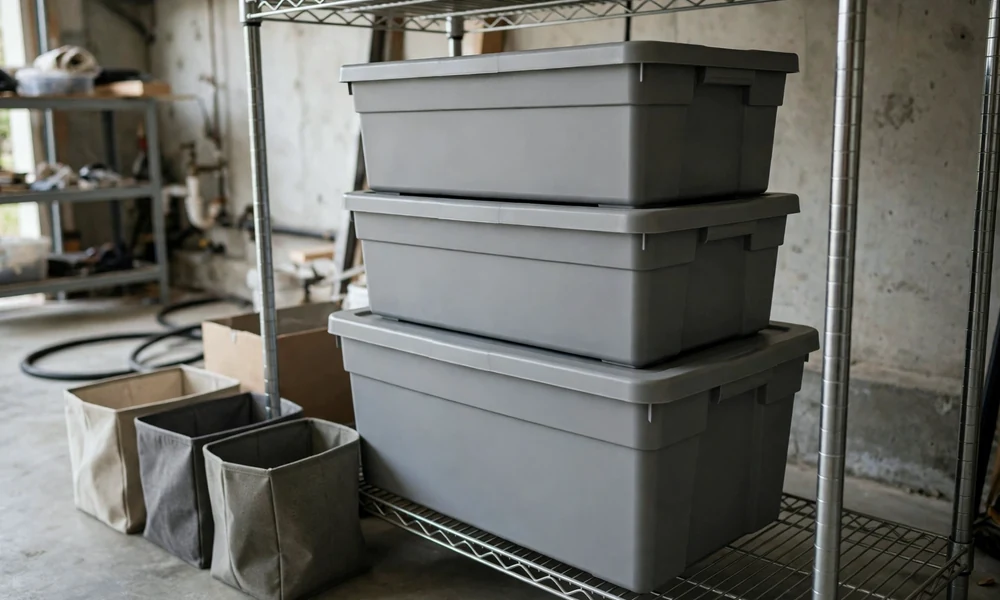
Plastic lidded boxes are the workhorses. They are cheap, tough, easy to wipe clean, and available in every size from a shoebox to a chest. They suit garages, lofts, sheds and anywhere damp or dust is a worry. Their weakness is looks: a stack of grey plastic tubs will never be beautiful, so they are best kept behind a cupboard door or on a rack rather than on display in a living room.
Under-bed boxes are the specialists of the household. They are low, long and wide, made to slide into the wasted space beneath a bed, and they are the easiest way to store out-of-season clothes, spare bedding and shoes without buying new furniture. If you are planning a bedroom clear-out, our guide to the best under-bed storage of 2026 covers the low boxes, bags and drawers that fit that space, and how much clearance your bed frame actually gives you.
Stacking cubes and open-front boxes suit the things you reach for every day. An open front means you can pull out a jumper or a toy without lifting a lid or unstacking a tower, which is why cubes work so well in children’s rooms, hallways and home offices. Their trade-off is dust: anything in an open box will need a wipe now and then, so they suit clean indoor rooms rather than garages and lofts.
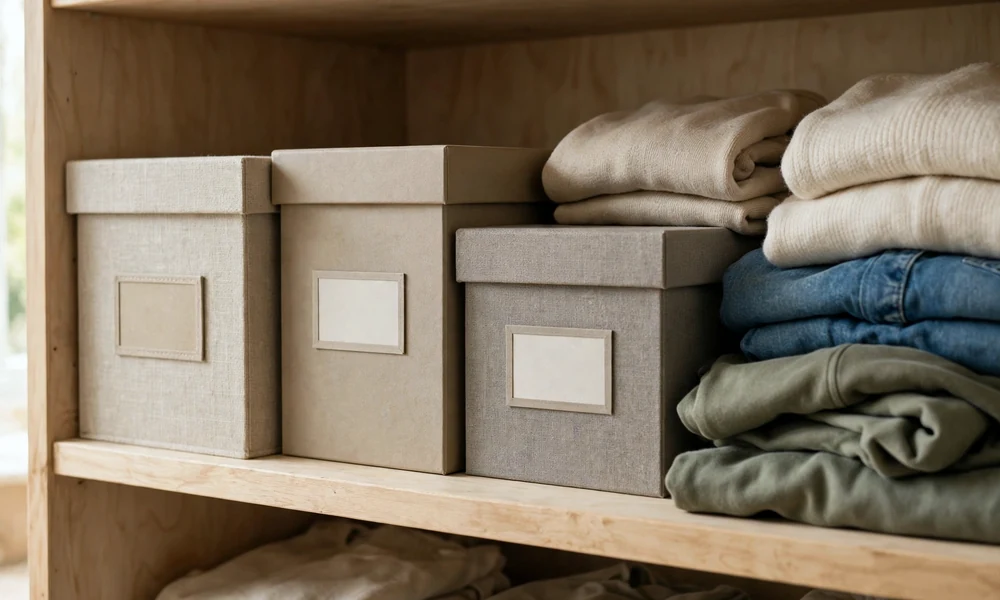
Decorative boxes are the ones that sit on display: woven seagrass, wood, or sturdy card covered in fabric. They are the right choice for a living room shelf, a hallway console or a bedside table, where the box itself is part of the room. They are not the right choice for heavy or damp storage, and their price reflects their looks rather than their toughness. Our guide to the best storage baskets of 2026 covers the woven end of this family, which overlaps with decorative boxes wherever a basket does the job better than a lidded box.
Materials Compared
Fabric boxes trade toughness for looks and lightness. Cotton canvas, linen-look polyester and felt all fold flat for storage, which is a real advantage in a small home where empty boxes are themselves clutter. Their weakness is structure: without a stiffened frame they slump, and without a wipe-clean lining they stain. A good fabric box has a rigid insert in the base and walls, a lining you can sponge clean, and stitching that holds when the box is full.
Metal boxes are the toughest of all, and the least common in a home. A steel or aluminium box with a latch will protect its contents from knocks, pests and water far better than anything else, which is why metal suits tools, archives and anything stored in an outbuilding. The price is weight and noise: a metal box is heavy when empty and loud when its lid drops, and it can rust if its coating is chipped. For most household storage, metal is more than you need.
Stacking, Labelling and Finding Things Again
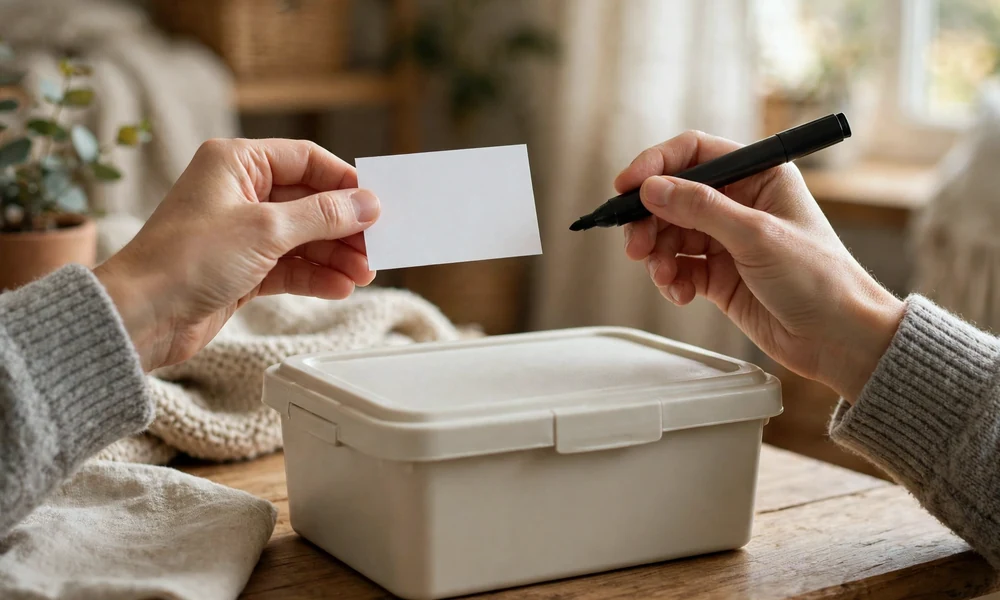
A storage system fails when you cannot find anything in it. Label every box on the front, not on the top, because the front is what you see when boxes are stacked on a shelf. Write what is inside in plain words, and add a date if the contents are seasonal. A label that says winter coats 2025 is useful in a way that a label saying miscellaneous never will be. Keep the labels consistent, and replace them when the contents change instead of adding a second label underneath the first.
What to Avoid When Buying Storage Boxes
Avoid boxes with no lid when you need one, and boxes with a lid you will never use. An open box in a dusty loft will fill with dust, and a lidded box for everyday toys will have its lid left on the floor within a week. Match the box to the job: lids for storage you leave alone, open fronts for storage you use every day. A box bought for the wrong job is a box you will stop using.
Avoid buying one of everything. A shelf of mixed sizes, colours and brands looks messy and stacks badly, and you will waste time working out which lid fits which box. Pick one size and one style for each job, buy enough of them to finish the shelf, and keep one spare of each size for the things you forgot. The tidy homes in photographs are almost always tidy because the boxes match, not because the contents are special. Specialist boxes built for a single job, like a tackle tray or a jewellery case, are a different purchase entirely and should not be counted as general storage.
Setting Up a System That Stays Tidy
Start with one shelf or one cupboard, not the whole house. Empty it completely, sort everything into keep, move elsewhere, and let go, and only then measure the space and buy boxes for what is left. Buying boxes first and sorting second is how people end up with a cupboard full of empty boxes and the same pile of things on the floor. One finished shelf teaches you more about what you need than a trolley full of hopeful purchases.
Then keep the system simple enough to maintain. If putting something away takes more than a few seconds, it will not happen. A box with a lid that needs two hands, a label that needs updating and a stack that needs rebuilding every time you open it is a system that will collapse within a month. The best storage system is the boring one: matching boxes, plain labels, and a place for everything that is easy enough for everyone in the house to use.
Frequently Asked Questions
How many storage boxes do I need? Fewer than you think. Start by sorting what you own, then buy boxes for what is left. Most households find that six to ten medium boxes clear a whole room, and buying more than that usually means you are storing things you could let go of instead.
Are clear boxes better than opaque ones? Clear boxes are better where you need to find things fast, like a garage or a craft room. Opaque boxes are better where the box is on display, like a living room or a bedroom, because they hide the clutter completely. A clear window or a good label gives you most of the benefit of both.
Can storage boxes go in a damp garage? Plastic boxes with sealed lids can, and fabric or card boxes should not. Keep boxes off a concrete floor on a low rack or a pallet, leave a gap for air to move, and check the contents after the first wet winter. If anything smells musty, the box is not sealing well enough for that room.
What size storage box is best for clothes? A box of 30 to 40 litres holds a season of folded clothes for one person, and a box of 60 to 80 litres holds bedding or bulky winter coats. Fold clothes flat rather than rolling them if the box is deep, and do not overfill it: a lid that will not close is a box that is not protecting anything.
The best storage box is the one that fits your shelf, holds its shape when it is full, and lets you find what you put in it a month later without a search. Measure first, buy matching boxes, label the front, and keep the heaviest boxes low. Do that, and the boxes will quietly do their job for years, which is exactly what a good storage box is for.