
The violin is a small instrument with an outsized voice. Four strings, a carved wooden body and a horsehair bow are all it takes to fill a concert hall, yet the same instrument sits comfortably in a school music room, a living room or a bedroom where a beginner is working through their first scale. Choosing the right violin matters more than it does with most instruments, because a violin that fights you will slow your progress, while one that fits your hands and your ear will make practice something you look forward to.
This guide covers the best violins of 2026 for every kind of player: complete beginners who need a ready-to-play outfit, students moving up from a rental, advancing players who want a warmer and more responsive tone, adults returning to the instrument after years away, and parents buying a first fractional-size violin for a child. Every recommendation below is judged on the things that actually shape your playing: tone, playability, build quality, the accessories included, and honest value for money.
What to look for in a violin
Start with the wood. A good violin top is made from solid spruce, because spruce is light and stiff and lets the soundboard vibrate freely, while the back, ribs and neck should be solid maple. Laminated wood, which is pressed layers glued together, is cheaper and tougher, but it sounds dull and does not improve with age. If a listing does not say solid spruce and solid maple, treat that silence as an answer. The varnish matters too: a thin, flexible varnish lets the wood breathe, while a thick glossy coat can choke the tone, so look for a warm amber or reddish-brown finish that shows the grain underneath.
Next, check the fittings. The fingerboard, tailpiece, chin rest and pegs should be ebony, which is dense, smooth and hard-wearing. Cheaper outfits use stained softwood or plastic, and those parts wear quickly, slip out of tune and feel rough under the fingers. Fine tuners on the tailpiece are almost essential for beginners, because they let you make small pitch adjustments without wrestling with the pegs. A well-fitted bridge, carved to the right height and curve, is equally important: too high and the strings feel like wire, too low and they buzz against the fingerboard.
The best violins of 2026
The violins below are organised by who they suit best, not by price alone. A beginner does not need the most expensive instrument on this page, and an advancing player will be held back by a cheap outfit, however good its reviews look. Work out which group you belong to, read the pick for that group, and use the rest of the guide to check sizes, strings and care.
Best student violin
The best student violin is a full-size acoustic instrument with a solid spruce top, a solid maple back, ebony fittings and four fine tuners, sold as a complete outfit with a decent bow and a protective case. This is the violin for a player who has been learning for a year or two and has outgrown a rental or a very cheap starter, and it should last through several years of lessons, school orchestra and grade exams without needing to be replaced.
What sets a good student violin apart is setup. Two violins from the same workshop can feel completely different depending on how the bridge is cut, how the soundpost is placed and how the strings are fitted, so buy from a seller who sets the instrument up before dispatch and offers an exchange if the setup is wrong. Expect to pay a mid-range price for this class of violin, and be suspicious of anything far below it: at very low prices the savings come from laminated wood, plastic fittings and a bow that will need replacing within months.
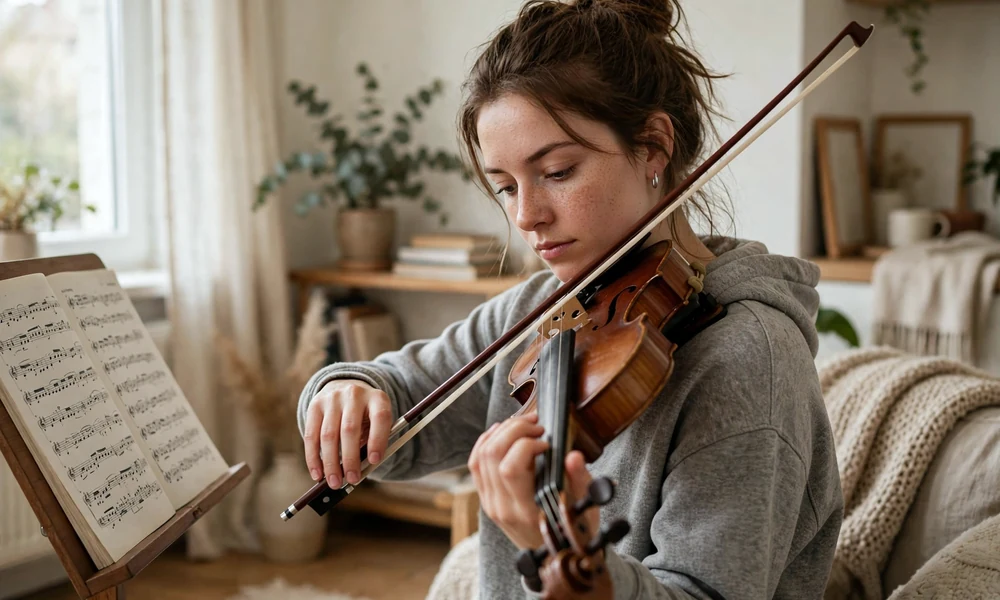
Best beginner violin outfit
A beginner outfit should remove every obstacle between you and your first tune. Look for a package that includes the violin, a straight and balanced bow, a shaped case, rosin and a spare set of strings, all ready to play out of the box. The violin itself should be full size for an adult or older teenager, or a fractional size for a younger player, and it should arrive tuned close enough to pitch that a teacher can finish the job in a minute.
Beginners should not spend a fortune, but they should also avoid the very cheapest outfits, which are often unplayable. The warning signs are a bridge that arrives loose in the case, pegs that will not hold, strings that feel like cheese wire, and a bow that bends sideways when you tighten it. A sensible beginner outfit costs more than a takeaway dinner for a family, yet far less than a term of lessons, and it should survive being carried to school every week. Playing along with backing tracks is a great way to build rhythm early on, and a pair of comfortable earbuds lets a beginner practise with play-along recordings without disturbing the rest of the house.
Best step-up violin for advancing players
A step-up violin is for the player who can hear the difference. You are playing pieces with shifting, vibrato and double stops, and your current instrument sounds thin when you push it or muddy when you play quietly. The right step-up violin gives you a wider dynamic range, a warmer tone in the lower register and a clearer, singing voice on the E string, and it responds to subtle changes in bow speed and pressure instead of flattening them out.
At this level, hand-carved instruments with carefully graduated plates make a real difference, and it is worth trying several violins side by side rather than ordering blind. Bring your own bow and play the same passage on each one, listening for evenness across all four strings and for a tone that stays sweet when you play loudly. A good step-up violin is a serious purchase, but it is also the instrument you may keep for a decade, and a good violin holds its value far better than a cheap one. Recording yourself is the fastest way to hear what an audience hears, and a simple microphone is enough to capture your practice sessions honestly.

Best electric violin
An electric violin is a different tool for a different job. With no hollow body to resonate, it makes almost no sound on its own, and its voice comes from a pickup and an amplifier or headphones. That makes it ideal for late-night practice in a flat, for players who perform with a band, and for anyone who wants to explore effects and looping without disturbing the neighbours.
When choosing an electric violin, look for a solid body with a comfortable chin rest and shoulder rest, a good pickup that captures the full range of the strings without harshness, and a standard output you can plug into an amplifier, an audio interface or a practice amp. Many players use one for silent practice and keep an acoustic violin for lessons and orchestras, which is a sensible split. For quiet sessions, a good pair of headphones turns an electric violin into a private practice room, letting you hear every detail of your bowing and intonation without a sound escaping into the house.
Best violin for young children
Children do not play full-size violins. A violin that is too big forces a child to stretch, hold their arm at a painful angle and develop bad habits that take years to undo, so size comes before everything else. Fractional sizes run from 1/16 for the smallest children through 1/8, 1/4, 1/2 and 3/4 up to a full 4/4, and the right size is the largest one the child can hold comfortably with the scroll resting in the palm of the outstretched left hand.
For a first violin, choose a fractional outfit with the same standards as an adult beginner violin: solid spruce top, ebony fittings, fine tuners and a bow of the matching size. Children grow quickly, so many families rent fractional violins and exchange them as the child grows, which is sensible, but a bought fractional violin in good condition keeps a reasonable resale value. The most important thing is that the child enjoys picking it up, so let them choose between two or three sizes with a teacher present and never buy a size to grow into.

Violin sizes, explained
Violin sizes are measured by body length, not by the age of the player, and the only reliable way to choose is to measure the player. Have the player stand with their left arm stretched out to the side, palm facing up, and measure from the neck to the middle of the palm: that length points to the right size, with a teacher confirming the choice. Arm length varies widely between children of the same age, so age charts are a rough guide at best and should never replace a physical check.
Acoustic or electric: which should you buy?
Most players should buy an acoustic violin first. It teaches you to produce tone with the bow, to listen to the instrument’s natural voice and to play with other people without any equipment, and every teacher, orchestra and exam board expects one. An acoustic violin is also the instrument you will use for lessons, ensembles and performances, so it is the natural starting point for beginners, students and advancing players alike.
Care, strings and accessories
A violin is a living piece of wood, and it needs simple, regular care. Wipe rosin dust from the strings and body with a soft cloth after every practice session, because rosin left on the varnish builds into a sticky layer that dulls the sound. Keep the violin in its case when you are not playing, away from radiators, damp rooms and hot cars, and loosen the bow hair after playing so the stick does not warp over time. Never leave a violin in a car, even for an hour, because heat and cold can open seams and crack the wood.
Strings wear out, and fresh strings are the cheapest upgrade a violin can have. Beginners can change strings every few months, while players who practise daily will notice a difference after six to eight weeks. A shoulder rest is worth buying early, because it holds the violin at a comfortable height and stops the neck and shoulder pain that puts many beginners off. Rosin, a spare set of strings, a cleaning cloth and a music stand complete a sensible kit, and none of them needs to be expensive. A teacher can show you how to change a string safely the first time, and after that it is a five-minute job.
Verdict
The best violin of 2026 is the one that fits the player in front of it: a solid-wood beginner outfit for a new starter, a well set-up student violin for a player moving up, a responsive step-up instrument for an advancing musician, a fractional size for a child, and an electric violin for silent practice or the stage. Spend your money on solid spruce and maple, ebony fittings, a straight bow and a proper setup, and the violin you choose will reward every hour you put into it.


