
A walking pad is a slim, flat treadmill with no handrails and no tall console, built for walking rather than running. It slides under a standing desk, hums quietly while you answer emails, and then tucks under a sofa or against a wall when the working day ends. Yet the differences between a good one and a bad one show up fast: a belt too short for your stride, a motor that whines as you speed up, or a deck that shakes the floor. The best walking pads of 2026 disappear into your routine, adding thousands of steps to an ordinary day without demanding a spare room.

What Makes a Walking Pad Good
The first thing to judge is the belt. A walking pad belt is shorter and narrower than a full treadmill belt, and that is the whole point, but it still has to fit the person walking on it. As a rough guide, a belt around 110 centimetres long and 42 centimetres wide suits most walkers, while taller people, or anyone with a long stride, should look for 120 centimetres or more. A belt that is too short forces short, shuffling steps, which feels awkward within minutes and is hard on the knees over weeks. Width matters just as much: a narrow belt makes you watch your feet instead of your work, and that defeats the purpose of walking while you work.
The second thing is the motor, and here quiet matters more than power. Most walking pads use a motor between 1.5 and 2.5 horsepower, and that is plenty for walking speeds, but the number on the box is less important than how the motor behaves. A good motor holds a steady pace without surging or whining, starts smoothly instead of jerking, and stays quiet enough that a video call does not notice it. Listen at your real walking speed, not at the slowest setting, and remember that a motor working near its limit will always be louder and shorter-lived than a motor with room to spare. Weight limit is the honest clue: a pad rated well above your weight will run more quietly than one rated just at it.
The Main Types of Walking Pad
Flat under-desk pads are the classic choice and the best choice for most people. They have no handrails, no folding deck, and often no display at all beyond a small readout or a remote control, and they are built to sit under a standing desk at walking pace. They suit anyone who wants more steps during the working day, and they are the easiest to store, since they are already flat. The trade-off is speed: most top out at a brisk walk, around six kilometres an hour, so they are not running machines and should not be bought as one.
Folding walking pads are the flexible option. They fold in half, so they take up less floor when stored and are easier to carry from room to room, and they are the best choice for a small flat or a shared house where the pad has to disappear completely. They suit a spare bedroom or a living room corner, and they are often the lightest pads on the market. The downside is the join: a folding deck can feel slightly less solid underfoot than a one-piece deck, so check that the hinge locks firmly and that the belt stays centred after folding and unfolding.
Best Overall
This is the pick for most people because it gets the balance right. The belt is 120 by 45 centimetres, long enough for a natural stride and wide enough that you stop thinking about your feet, and the 2.25 HP motor holds a steady pace from a slow stroll to a brisk walk without the whine cheaper motors make when they work hard. The deck is slim enough to slide under a standing desk and light enough to move with one hand, and it folds flat for storage under a sofa. The remote is simple, with direct speed keys and a clear display, and the cushioning is firm rather than bouncy, which suits both socked feet and trainers. It is the pad most likely to still be used in a year, and that is the real test of any walking pad.
Best for Desk Work
A desk pad has one job above all others: to be quiet enough that nobody on a call notices it. This one is the quietest at desk-walking speeds, with a 1.75 HP motor that hums rather than roars and a belt that runs smoothly without slap. At 110 by 42 centimetres it fits under most standing desks, and the remote control means you never have to bend down or step off to change speed. It tops out at a brisk walk, which is exactly right for working, since anything faster makes typing a chore. The display is minimal, showing speed, time, and distance, and there is nothing to learn. For anyone whose main goal is steps during the working day, this is the pad to buy.

Best for Taller Walkers
Tall walkers should not buy a short-belt pad and hope for the best. This pick has a 130 by 48 centimetre belt, so a full stride fits without shortening your step, and a 2.5 HP motor that holds speed smoothly even for heavier walkers. The deck cushioning is tuned for repeated impact, the frame does not rock, and the belt does not slip when you change pace. It is larger and heavier than the desk pads, and it needs a dedicated corner rather than a gap under a sofa, but for anyone over six feet, or anyone who finds standard pads cramped, it is the only pick that feels right. Check the weight limit and the belt length first, and everything else second.
Best Budget Pad
A budget walking pad should do the basics well and skip the rest, and this one does. It has a 110 by 42 centimetre belt, a 1.75 HP motor, and a straightforward remote with speed, time, distance, and calories, and little else. It runs quietly at walking pace, feels stable underfoot, and costs far less than the premium picks while still being a proper walking pad rather than a toy. The limits are honest: a shorter belt, no incline, and a manual approach to everything. Spend the money you save on a good mat and proper footwear, and this pad will serve a first-time buyer very well indeed.
Walking Pad or Full Treadmill?
It also helps to know where a walking pad ends and a full treadmill begins. A walking pad has no handrails, a short belt, and a low top speed, and it is built for gentle daily movement. A full treadmill has handrails, a long belt, a stronger motor, and room to run, and it is built for training. If you want to run, train for a race, or use incline workouts, you need a full treadmill, and our guide to the best treadmills of 2026 compares the machines that do that job properly. If you want steps while you work and a machine that disappears when you are done, a walking pad is the better buy, and it costs less too.
Setting Up Under a Desk
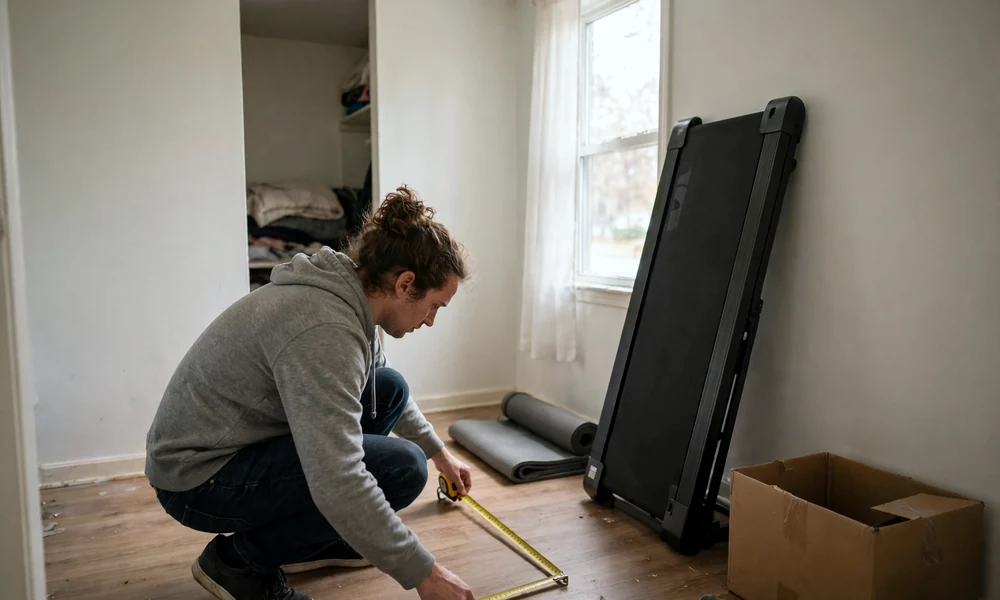
Setting up a walking pad under a desk is simple, but three measurements decide whether it works. First, the desk itself: a standing desk needs to rise high enough that your elbows sit comfortably while you walk, and most people need the desk a little higher than they expect, since walking lifts your shoulders. Second, the floor space: allow the length of the pad plus room to step on and off safely at the back, and a little room at the sides, so you are never boxed in. Third, the storage spot: measure the gap under the sofa or bed before the pad arrives, not after, and measure the route it will take to get there, including doorways and tight corners.
Footwear matters more than people expect. Bare feet work on a clean belt for short sessions, socks are fine for gentle walking, and trainers are best for longer sessions, since they cushion the impact and keep your feet comfortable. Whatever you wear, keep it clean, because grit on the belt wears it out and makes it noisy. A mat under the pad is worth having on any floor: it damps vibration, protects wood from scuffs, and stops the pad creeping across the floor. And if you are building a proper walking setup, the right shoes make a real difference to comfort over an hour, so our guide to the best walking shoes of 2026 is worth a read before you settle into a daily routine.
Tracking Your Walking
Tracking helps, because a walking pad makes it easy to forget how much you have done. Two hours of slow desk walking across a working day can add several thousand steps without a dedicated workout. Start slowly, though: twenty minutes at a gentle pace for the first week, then add time as your legs adjust, keeping the speed low enough to type and talk normally. A step count turns a vague habit into a visible one, and visible habits stick. Our guide to the best fitness trackers of 2026 covers the watches and bands that count steps, distance, and active minutes without getting in the way.
Walking Pad Mistakes to Avoid
The most common mistake is buying for the fastest walk you might do one day, instead of the slow walking you will actually do every day. A pad bought for jogging that is used for desk walking is louder, larger, and more expensive than it needed to be, so buy for your real routine. The second mistake is skipping the measuring tape: a pad that does not fit under the desk, or under the sofa, is a pad that owns the room. The third is ignoring maintenance, since ten minutes a month keeps a good pad quiet for years, and the fourth is walking too fast while working, which wrecks your typing and your posture.
Walking Pad Questions, Answered
Can you run on a walking pad? Most walking pads are not built for running, and you should not try. They have short belts, no handrails, and motors sized for walking, so running on one is uncomfortable and can damage the motor. Can you use a walking pad on carpet? Yes, but a mat helps: it stops the pad sinking unevenly, which keeps the belt running true, and it damps vibration. Is a walking pad good for weight loss? It helps, because it adds gentle daily movement, but it is not a shortcut, and it works best alongside sensible eating and other exercise. Do walking pads need much maintenance? Very little: keep the belt clean, lubricate it as the manual suggests, and check that the belt stays centred.
The Bottom Line
The best walking pad in 2026 is the one that fits your stride, your desk, and your home, and gets used every day. For most people, that means a quiet pad with a belt around 120 by 45 centimetres, a motor with room to spare, and a shape that slides away when the day ends. Measure first, buy for the walking you will actually do, and choose quiet over speed. Do that, and a walking pad will quietly add thousands of steps to days that used to be spent sitting still.


