
A work light is the tool you reach for when the light in the room is not enough. It is the bright, portable lamp that turns a dark garage corner, a cupboard, a loft, or the underside of a car into a place where you can actually see what you are doing. A good work light does not just make things brighter. It puts the light exactly where your hands are, stays where you put it, and keeps shining for as long as the job takes. A bad one does the opposite. It glares into your eyes, falls over at the worst moment, runs out of charge halfway through, and leaves you working by feel instead of by sight. The best work lights of 2026 are the ones that are bright, tough, easy to move, and simple to use, whether you are fixing something at home, working in a workshop, or tackling a job outside after dark.

What Makes a Work Light Good
The first thing to judge is brightness, and brightness alone is not enough. A work light needs to be bright enough to show fine detail, such as a small screw, a wire colour, or a crack in a surface, without washing everything out in a harsh white glare. Look for a light that spreads its beam evenly across the area you are working on, rather than throwing a narrow spotlight into the middle and leaving the edges in darkness. An even spread means you can see the whole job at once, move your hands without casting a sharp shadow over the exact spot you need, and work for longer without eye strain. A light with more than one brightness setting is usually the most useful, because a close-up repair needs less light than a whole room, and a lower setting also saves battery.
The Main Types of Work Light
Handheld work lights are the simplest type. They look like a large torch or a small lantern, with a handle you can carry, hang, or prop up. They are light enough to carry around a house or a garden, and they are ideal for quick jobs, such as looking inside a cupboard, checking a pipe under a sink, or finding something in a dark loft. Many handheld lights have a magnetic base or a hook on the back, so you can stick one to a metal surface or hang it from a nail and work hands-free. Their weakness is that they are small, so they cannot light a whole room on their own, and they need to be held or hung in the right place to be useful.
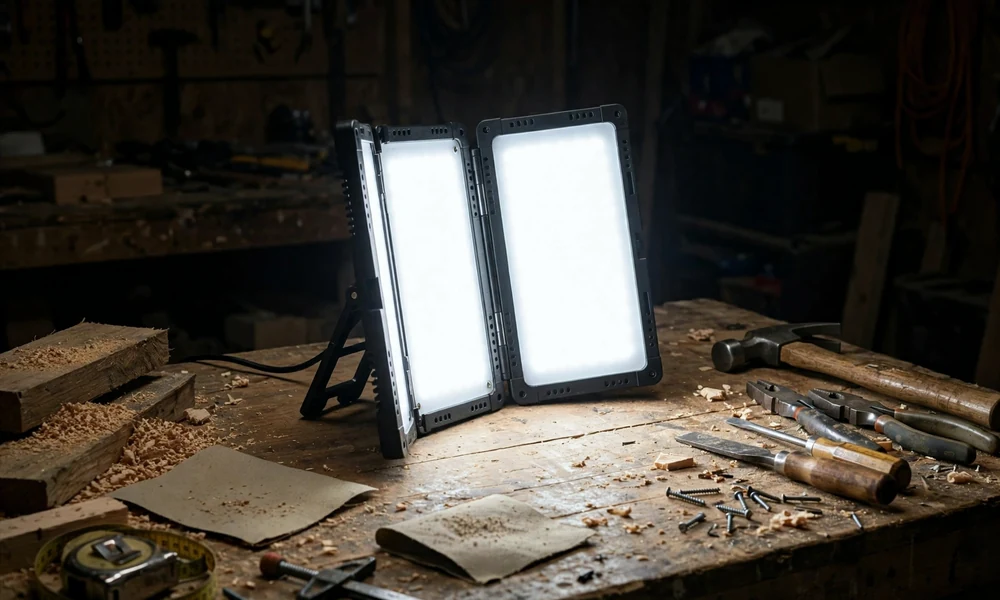
Folding panel lights are the most versatile type for a workshop or a garage. They open out like a small book or a flat panel, with a wide face of light that covers a large area evenly. Some fold flat for storage and open to stand on a bench, while others have a handle and a stand that lets you angle the panel exactly where you need it. The wide beam is excellent for painting, sanding, assembling furniture, or any job where you need to see a whole surface at once. They are larger and heavier than a handheld light, so they are less handy for carrying around, but for a fixed workspace they are hard to beat.
Tripod work lights are built for big jobs and large spaces. The light sits on top of a tall, adjustable tripod, so it can shine down over a whole room, a driveway, or a building site from above. Many tripod lights have two heads that can be aimed in different directions, and some can be taken off the tripod and used on their own. They are the best choice when you need to light a whole area for hours, such as decorating a room, working on a car outside, or doing repairs in a garage with no ceiling light. They take up more space and take longer to set up, so they are not the right pick for a five-minute job, but for a long evening of work they are worth the effort.
Magnetic and clamp work lights are made for tight, awkward places. A magnetic light sticks to a car bonnet, a metal shelf, or a steel beam and stays there while you work underneath it. A clamp light grips onto a shelf edge, a ladder rung, or a workbench and points its beam into a corner that no standing light can reach. These lights are usually smaller and lighter than panel or tripod lights, and they are at their best when the job is in a place that is hard to reach. If you spend a lot of time fixing cars, appliances, or anything with a metal body, a strong magnet or a firm clamp can make the difference between a comfortable job and a frustrating one.
How to Choose the Right Work Light
Start with brightness, measured in lumens, and match it to the size of the job. A small light of a few hundred lumens is enough for a cupboard, a drawer, or a close-up repair. A medium light of around one thousand lumens will cover a workbench or a small room. A large tripod light of several thousand lumens will light a garage or a driveway. More lumens are not always better, because a very bright light in a small space can glare and make it harder to see fine detail. Choose a light with at least two brightness levels, so you can turn it down for close work and turn it up when you need to see further. A dimmer or a stepless control is even better, because it lets you set the light to exactly the level that suits your eyes and the job.
Next, think about power and battery life. Rechargeable work lights are the most convenient for most people, because you can charge them from a plug or a USB charger and use them anywhere without trailing a cable. Check how long the light lasts on its brightest setting and on its lowest setting, because the two numbers are often very different. A light that lasts one hour on full brightness and eight hours on low is fine for a long job if you can turn it down, but it will disappoint you if you need full brightness all evening. Mains-powered lights never run out of charge, which makes them ideal for a workshop, but they need a socket nearby and a cable that can get in the way. Some lights offer both, with a battery for portability and a mains option for long sessions, and that combination is often the most practical.
Where to Use a Work Light
Outside the house, a work light is useful for evening jobs that cannot wait until morning. It can light a driveway while you change a tyre, a garden path while you fix a fence, or a patio while you finish a repair before dark. For these jobs, a light that can stand on uneven ground, resist a splash of rain, and run for a few hours on a charge is the most useful. Fixed lighting around the outside of a house serves a different purpose, and if you are thinking about permanent lights for a porch or a garden, our guide to the best outdoor lights of 2026 covers the fixed fittings that stay in place all year round, while a work light is the portable light you carry to the job itself.
Inside the house, a work light is the tool for repairs that happen in dark corners. It can light the inside of a wardrobe while you fix a hinge, the space under a sink while you check a leak, or a loft while you look for a stored box. A small handheld light with a hook or a magnet is ideal here, because you can hang it above the job and work with both hands free. For a hallway or an entrance that needs light every time someone arrives, a fixed fitting is a better answer, and our guide to the best porch lights of 2026 covers the lights that welcome you home each evening, while a work light is the light you bring out only when there is a job to do.
A work light is also handy for jobs where you need light only when you move. In a shed, a cellar, or a passage where you are carrying tools in and out, a light that switches on when it senses you can save you from fumbling for a switch with full hands. That kind of automatic lighting is a different product from a work light, and our guide to the best motion sensor lights of 2026 covers the fittings that turn themselves on and off as you come and go, while a work light stays on for as long as you choose and points exactly where you aim it.
Mistakes to Avoid
The most common mistake is buying the brightest light you can find and assuming it will be the best. A very bright light with a narrow beam can create harsh shadows, glare into your eyes, and make it harder to see the detail you are working on. A light with an even beam, a choice of brightness levels, and a way to aim it properly will serve you better than a light that is simply powerful. Test the beam in a dark room before you trust it with a job, and notice whether the light is even, whether the edges are dark, and whether the glare hurts your eyes when you look towards it.

The Bottom Line
There is no single best work light for everyone, because the best light depends on the job, the space, and the way you work. A handheld light is the best choice for quick jobs and tight spaces. A folding panel light is the best choice for a bench or a workshop. A tripod light is the best choice for a large space or a long job. A magnetic or clamp light is the best choice for a car, an appliance, or any job in an awkward place. The best work light of 2026 is the one that matches your work, stays where you put it, lasts for the whole job, and shows you the detail you need to see.
The simplest way to find it is to think about your last few jobs and where the light let you down. If you were always holding a torch in one hand, you need a light with a hook or a magnet. If you were always working in a shadow, you need a wider beam or a tripod. If the light always ran out, you need a longer battery or a mains option. Choose the light that fixes the problem you actually had, keep it charged and close at hand, and the next job will be easier, safer, and finished sooner.


