Worst Equipment Trailers 2026: Heavy Haulers That Bend, Sway and Break Under Load
The worst equipment trailers of 2026 are not the oldest trailers in the yard or the cheapest ones on the lot. They are the heavy-equipment haulers that look solid in the sales yard and turn into a repair bill on the first job: decks that bend, ramps that flex, axles already at their limit, and trailers that sway under load. This guide ranks the worst types of equipment trailer in 2026, so you can spot the patterns before you sign anything. An equipment trailer is a heavy-duty towable trailer built to haul machines such as excavators and skid steers, and that is a different job from every neighbouring trailer: travel trailers are living trailers, utility trailers are light-duty garden trailers, and car haulers carry road vehicles.
Key takeaways
- The worst equipment trailers fail at the basics first: the deck holds the machine, the ramps hold the weight, and the trailer tows straight loaded.
- A trailer rated for a machine on paper is often already at its limit in real life, once the bucket and attachments are counted.
- Cheap construction shows up as bent decks, cracked welds and rusted crossmembers within the first year, not the fifth.
- Balance matters more than the brochure payload: a machine loaded behind the axles makes a trailer sway.
- Always inspect the deck, the ramps, the coupler and the axles in person, and walk away from any seller who rushes you.
How the worst equipment trailers of 2026 were chosen
Every type below was scored on five measures. Build quality comes first: does the deck stay flat under a loaded machine, and do the ramps and welds survive a season of real use? Load capacity is second, judged on the real loaded weight of the machine with its bucket and attachments, not the brochure dry weight. Towing and stability are third, because a trailer that sways or pushes the tow vehicle downhill is dangerous however strong its deck looks. Ramps and loading are fourth: ramps that flex, slip or jam make a trailer a hazard before it ever moves. Running costs are the fifth measure: repairs, tyres and depreciation over a full year of work.
Two notes before the list. First, no single brand or model is named as the worst, because the same bad patterns appear across many makers, and what matters is learning to recognise them in whatever trailer you inspect. This follows the approach of the worst RV campers guide, which also ranks types rather than naming brands. Second, an equipment trailer hauls machines, a narrower job than the neighbours cover: the worst utility trailers of 2026 covers light-duty trailers for quads and garden work, and the worst car haulers of 2026 covers trailers that carry road vehicles, not working machines. This guide goes deep on heavy-equipment hauling subtypes only, and judges them as machine trailers, not as living trailers or car decks.

Comparison table: the worst equipment trailers of 2026
| Rank | Trailer type | Biggest problem | Warning sign |
|---|---|---|---|
| 1 | The overloaded single-axle equipment trailer | Axles at their limit empty | Tyres bulging under a light load |
| 2 | The cheap tilt-bed with a weak deck | Deck bends under the machine | Deck bows between the crossmembers |
| 3 | The lowboy with a sagging deck | Deck sags and scrapes the ground | Scrape marks on the low deck |
| 4 | The gooseneck with a bent neck | Neck flexes and cracks at the welds | Cracked paint around the neck welds |
| 5 | The pintle-hook trailer that sways | Loose hitch makes the trailer wander | Clunking and wagging at speed |
| 6 | The deck-over with rotting deck boards | Soft boards hide a rusted frame | Boards flex underfoot |
| 7 | The hydraulic dovetail that jams | Tail sticks halfway up or down | Slow, jerky tail movement |
The worst equipment trailers of 2026
1. The overloaded single-axle equipment trailer
The overloaded single-axle equipment trailer is the worst equipment trailer type of 2026 because one axle leaves no margin at all. A single axle under a skid steer is already at its rated limit before the bucket and attachments are counted, and the first pothole finds the weak point. The tyres bulge, and a single flat tyre strands the whole load with no second axle to limp on. Check the axle rating plate, add the real loaded weight of the machine and compare the two with a proper margin left over.
2. The cheap tilt-bed with a weak deck
The cheap tilt-bed with a weak deck promises the easiest loading in the yard, because the whole bed tips down and the machine simply drives on. The trouble starts the moment a real machine is on it: the deck is built light, the crossmembers are spaced too far apart, and the bed bows under the tracks of an excavator until it is no longer flat. The tilt mechanism is the second complaint: cheap beds use a single small cylinder or a gravity latch, and both wear fast, so the bed sticks halfway. Load your heaviest machine and watch the deck from the side.
3. The lowboy with a sagging deck
The lowboy with a sagging deck is built to carry the tallest machines at the lowest height, and the worst ones fail at exactly that. The deck sits between the wheels, low to the ground, which leaves almost no clearance underneath. A deck that has sagged even a little scrapes on every driveway apron and site entrance. The neck is the other weak point: an overloaded neck cracks at the welds where it meets the deck. Look along the deck from the side on flat ground: it should be dead straight, with no dip and no scrape marks underneath.
4. The gooseneck with a bent neck
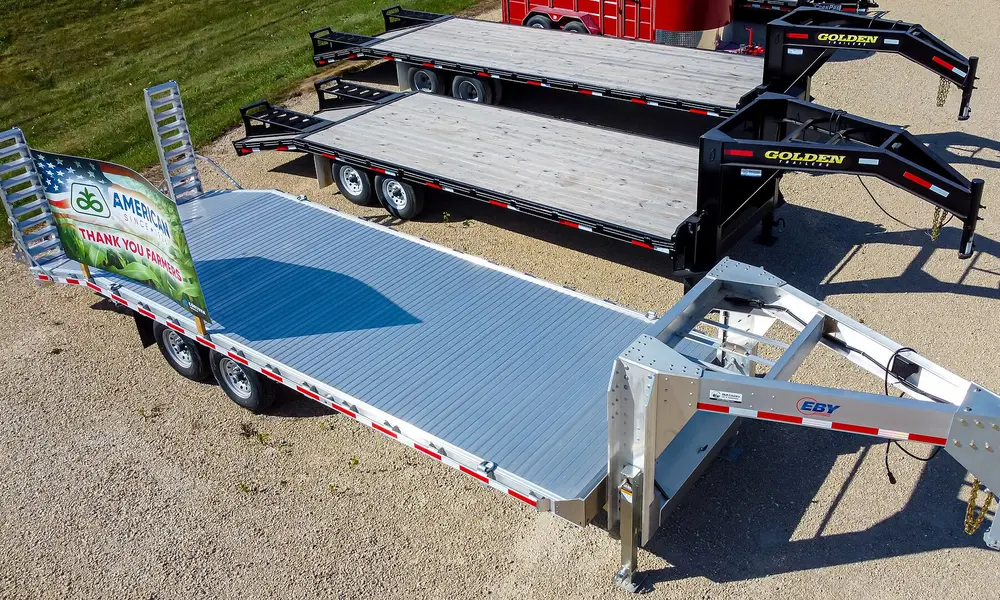
The gooseneck with a bent neck looks like the strongest trailer in the yard, because the hitch puts part of the load over the tow vehicle and makes the rig tow straight. The problem is the neck itself: it concentrates enormous force where it meets the deck, and a thin or badly welded neck flexes every time the trailer is loaded. The flex shows first as cracked paint around the welds, then as a visible bow. The coupler is the second complaint: a worn coupler clunks on every start and stop. Hitch the trailer, load it, and watch the neck from the side.
5. The pintle-hook trailer that sways
The pintle-hook trailer that sways is the old workhorse of the equipment world, and the worst ones are worn out where it matters most. A pintle hook and lunette ring are made to take punishment, but a worn ring and hook leave slack in the hitch, and slack is what starts sway. The trailer wanders behind the truck, clunks on every bump, and on a downhill run it can wag until the driver is fighting the wheel. The second problem is balance: a machine parked too far back lightens the coupling until the trailer steers the truck. Hitch the trailer and pull the ring by hand: any movement means the hitch is worn.
6. The deck-over with rotting deck boards
The deck-over with rotting deck boards hides its worst fault in plain sight. The deck sits above the wheels, and the boards are what the machine actually drives on. Cheap deck-overs use untreated softwood, and the boards rot from underneath where nobody looks: water sits between board and steel, the wood softens, and the steel rusts too. The first sign is a board that flexes underfoot, and the real danger is one that gives way under a track while the machine is halfway on. The frame is the second complaint: the crossmembers underneath are often rusted through at the same damp joints. Walk the deck and press every board hard.
7. The hydraulic dovetail that jams
The hydraulic dovetail that jams sells itself on convenience: press a button, the tail drops to the ground, and the machine drives straight on. The hydraulics leak at the cylinder seals, the hinges seize after a winter outside, and the tail sticks halfway up or down, leaving the trailer unusable. The second complaint is the deck joint: where the tail meets the main deck, a worn hinge lets the tail sit unevenly, so the machine tips sideways as it crosses. Work the tail through a full cycle three times, loaded and empty. If it moves slowly, jerks, or stops short of level, the hydraulics are already tired.

What to avoid when buying an equipment trailer in 2026
The most common buying regret is not a bad trailer but a wrong match: a single-axle trailer bought for a machine it cannot carry, or a gooseneck bought for a truck with no gooseneck hitch. Check the deck, the ramps, the coupler and the real loaded weight before you pay. The same checks work across every hauling trailer, and our guide to the worst flatbed trucks of 2026 makes the same point about decks and load ratings, because the traps are the same wherever heavy loads are carried.
Checklist: inspecting an equipment trailer before you buy
- Add the real loaded weight of the machine, with bucket and attachments, and compare it with the axle and deck ratings.
- Load your heaviest machine and watch the deck from the side: any bow between the crossmembers is a warning.
- Work every ramp, tilt bed and dovetail through a full cycle, loaded and empty, and reject any that stick or drop suddenly.
- Check the coupler, the neck welds and the pintle ring for wear, and hitch the trailer before you buy.
- Walk the deck, press every board hard, and lift one if you can to check the crossmembers for rust.
- Tow the trailer loaded at motorway speed on a windy day, and reject any that sways or pushes the truck downhill.
Frequently asked questions
Which equipment trailer should I avoid first in 2026?
The overloaded single-axle equipment trailer, because one axle leaves no margin at all and a single flat tyre strands the whole load. A trailer with tandem axles and a real payload margin is the safer buy.
Are equipment trailers the same as utility trailers?
No. A utility trailer is a light-duty trailer for quads, garden machines and small loads, while an equipment trailer is built to haul heavy working machines such as excavators and skid steers, with a much stronger deck, ramps and axles.
Are equipment trailers the same as car haulers?
No. A car hauler carries road vehicles on a car deck, while an equipment trailer carries working machines up steel ramps, which is why deck strength, ramp angle and load balance matter so much more.
What matters more than the brochure payload in an equipment trailer?
The deck, the ramps and the axles. A trailer that bends, has ramps that flex, or runs its axles at their limit is a bad buy whatever the brochure rating says.
Is a tilt-bed equipment trailer worth it?
Only if the deck stays flat under your heaviest machine and the tilt works smoothly loaded and empty. If the deck bows or the tilt hesitates, the convenience is not worth the repair bill.
Can any truck tow an equipment trailer?
No. The tow vehicle needs the rated towing capacity and the payload to carry the coupling weight, and the trailer needs to be balanced over its axles. Check the vehicle’s real limits and the trailer’s loaded weight before you hitch up.
Bottom line
The worst equipment trailers of 2026 let a working day down where it hurts: a deck that bends, a ramp that flexes, an axle already at its limit, a hitch that sways, or a tail that jams halfway. An equipment trailer is a machine hauler, not a living trailer or a car deck, and it should be judged as one. Check the deck, the ramps, the coupler and the loaded tow before you buy, and the trailer will earn its keep instead of eating it.