A field hockey stick looks like a simple curved piece of wood, and that is exactly the problem. It looks so simple that anyone can sell a bad one, and so many do. A bad stick is too heavy, too stiff, or made from wood that splits at the first hard hit. It ruins your first touch, it makes trapping the ball feel like catching a stone, and it breaks when you need it most. The worst field hockey sticks of 2026 are the ones that make good players look clumsy, hurt young players’ wrists, and fall apart in the middle of a season, and they are still on sale.
What Makes a Field Hockey Stick Bad
The first problem is the material. A good stick is made from well-chosen wood, fibreglass, carbon, or a careful mix, pressed and bonded so the whole stick works as one piece. A bad stick uses poor wood with knots and uneven grain, or cheap composite that is mostly filler. Poor wood splits along the grain the first time it meets a hard ball. Cheap composite feels dead, with no spring, so the ball comes off with no pace. Either way, the stick fails at its one job: controlling the ball and passing it where you want it.
The second problem is the weight and the balance. A stick should feel light in the hands even at a normal weight, because the weight is spread well and the balance point sits near the middle of the shaft. Bad sticks are badly balanced. They are heavy at the head, so they feel like swinging a hammer, or heavy at the handle, so they feel dead and slow. A head-heavy stick makes the hands late, which is why players with bad sticks are always beaten to the ball. A badly balanced stick also tires the forearms, and tired forearms make mistakes.
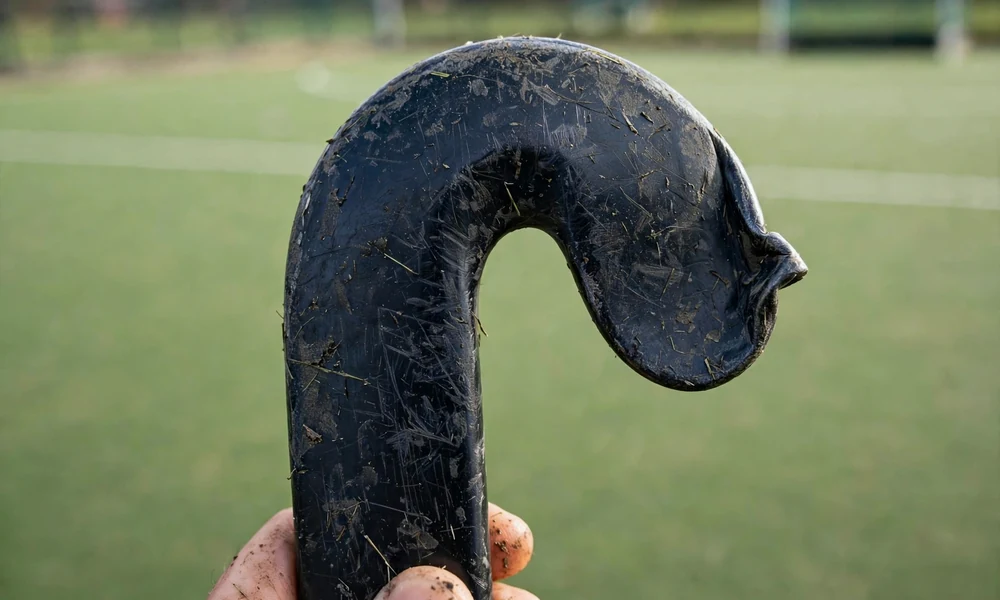
The third problem is the shape. The curve of the head, called the bow, decides how the stick lifts the ball and how it hits. A good bow is smooth and even, with no flat spots. A bad bow is lumpy or in the wrong place, so the ball bounces off the face instead of sitting on it. The head should be flat and true. A twisted or warped head will never trap cleanly, and no practice fixes it.
The Main Types of Field Hockey Stick, and Where They Go Wrong
Cheap wooden sticks are the most common trap. Wood can make a perfectly good stick when it is chosen and laminated well, but the cheapest ones use low-grade timber that is heavy, stiff, and lifeless. They are often sold to beginners at a price that seems too good to refuse, and it is: the stick is heavy, the head is thick, and the ball comes off with no pace. A beginner with one of these learns to hack at the ball instead of trapping it, the habits that ruin a technique.
Poorly made composite sticks are the more expensive trap. Composite sticks mix fibreglass, carbon, and aramid to get power and feel, and a bad one costs as much as a good wooden stick while performing worse. The usual fault is too much cheap filler and too little carbon, which leaves the stick dead and heavy. The other fault is a bad bond between the layers, so the stick delaminates: it goes soft in the middle and snaps without warning. A delaminated stick looks fine from the outside, which makes it dangerous.
Junior sticks are where bad manufacturing does the most damage. A junior stick should be light, well-balanced, and sized for a child’s hands. Bad junior sticks are simply adult sticks cut short, leaving them heavy at the head and impossible to control. A child with a head-heavy stick cannot trap cleanly, cannot get the stick down in time, and learns to swipe at the ball instead of receiving it. Worse, the weight strains young wrists, and the child decides hockey is not for them.
Then there are the novelty and gift sticks, the ones sold in toy shops and tourist stores. They look like hockey sticks, with a grip and a coloured head, but they are not hockey sticks at all. The shaft is often a single piece of cheap wood, the head is painted on, and the whole thing splits on the first hard ball. They are bought as presents and broken within a week.

How to Spot a Bad Stick Before You Buy
The head tells the truth first. Hold the stick up and look along the face in good light. It should be flat, smooth, and even, with no twists, warps, or bumps. Run your hand over the face: it should feel consistent, with no soft spots or rough patches. Look at the bow, the curve of the head: it should be smooth and gradual, not sudden or lumpy. A bow that changes shape halfway along the head will make the ball bounce, and a ball that bounces is one you cannot control.
Next, check the balance. Hold the stick by the handle and let it hang. It should feel light and easy, not heavy at the head. Pick it up and play a few shadow traps and hits. The stick should come through smoothly and stop where you want it to. If it drags, wants to keep going past the shot, or makes your wrists ache after a minute, the balance is wrong. A stick that is too heavy for you will slow your hands down, and slow hands are the difference between trapping the ball and missing it.
Finally, check the shaft and the grip. Look along the shaft for cracks, splits, or places where the surface has bubbled or peeled. Squeeze it gently: it should feel solid all the way down, with no soft spots and no give. Twist the grip: if it slips, feels spongy, or has come away from the shaft at the top, the stick will not feel right in your hands. A grip that slips when your hands sweat will cost you possession.
The Most Common Faults, One by One
A dead feel is the fault players notice first. The stick connects well, the timing feels right, and the ball goes nowhere, dropping into space for the opposition to pick up. The cause is almost always the material. A stick full of cheap filler has no spring, and a stick with poor wood absorbs the impact instead of returning it. Either way, the player has to hit harder to get the same result, which means swinging wildly and losing shape. A stick that makes you work harder for less is a stick to avoid.
Breakage comes second, and it usually starts at the head. A stick with a weak head cracks the first time it meets a hard ball on the edge, and once a head cracks, the crack spreads. Cheap sticks break at the shaft too, because the shaft is the thinnest part and takes the most punishment from tackles and from hitting the ground. A stick that needs replacing after a month was never worth buying.
Poor balance is the third fault, and it is the one that does the most damage to technique. A head-heavy stick makes the player late, and a late player swipes at the ball, misses traps, or gets beaten to it. A handle-heavy stick feels dead and makes the player push at the ball instead of receiving it. Both faults teach the player to compensate, and compensation becomes habit. Months later, the player is still swiping at the ball, long after the stick is gone.
A bad grip is the last fault, and it is the most dangerous. A grip that slips sends the stick twisting in the hands with every hit, which stings and, over time, hurts the wrists. A grip that comes off mid-game leaves the player holding a bare shaft, dangerous for everyone on the pitch. If the grip slips, the tape is peeling, or the shaft underneath is smooth and shiny, the stick is not safe to use.
Who Gets Hurt Most by a Bad Stick
Young players suffer first. A child with a heavy, badly balanced stick cannot learn the game properly, because the stick fights them on every trap. They learn to swipe instead of trapping, play with a stiff wrist, and lose the ball the same way every time. Many give up, and the tragedy is that the stick was the problem, not the child. A good junior stick is light, balanced, and sized properly, and it is the single most important piece of kit a young player owns.
Club players suffer differently. They buy a stick, play with it for a season, and watch their form fall without knowing why. The stick is dead, the head is cracking, or the grip is slipping, and each fault costs them possession in a different way. They spend the winter working on their technique when the real problem was in their hands all season. A bad stick costs games before it costs money.
Occasional players suffer last: they buy the cheapest stick on the shelf and play three games a year. The stick sits in a garage, the glue dries out, the grip hardens, and when they do play, it feels terrible. They decide hockey is a hard game, when they never gave themselves a fair chance with a decent stick.

What to Buy Instead
The fix is not to buy the most expensive stick, but to buy one with the right material, weight, and balance, and to check all three before you pay. Look for a flat, true head, a smooth bow, and a balance that feels light. Hold it, shadow a few traps and hits, and trust what your hands tell you. A stick that feels right in the shop usually plays right, and one that feels wrong never improves.
Weight matters more than most people think. A stick should be as light as you can control, because a lighter stick means faster hands and better trapping. The old advice to buy the heaviest stick you can lift is wrong: buy the stick you can move late and still control, and your game will improve. If you play other stick sports, the same rule applies: the stick should feel like an extension of your hands, not a weight you drag around. Our guide to the best baseball bats of 2026 makes the same point about weight and balance, and is worth reading before you buy any stick.
The Bottom Line
The worst field hockey sticks of 2026 share the same faults: dead materials, bad balance, weak heads, and grips that slip. They are easy to spot once you know what to look for, and easy to avoid. Check the head, the balance, and the grip, and trust your hands. Spend a little more on a stick with a flat head, a smooth bow, and a light balance, and it will last longer, control the ball better, and make the game more fun. The same care applies to any stick or racket sport: our guides to the best badminton rackets of 2026 and the best golf clubs of 2026 start with the same advice, check the balance and the build, and never trust a stick you have not held.