
Choosing a new hob is one of the biggest decisions in any kitchen refit, and the debate around gas vs induction hobs cooking has never been livelier. Gas has been the default for generations of cooks, loved for its visible flame and instant response. Induction, once a niche premium option, is now the fastest-growing hob type in modern homes, praised for its speed, safety and easy-clean glass surface.
This guide compares gas and induction hobs on speed, control, running costs, safety, cleaning and cookware, so you can judge each point against your own cooking habits.
By the end, you will know which hob wins on speed, control, cost, safety and cleaning, and what it takes to switch. It helps to start with how each hob works.
Key takeaways
- Induction boils water noticeably faster than gas, while gas gives you a visible flame and instant visual feedback on heat level.
- Gas works with almost any pan, but induction needs magnetic cookware, so switching may mean replacing some of your pans.
- Induction hobs are safer around children and easier to clean, since the glass stays cooler and spills do not bake on.
- Gas can be cheaper to run in some homes, yet induction wastes far less heat, so real running costs are often closer than expected.
- The best hob depends on your cooking style, your pans and your kitchen wiring, not on which technology is newer.
How Gas Hobs Work
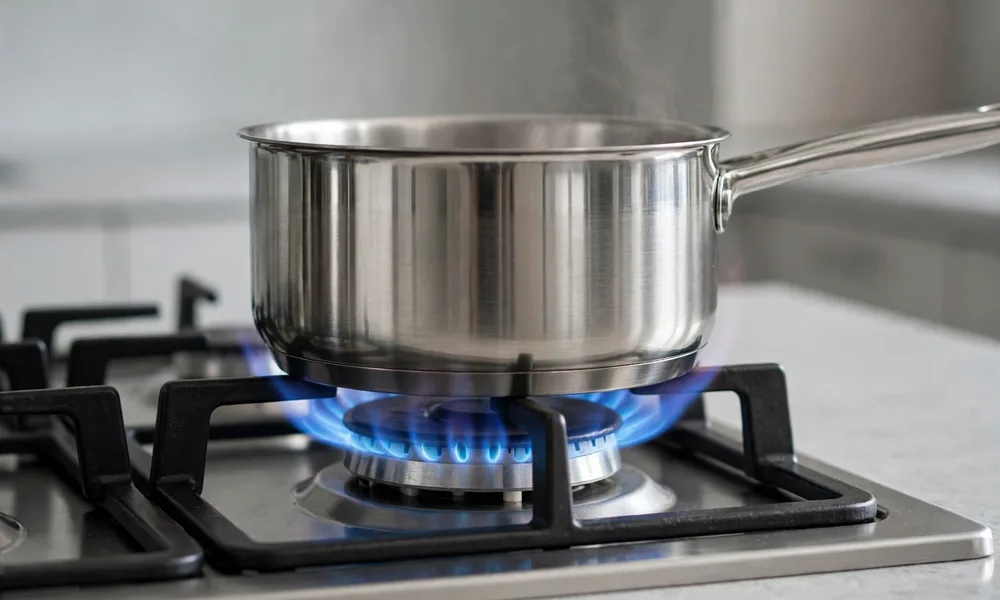
A gas hob burns natural gas or LPG at a ring burner beneath your pan. The flame heats the pan directly, and you control the heat by turning a knob that raises or lowers the flame. There are no electronics between you and the heat, and you can see exactly how much fire you are cooking with.
Most gas hobs have cast iron pan supports, enamelled or stainless steel surfaces, and automatic ignition. Higher-end models add flame failure devices that cut the gas if the flame goes out, now a standard safety feature.
The Feel of Cooking on Gas
Many experienced cooks prefer gas because the feedback is immediate and visual. You can see the flame grow or shrink as you turn the knob, and you can tilt a pan into the flame or lift it away to control the heat. This matters for stir-frying and for charring peppers directly over the burner. Gas also responds instantly when you turn it down, so a sauce about to boil over can be saved in a second. That responsiveness is the main reason professional kitchens still rely heavily on gas. For a closer look at how gas compares with another electric option, our guide to gas vs electric hobs for everyday cooking breaks down the differences in detail.
What Gas Hobs Need From Your Kitchen
A gas hob needs a gas supply, either a mains connection or an LPG bottle, and proper ventilation. Building regulations in many areas require a cooker hood above a gas hob, because burning gas produces heat, moisture and combustion products that should be vented outside. Installation must be carried out by a qualified gas engineer. Gas is often cheaper per unit of energy than electricity, but much of the flame’s heat escapes around the pan and warms the kitchen instead.
How Induction Hobs Work
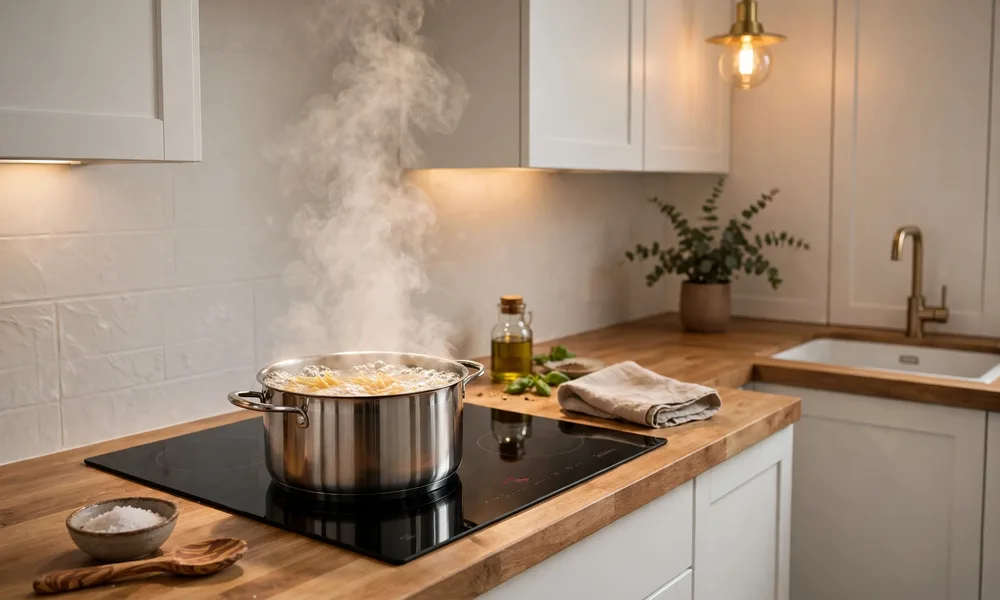
An induction hob looks like a smooth sheet of black glass, but beneath the surface are copper coils. When you switch a zone on, the coil creates a magnetic field that heats the base of the pan directly, while the glass itself stays comparatively cool. The pan becomes the heating element, which is why induction is so fast and so efficient.
Induction hobs offer precise digital controls, timers for each zone, and boost modes that deliver extra power for fast boiling. Many models detect the size of the pan and heat only the area beneath it. The flat glass also doubles as extra worktop space when the hob is off, a real advantage in small kitchens.
The Feel of Cooking on Induction
Cooking on induction feels different at first, because there is no flame to watch. Instead, you set a power level, usually from one to nine, and the hob holds it steadily. Control is very precise and repeatable, which suits delicate work like melting chocolate or holding a sauce at a low simmer. The speed is the first thing most people notice: a pan of pasta water can boil in about half the time it takes on gas.
What Induction Hobs Need From Your Kitchen
Induction hobs need a dedicated high-power electrical circuit, and some larger models require a 32-amp supply. Older homes may need an electrician to upgrade the wiring, so get a quote before you buy. The other requirement is magnetic cookware. Cast iron and most stainless steel pans work well, but aluminium, copper and some older non-stick pans will not heat on induction unless they have a magnetic base. Test a pan with a fridge magnet: if it sticks firmly, the pan should work.
Gas vs Induction Hobs: Head-to-Head Comparison
The table below sums up the main differences at a glance.
| Feature | Gas Hob | Induction Hob |
|---|---|---|
| Heating speed | Good, slower to boil water | Very fast, with boost mode |
| Temperature control | Instant, visual flame control | Precise, repeatable digital levels |
| Energy efficiency | About 40 to 55 percent | About 85 to 90 percent |
| Cookware needed | Almost any pan works | Magnetic-based pans only |
| Safety | Open flame, hot surfaces | No flame, cooler surface |
| Cleaning | Burners and grates need scrubbing | Flat glass wipes clean |
| Installation | Gas supply and ventilation | High-power circuit needed |
| Works in a power cut | Yes, with manual ignition | No |
Cooking Performance Compared
Performance is where the two hobs differ most. Neither hob is better at everything, so think about the dishes you cook most often.
Speed and Boiling
Induction wins clearly on speed. A litre of water boils in roughly three minutes on a good induction hob with boost, compared with five to six minutes on a typical gas burner. The gap widens with larger volumes. Gas is no slouch, though: a powerful wok burner can boil water quickly. The difference is that induction delivers its speed on every zone, while on gas only the largest burner is truly fast.
Temperature Control and Simmering
Both hobs can simmer well, but they do it differently. Gas gives you fine control by eye, with tiny adjustments instantly. Induction gives you exact, repeatable power levels, and the lowest settings hold a gentle simmer. For long, slow cooking like stocks and sauces, induction’s steady low heat is a genuine advantage. Gas excels at wok cooking, because the flame licks up the sides of the pan, while induction needs a flat-bottomed wok and cannot match flames wrapping around a round-bottomed one.

Cookware Compatibility
Cookware is the practical issue that catches many switchers by surprise. Gas accepts everything: copper, aluminium, cast iron, clay pots and round-bottomed woks. Induction is fussier: pans must have a flat, magnetic base that sits flush against the glass, and warped pans heat unevenly. The upside is that induction encourages a smaller, better-chosen set of pans.
Running Costs and Energy Use
Running costs depend on fuel prices, efficiency and how much you cook. Gas is usually cheaper per unit of energy than electricity. But induction transfers far more of its energy into the pan, around 85 to 90 percent compared with roughly 40 to 55 percent for gas, so it needs less energy to do the same job.
In practice, the two often come out surprisingly close. In homes with cheap gas and expensive electricity, gas usually wins. In homes with solar panels or off-peak tariffs, induction can be cheaper. Basic gas hobs are often cheaper to buy, although the gap has narrowed. Add up the full cost of switching, including installation and new cookware, not just the price tag.
Safety and Cleaning
Safety is one of induction’s strongest selling points. There is no open flame, the glass cools quickly once a pan is removed, and most models switch off automatically if a pan is lifted away. Child locks are standard, and the risk of burns is much lower than with gas. For households with small children, that peace of mind is hard to overstate.
Gas is safe when installed and used correctly, but it carries risks induction does not. An open flame can catch a tea towel or a sleeve, and gas hobs produce combustion products, which is why ventilation matters. Modern flame failure devices reduce the risk, but they cannot remove the flame itself.
Cleaning After Cooking
Cleaning is the other area where induction wins by a wide margin. The flat glass surface can be wiped clean with a damp cloth in seconds, because spills rarely burn on. A gas hob takes longer: burner caps, grates and the surface around them all need lifting, scrubbing and drying. Keeping the worktop clear helps too, and our guide to the worst kitchen gadgets for counter space shows which items are worth moving out of the way.
Which Hob Suits Your Kitchen?
The right hob depends on your home, your habits and your budget. Work through the checklist below.
- Choose gas if you love flame cooking: you stir-fry often or use a round-bottomed wok.
- Choose induction if speed matters most: you want the fastest boiling and precise simmering.
- Choose gas if your pans are non-magnetic: you own copper, aluminium or clay cookware you will not replace.
- Choose induction if safety is a priority: you have young children or want auto shut-off and a cooler surface.
- Choose gas if your wiring is limited: your home has no spare capacity for a high-power circuit.
- Choose induction if you hate cleaning: you want a flat glass surface that wipes clean in seconds.
There is also a middle option: a mixed hob, with gas burners on one side and induction zones on the other. These cost more and need both a gas supply and a high-power circuit, but for serious cooks they solve the dilemma neatly. If you bake as well as fry, look at the best stand mixers for baking in 2026 alongside your hob choice, so your whole setup suits the food you make.
Frequently Asked Questions
Is induction cooking better than gas?
Induction is better for speed, efficiency, safety and cleaning, while gas is better for flame techniques, wok cooking and working with any pan. Neither is better at everything.
Do I need special pans for an induction hob?
Yes, pans need a magnetic base. Cast iron and most stainless steel pans are suitable, while aluminium, copper and glass pans usually are not.
Is induction cheaper to run than gas?
It depends on your energy prices. Gas is often cheaper per unit, but induction is far more efficient, so the total cost is often close.
Can you use a wok on an induction hob?
Yes, with a flat-bottomed wok designed for induction. A round-bottomed wok will not sit properly on the flat glass. For authentic wok cooking, gas is still better.
Is it expensive to switch from gas to induction?
The hob is only part of the cost. You may also need an electrician for a dedicated circuit, and you may need to replace some pans. Get quotes before buying.
Does induction work during a power cut?
No, an induction hob needs electricity. A gas hob can still be lit manually with a match. If power cuts are common where you live, keep this in mind.
The Bottom Line
Gas and induction are both excellent ways to cook, and the best choice comes down to your kitchen and your habits. Choose gas if you love a visible flame, use a wide range of pans, and already have a gas supply. Choose induction if you want speed, precision, safety and the easiest cleaning, and you are happy to check your pans and wiring first.


