
An air hockey table is one of the few games that needs no explaining. You pick up a mallet, the puck starts floating on a cushion of air, and within seconds everyone in the room is leaning over the table, shouting, laughing and trying to score. It is fast, loud, simple to learn and hard to master, which is exactly why it works so well at home. The best air hockey tables of 2026 are not the flashiest ones and they are not the biggest. They are the tables with steady airflow, a flat and true playing surface, sturdy legs that do not wobble when play gets rough, and a puck that glides instead of bouncing or catching.

What Makes an Air Hockey Table Good
The first thing to judge is the airflow. An air hockey table works by pushing air up through hundreds of tiny holes in the playing surface, so the puck floats on a thin cushion and slides with almost no friction. If the blower is weak or the holes are uneven, the puck drags, slows down in the middle of the table, and the game turns into a frustrating push rather than a fast rally. A good table keeps the puck moving at the same speed from one end to the other, so shots stay honest and the better player usually wins. Listen for a steady, even hum when the blower runs, and watch whether the puck drifts or sticks in any one spot.
The playing surface matters just as much. It should be smooth, hard and perfectly flat, with no dips, seams or rough patches that can change the path of the puck. Most good tables use a slick coated surface that lets the puck slide freely and resists scratches from mallets. A surface that is too soft will dent and slow the puck over time, while a surface that is too rough will wear out the puck and make every shot unpredictable. Run your hand across the surface before you buy if you can, and look for a table whose surface feels even and polished from edge to edge.
The rails and goals are the parts that take the most punishment. Strong side rails keep the puck in play and give it a true, lively bounce, so bank shots work the way they should. Weak rails deaden the puck and make the game feel slow. The goals should be wide enough to reward a well-placed shot but not so wide that every weak tap scores. A good table has goal boxes that catch the puck cleanly and return it easily, without jamming or needing a hand to fish it out. The scoring system should be simple to read at a glance, whether it is a manual slider or an electronic display.
The Main Sizes of Air Hockey Table
Tabletop tables are the smallest option, usually around four feet long, and they sit on a dining table or the floor. They are cheap, light and easy to store, and they suit younger children or anyone who wants a quick game without giving up a whole room. Their weakness is the game itself. The playing area is small, the airflow is often weaker, and the puck has little room to build up speed. A tabletop table is a good first step, but most families outgrow it quickly once they have felt a full-size game.
Mid-size tables, around five to six feet long, are the most popular choice for homes. They are big enough for a real game, with enough space for fast shots and proper rallies, but they still fit in a playroom, a basement or a large living room. The blower is usually stronger than on a tabletop model, and the legs are sturdier. This is the size most buyers should start with, because it balances play quality against the space it takes up. Measure your room first, and leave at least three feet of space at each end so players can move freely.
Full-size tables, around seven to eight feet long, are the closest thing to the tables you find in an arcade. They are heavy, they need a dedicated space, and they are the most expensive option, but they play the best by a clear margin. The airflow is stronger and more even, the puck moves faster, and the extra length makes defence harder and goals more satisfying. If you have a games room and a family that plays often, a full-size table is worth the space it takes. For most homes, though, a good mid-size table plays nearly as well and is far easier to live with.
Blower Power and Airflow
The blower is the heart of the table, and it is worth understanding before you buy. A stronger blower pushes more air through the surface and keeps the puck floating higher, which means less friction and a faster game. A weak blower leaves the puck dragging on the surface, especially in the middle of the table where the air has furthest to travel. The best tables use a blower that is strong enough to lift the puck evenly across the whole surface, with no dead spots near the goals or along the edges.
Build Quality and Stability
An air hockey table takes a beating. Players lean on the rails, bump the legs, and hit the puck hard, so a flimsy table will wobble, creak and wear out fast. The best tables have thick side panels, solid legs with levelers, and cross supports that keep the frame rigid. Push on the table from the side before you buy, or read carefully about its construction if you are buying online. A table that flexes or rocks when you lean on it will only get worse with use.
Pucks, Mallets and Accessories
Most tables come with pucks and mallets included, but the quality varies a lot. A good puck is flat, smooth and evenly weighted, so it slides straight and does not wobble or flip. Cheap pucks are often slightly warped, which makes them catch on the surface and fly off unpredictably. Mallets should feel solid in the hand, with a comfortable grip and a smooth base that slides across the surface without scratching it. Thin, flimsy mallets crack under hard hits and feel cheap from the first game.

Air Hockey for Families and Children
For families with young children, look for a table with rounded corners, smooth edges and a sturdy build that can survive being climbed on or bumped into. A table that is too tall will be hard for small children to reach across, so a mid-size table or an adjustable-height model often works best. Keep the mallets and pucks stored where children can reach them, and set a simple house rule that mallets stay on the table, so nobody gets a bruised hand from a wild swing. If your family also enjoys quieter tabletop games, the best board games of 2026 are a good companion for the evenings when the air hockey table needs a rest.
Air Hockey for Serious Players
Serious players care about the same things as families, but more so. They want a fast, even playing surface, a strong blower, true rails and a table that does not move when play gets intense. The best tables for serious play are usually full-size, with a thick playing surface, a powerful blower and solid construction throughout. If you play competitively, or you simply love the game and want the best experience at home, these are the tables to look at.
Serious players should also think about the details that casual players might miss. A smooth, low-friction surface makes bank shots predictable. A puck that is perfectly flat keeps shots honest. A scoring system that is easy to read keeps the game flowing. And a table that is perfectly level means no goal was ever scored by a slope in the floor. If you already enjoy fast table games, the best table tennis paddles of 2026 offer a similar mix of speed and control, and many of the same ideas about grip, balance and feel apply to choosing a good air hockey mallet too.
Setting Up Your Table
Setting up an air hockey table is usually straightforward, but it is worth taking your time. Most tables arrive in a large box and need the legs attached and the blower connected, which takes one person about half an hour or two people about fifteen minutes. Read the instructions before you start, lay out all the parts, and check that nothing is missing. Tighten every bolt properly, because a leg that works loose later will make the table wobble and can damage the frame.
Looking After Your Table
A little care keeps an air hockey table playing well for years. Wipe the surface regularly with a dry or slightly damp cloth to remove dust, because dust clogs the air holes and weakens the airflow. Never use harsh cleaners or abrasive pads, which can scratch the surface and slow the puck. Vacuum around the table often, and check the air holes from time to time for any that are blocked. A soft brush or a gentle blast of air clears them easily.
Mistakes to Avoid
The most common mistake is buying a table that is too big for the room. A full-size table sounds wonderful until it arrives and there is no space to move around it, so players end up pressed against the wall and the game suffers. Measure your room carefully, including the space players need at each end, before you order. The second mistake is buying the cheapest table you can find. A very cheap table often has a weak blower, a thin surface and wobbly legs, and it will frustrate everyone who plays on it.
Another mistake is ignoring the weight of the table. A light table might be easier to move, but it will also shift during play and wear out faster. A heavier table stays put and feels far more solid. Finally, do not forget the extras. A table without spare pucks, a cover or a cleaning cloth will cost you more in the long run than a slightly more expensive table that includes them. If your games room is growing, the best bowling balls of 2026 are worth a look too, because the same care in choosing weight, grip and feel pays off in any game you play seriously.
The Bottom Line
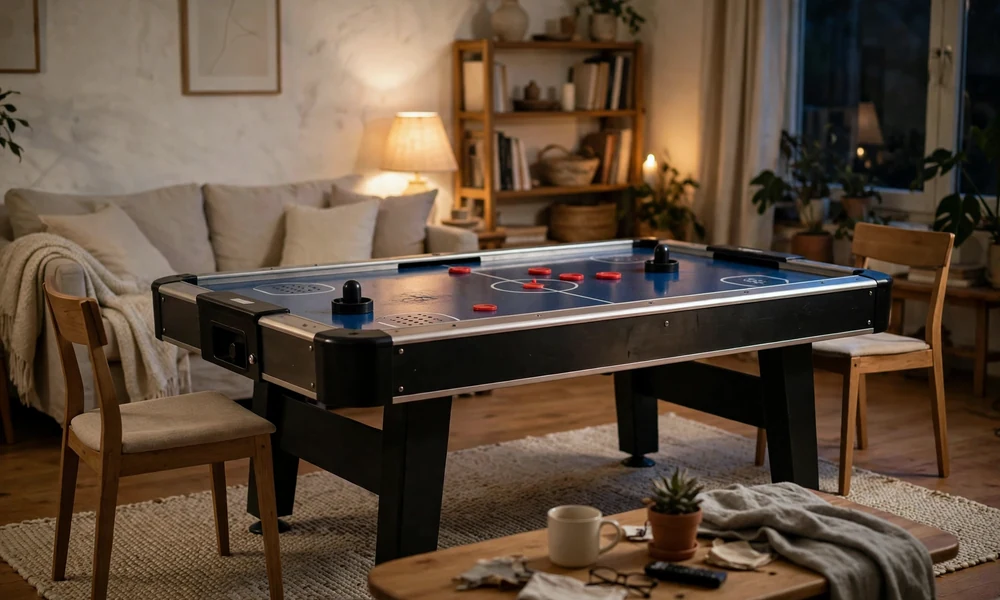
The best air hockey table of 2026 is the one that fits your room, your players and the way you actually play. For most families, a sturdy mid-size table with a strong, even blower and a smooth playing surface is the right choice. For serious players with the space, a full-size table plays better and lasts longer. For younger children or a first table, a tabletop model is a fair way to start, as long as you know you will probably want a bigger one soon.
Whatever size you choose, judge the table by the things that matter during a game: steady airflow, a flat surface, true rails, solid legs and a puck that glides. Get those right and the table will bring years of fast, noisy, laughing games to your home. Choose carefully, set it up properly, keep it clean, and the best air hockey table is the one that is always ready for the next game.


