Best Chicken Coops 2026
A chicken coop is the one purchase that decides whether keeping hens feels like a pleasure or a chore. A coop that is too small leaves the birds crowded and stressed, and stressed hens stop laying. A coop that lets in the rain leaves the bedding damp, and damp bedding brings smell, flies, and sick birds.
Get the coop right, though, and the whole routine settles into place: the hens lay in the same nesting boxes every morning, the run stays dry underfoot, and cleaning takes ten minutes instead of an hour. These are the best chicken coops of 2026, chosen for size, predator protection, ventilation, and how easy they are to live with day after day.
Key Takeaways
- Allow at least 0.4 square metres of indoor space per hen, and at least 1 square metre of run space per hen, because crowded birds peck each other and stop laying.
- Predator protection matters more than looks, since a fox, a rat, or a badger will test every weak latch, thin panel, and gap under the roof.
- Ventilation without draughts is the secret to a healthy coop, because ammonia from droppings builds up fast in a sealed box.
- Buy a coop you can clean standing up or reaching in easily, since a coop that is hard to clean will be cleaned less often.
- Check your local rules before you buy, because some councils and housing estates limit flock size, coop height, and how close the coop can sit to a boundary.
Chicken Coops 2026 at a Glance
| Best for | Coop type | Hens | Standout strength |
|---|---|---|---|
| Best overall | Raised timber coop with run | 4 to 6 | Dry, draught-free, and easy to clean |
| Best for small gardens | Compact A-frame coop | 2 to 3 | Fits a small corner and moves easily |
| Best for large flocks | Walk-in timber coop | 8 to 12 | Stand-up cleaning and room to grow |
| Best for beginners | Flat-pack coop with run | 3 to 4 | Simple to build and ready in an afternoon |
| Best for cold winters | Insulated double-wall coop | 4 to 6 | Stays warm without trapping damp air |
| Best for moving around | Mobile chicken tractor | 3 to 5 | Fresh grass every few days |
What a Chicken Coop Is Really For
A chicken coop does four jobs at once. First, it gives hens a safe place to sleep at night, shut away from foxes and other night-time visitors. Second, it gives them a dry, dark place to lay eggs. Third, it shelters them from wind, rain, and summer heat. Fourth, it keeps the mess in one place you can manage, instead of spreading it across the garden.
It helps to know the difference between a coop and its close cousins. A shed is a bigger, plainer wooden building, and our guide to sheds that hold the garden tools without the mess covers the storage end of the garden, while a coop is a home built around roosting bars, nesting boxes, and a run. The two share timber, roofing, and siting sense, but only one is built for birds.
Getting the Size Right
Size is where most chicken coop purchases go wrong. A coop sold as suitable for six hens often holds six birds only if they never move, and hens that cannot move freely will peck, fight, and lay fewer eggs. As a rule, allow 0.4 square metres of indoor floor space per hen, 20 to 25 centimetres of roosting bar per hen, and one nesting box for every three or four hens.
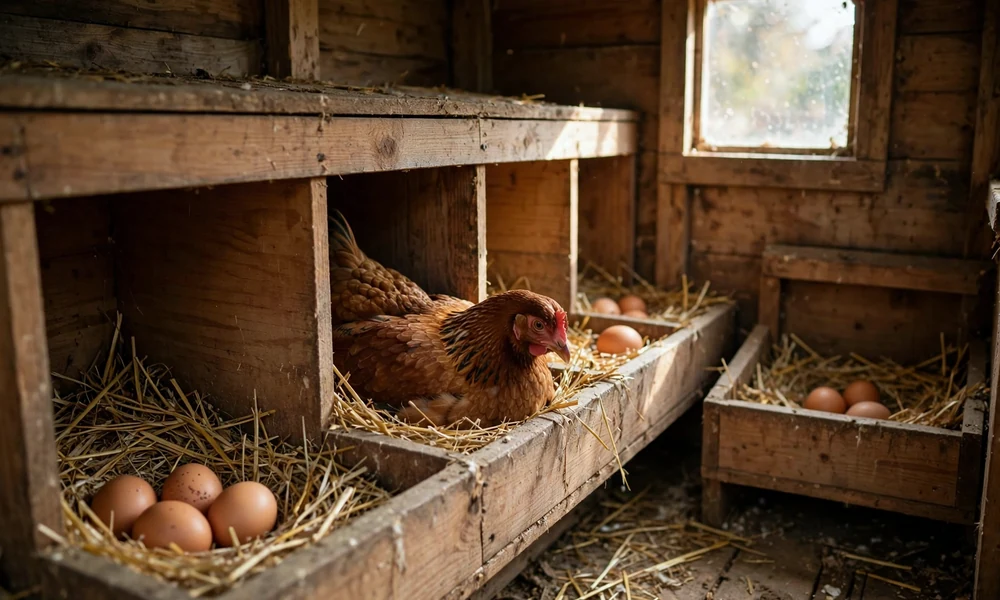
The run matters just as much as the house. Hens need at least 1 square metre of run each, and more is always better, because the run is where they spend the day scratching, dust bathing, and pecking at the ground. A run that is too small turns to bare mud within weeks, and mud brings parasites and dirty eggs. If your garden is small, choose fewer hens rather than a smaller run.
The Main Types of Chicken Coop
Chicken coops fall into a handful of types, and each suits a different garden and a different flock. The right choice depends less on taste than on how many hens you keep and how much space you have.
The raised timber coop with an attached run is the safest choice for most homes: a wooden house lifted off the ground on legs, with a ramp down into a fenced run. Its strength is dryness, since the raised floor stays clear of rain and mud. Its weakness is size, because the run underneath is rarely big enough on its own.
The walk-in timber coop is the best choice for a larger flock of eight to twelve hens. You can stand inside to clean, collect eggs, and check the birds, and there is room to add a feeder and a drinker out of the rain. A walk-in coop costs more and needs a level base, so plan the groundwork before it arrives.

The mobile chicken tractor is the flexible option. It is a light coop and run in one unit that you drag to fresh grass every few days, so the hens always have something green to peck and the ground recovers behind them. If your garden is large and you like the idea of the hens working the lawn, a tractor is worth a look. A greenhouse is a different kind of garden structure, and our guide to the best greenhouse kits of 2026 covers that side of the garden, while a chicken tractor is built to move, not to stay put.
Materials and Build Quality
Timber is the classic coop material, and it earns its price. Cedar and pressure-treated softwood resist rot, feel warm in winter, and can be repaired with a saw and a screwdriver when a board splits. Thin plywood coops look neat in the catalogue and cost far less, but they warp in the rain, and red mites love the gaps between thin panels.
Predator Protection
A coop is only as good as its weakest point, and predators are patient. Foxes dig, rats gnaw, and badgers push, so every opening needs to be covered with welded wire mesh, not chicken wire, which a fox can bite through. Mesh with 12-millimetre holes keeps out rats and stoats, and it should be fixed with screws and washers, not staples.
Ventilation and Warmth
Hens need fresh air more than they need warmth. A coop that is sealed tight keeps the cold out, but it also traps ammonia from droppings and moisture from the birds breathing, and damp, ammonia-filled air causes respiratory illness. Ventilation should sit high, under the roof, so fresh air moves across the top of the coop without blowing directly onto the roosting birds.
Nesting Boxes, Roosts, and Laying
Nesting boxes are where the eggs happen, and hens are fussy about them. Each box should be about 30 centimetres square, dark, quiet, and lined with clean straw or wood shavings. One box for every three or four hens is enough, because hens will queue for a favourite box rather than use an empty one.
Roosting bars are where hens sleep, and they should sit higher than the nesting boxes, because hens always choose the highest spot to sleep. If the roosts are lower than the boxes, the hens will sleep in the boxes and soil them overnight. Bars should be flat-topped, about 5 centimetres wide, so the hens can cover their feet with their feathers on a cold night.
Feeding, Water, and Daily Care
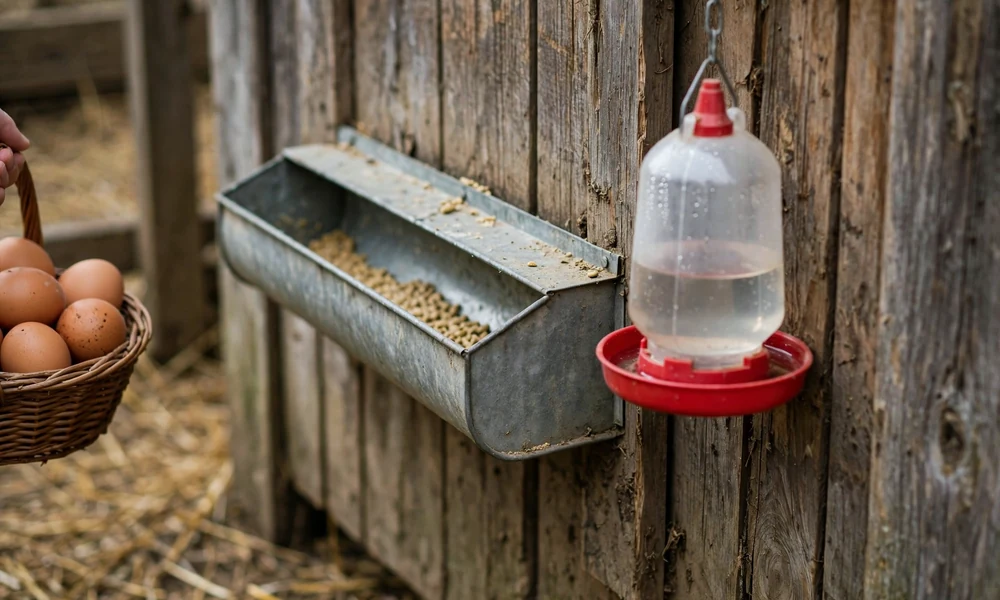
Feed and water belong inside the run, not scattered on the ground. A trough feeder fixed to the wall keeps the feed dry and stops the hens scratching it everywhere, while a hanging drinker keeps the water clean and out of the bedding. Check the drinker every morning, because a hen without water stops laying within a day.
Bedding is the other daily decision. Straw is warm and cheap, wood shavings are absorbent and easy to handle, and hemp bedding is dust-free but costs more. Whatever you choose, keep it dry and deep, and change it completely every week or two. The old bedding is excellent for the garden: it breaks down into rich compost, and our guide to why raised garden beds grow better vegetables shows where that compost does the most good.
Before You Buy: A Short Checklist
- Count your hens, then add two, and buy a coop sized for that number.
- Check the floor space, the roost length, and the number of nesting boxes against the rules above.
- Look for welded wire mesh, not chicken wire, on every opening.
- Check the latches: a bolt or carabiner beats a twist catch.
- Look for high ventilation under the roof, and a window for light.
- Check that you can reach every corner for cleaning, and that the roof lifts or the door is wide enough.
- Measure the garden, check the rules, and confirm the coop will fit through the gate.
Frequently Asked Questions
How big should a chicken coop be for four hens? Allow at least 1.6 square metres of indoor floor space for four hens, plus a run of at least 4 square metres. More space is always better, and it keeps the birds calm and laying.
Do chickens need a run, or can they free-range all day? Hens can free-range if your garden is secure, but they still need a fenced run for the times you are out, because a free-ranging hen is an easy meal for a fox. A run also protects the garden from being scratched bare.
How do I keep a chicken coop from smelling? Keep the bedding dry and deep, clean out the droppings regularly, and make sure the coop has high ventilation. A dry coop with fresh bedding barely smells at all, while a damp coop smells within days.
Should a chicken coop be insulated? Insulation helps in cold winters, but ventilation matters more. An insulated coop that traps damp air is worse than a draughty one that stays dry, so look for a coop with both insulation and high vents.
Can I keep chickens in a small garden? Yes, with two or three hens and a compact coop, provided the run is big enough and you keep it clean. Small flocks in small gardens work well, as long as you do not overcrowd them.
The Bottom Line
The best chicken coop of 2026 is the one that fits your hens, your garden, and your routine, and then quietly does its job every day. It is big enough for the flock you will have, not just the flock you have now, predator-proof in every corner, ventilated high under the roof, and easy enough to clean that you actually clean it.
Start with the tape measure, not the catalogue. Count the hens, measure the garden, check the rules, and then choose the type that fits: a raised timber coop for most homes, a compact A-frame for a small garden, a walk-in coop for a larger flock, or a mobile tractor if you want fresh grass under the birds every few days.