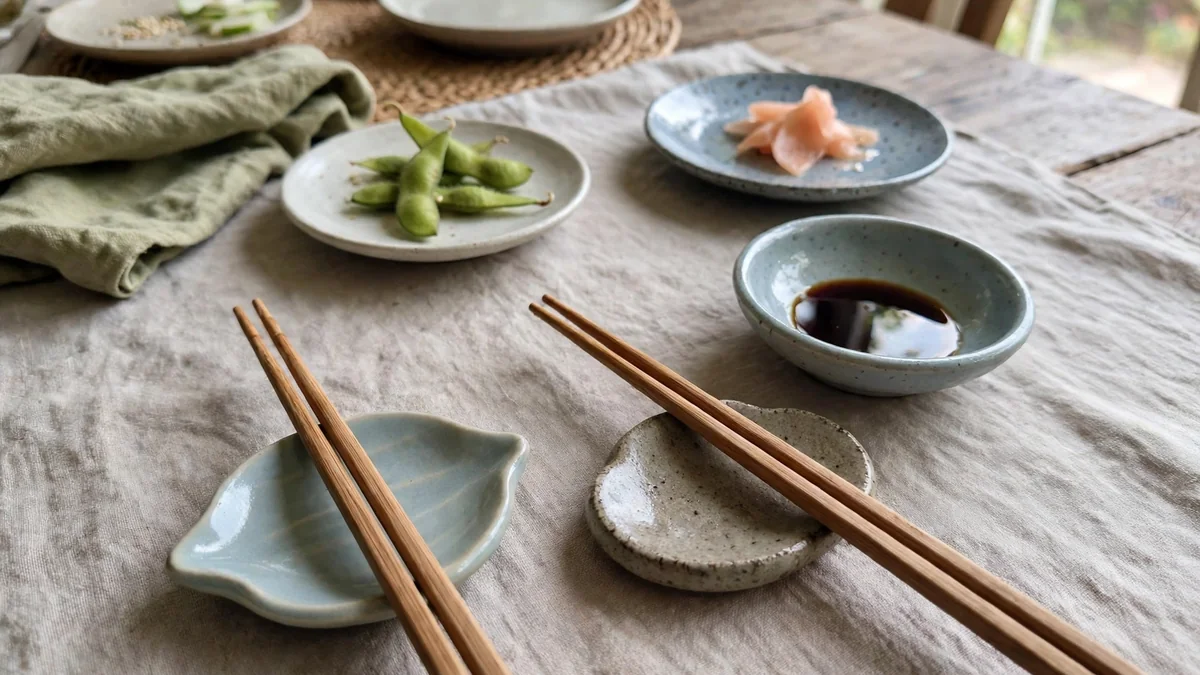
The top chopstick rests are small, quiet pieces of tableware, and that is exactly the point. A good rest holds your chopsticks off the table between bites, keeps the tips clean, and stops the pair from rolling away. It does a job so small that most people never think about it until the first time they eat sushi at home and realise their chopsticks have nowhere sensible to go.
Chopstick rests, known as hashioki in Japanese, are the little dishes, bars, and shaped pieces that sit beside your plate and cradle the tips of your chopsticks. They are not chopstick holders, which stand the pair upright in a cup. A rest is a low, flat piece that the chopsticks lie across, tips raised just enough to stay clear of the table. This guide compares the best chopstick rests for home use in 2026 by stability, size, material, and cleaning.
Key Takeaways
- Ceramic rests are the best all-rounders: heavy enough to stay put, easy to clean, and available in every shape.
- Wood and bamboo rests are light, warm, and kind to chopsticks, but they need hand washing and drying straight away.
- A rest should be long enough to hold both chopsticks with the tips raised, and heavy enough not to slide.
- Rests and holders are different: a rest lays chopsticks flat, while a holder stands them upright.
- Buy rests in sets of four or more so every place matches.
What a Chopstick Rest Actually Is
A chopstick rest is a small piece of tableware placed beside a plate, with a raised edge or a groove that the chopsticks lie across. The tips rest on the raised part and the handles on the table, and the business end stays off the cloth and out of the soy sauce. When you pause between bites, the chopsticks go on the rest. If you are putting together a full sushi night, our guide to how to choose sushi sets for home covers the plates, soy dishes, mats, and chopsticks as a matched group.
The confusion to clear up first is rest against holder. A chopstick holder, sometimes called a chopstick stand, holds the pair upright, tips up, in a slot or a cup. A rest holds the pair flat, tips raised a centimetre or two off the table. The rest is the everyday piece: faster to use, impossible to tip over, and suited to a meal where you pick the chopsticks up and put them down a dozen times.
The Main Types of Chopstick Rest
Five materials and a handful of shapes cover almost every rest worth buying. The shape decides how the chopsticks sit, and the material decides how the rest feels, cleans, and lasts.
Ceramic Rests
Ceramic is the classic rest material and the best place to start. A glazed ceramic rest is heavy enough to stay exactly where you put it, smooth enough to wipe clean in seconds, and available in every shape: plain bars, waves, leaves, and fish. The glaze keeps soy sauce from staining, and most ceramic rests are dishwasher safe. The weakness is breakage: ceramic chips if knocked against a hard plate or dropped on a tiled floor.

Wood and Bamboo Rests
Wood and bamboo rests are light, warm to the touch, and kind to chopsticks, because the soft surface never scratches a lacquered pair. They suit rustic tables and everyday noodle bowls, and they are the cheapest way to buy a full set. The trade-off is care: wood needs hand washing and quick drying, and it can stain if soy sauce sits on it.
Metal Rests
Metal rests, usually stainless steel, are the durable, modern option: thin, neat, dishwasher safe, and almost impossible to break, which makes them the best choice for families. The compromise is feel: steel is cold and a little slippery, so the chopsticks can slide unless the rest has a groove to catch them.
Stone and Glass Rests
Stone rests, cut from slate, marble, or river stone, are heavy, stable, and striking, and never move once you set them down. Glass rests are light, clear, and easy to clean, suiting a pale or minimal setting. Both are niche: stone can scratch a polished table unless it has a felt base, and glass is fragile and shows fingerprints.
Shaped and Novelty Rests
Shaped rests are where the craft lives: fish, cats, leaves, and waves, glazed in colours that match a set or stand out against it. A fish-shaped rest with a groove along its back holds chopsticks beautifully. But the shape is not just decoration: a good shaped rest has a groove that actually holds the pair, while a bad one lets the chopsticks roll off. Judge by the groove first and the charm second.
Chopstick Rests Compared
This table puts the main types side by side.
| Rest type | Best for | Stability | Cleaning | Feel |
|---|---|---|---|---|
| Ceramic | Everyday meals, sushi nights, guests | Very good, heavy and flat | Dishwasher safe, wipe clean | Smooth, cool, solid |
| Wood and bamboo | Daily use, rustic tables | Good, light but grippy | Hand wash, dry at once | Warm, soft, natural |
| Metal | Families, lunchboxes, travel | Good if grooved, fair if flat | Dishwasher safe | Cold, hard, neat |
| Stone | Formal tables, display | Excellent, very heavy | Wipe clean, seal occasionally | Cool, solid, weighty |
| Glass | Minimal tables, pale settings | Fair, light and smooth | Dishwasher safe | Smooth, light, clear |
How to Choose the Right Rest
Start with the groove, because it is the whole job. A rest needs a dip or a notch deep enough to hold the pair and wide enough to take both sticks at once. A flat rest with no groove is a coaster with ambition, and the chopsticks will roll off it the first time someone nudges the table. If you can see a clear channel where the pair lies, it will work.
Size and weight come next. A rest should be five to eight centimetres long for a standard pair, and low enough that the tips lift only a centimetre or two. A rest that is too short lets the pair seesaw, and one that is too tall lifts the tips so high the pair slides off backwards. A ceramic or stone rest stays where you set it, while a very light rest can skate on a smooth cloth. A flat base grips; a rounded base rocks.
Match the rest to the chopsticks you own. Our guide to why good chopsticks are worth the upgrade covers the materials, lengths, and tip shapes that decide how a pair handles, and the same logic applies to the rest: a heavy hardwood pair needs a deep groove, and a lacquered pair needs a rest that will not scratch its finish. Buy a set of four or six in the same design so every place setting matches, and keep a spare or two. If you roll your own sushi, our guide to the best sushi mats for tight rolls is the companion piece, since the mat, the knife, and the rest are the three small tools that decide whether a sushi night feels easy or awkward.

Using and Looking After Chopstick Rests
Place the rest to the right of the plate for a right-handed eater, or to the left for a left-handed one, with the groove facing the plate so the tips point towards it. The chopsticks lie across the rest with the tips on the raised part and the handles on the table. Between bites, set the pair down gently rather than dropping it, because a dropped pair can chip a ceramic rest.
Cleaning is simple, and it is why ceramic and metal win for most homes: rinse the rest after the meal, wash it with the plates, and dry it before it goes back in the cupboard. Wood needs more care: wash it by hand, dry it straight away, and never leave it soaking, because soaked wood swells and holds smells. Store rests in a small box or a drawer divider, so the set stays together.
What to Avoid
Avoid a rest with no groove, however pretty it is. A flat disc looks like a rest in a photograph and behaves like a coaster at the table, and the chopsticks will roll off it onto the cloth or into the soy sauce. The groove is the product, and everything else is decoration. Avoid buying a single rest when you need a set: buy four as a minimum, six if you host, all in the same design.
Avoid rests that are too light for your table, because a featherweight rest on a smooth tablecloth will move every time you set the chopsticks down. And do not use the rest for something it is not: it is not a spoon rest or a place to park a wet tea bag. Keep it for chopsticks and it will last for years.

Before You Buy Checklist
- Check the groove: a clear dip or notch, deep enough to hold both chopsticks at once.
- Measure the length: five to eight centimetres suits a standard pair, longer for cooking chopsticks.
- Test the weight: heavy enough to stay put on your tablecloth, with a flat base that grips.
- Match the material to your care habits: ceramic or metal for easy weeks, wood only if you will hand wash.
- Buy a set, not a single: four as a minimum, six if you host, all in the same design.
- Match the rest to your chopsticks: deep grooves for heavy pairs, smooth surfaces for lacquer.
Frequently Asked Questions
What is the difference between a chopstick rest and a chopstick holder?
A rest lays the chopsticks flat on the table, with the tips raised a centimetre or two on a small grooved piece. A holder stands the pair upright in a slot or a cup. The rest is the everyday piece for eating, because it is faster to use and cannot tip over; the holder suits display and storage.
Do I really need a chopstick rest?
You do not need one to eat, but it keeps the chopstick tips off the table, stops the pair rolling away, and keeps soy sauce off the cloth. At a sushi night or a noodle meal, it makes the table tidier and the meal more relaxed.
Which material is best for a chopstick rest?
Ceramic is the best all-rounder: heavy, stable, easy to clean, and available in every shape. Wood and bamboo are warm and light but need hand washing. Metal is nearly unbreakable and dishwasher safe. Choose by how you wash up and how your table looks.
How many chopstick rests should I buy?
Buy four as a minimum, and six if you host regularly. Rests are small and easy to chip, so keep one or two spares in the same design, and buy them as a set rather than one at a time.
Can I put ceramic chopstick rests in the dishwasher?
Most glazed ceramic rests are dishwasher safe, as are metal and glass. Wood and bamboo rests should always be hand washed and dried straight away, because the dishwasher swells the wood and dulls the finish. Check the listing if you are unsure.
Where should the rest sit on the table?
Place it beside the plate on the side of your dominant hand, with the groove facing the plate. The chopsticks lie across it with the tips on the rest and the handles on the table, pointing away from the plate. That keeps the tips clean and the pair within easy reach.
Bottom Line
The top chopstick rests are the ones you stop noticing: the groove holds the pair, the weight keeps the rest still, and the table stays clean while you eat. Ceramic wins for most homes, wood wins for daily use, and metal wins for durability, and the shape matters less than the groove. Buy a set of four or six, match them to your chopsticks, and the smallest piece on the table will quietly make every sushi night a little tidier.