There is a particular kind of autumn morning that every gardener knows. The lawn is covered in damp maple and oak leaves and the driveway is hidden under them. A cordless leaf blower turns that clear up into ten minutes of easy walking: no cord to drag, no petrol to mix, no pull cord to fight with on a cold morning.
But not every cordless blower is worth your money. Some fade after five minutes, some scream without shifting a wet leaf, and some are too heavy to hold for long. The best leaf blowers of 2026 show what good garden machinery looks like at its best, and this guide picks the best cordless models by type.
Key Takeaways
- Air volume, in cubic feet per minute, matters more than top speed: a blower that moves a lot of air clears wet leaves, while a fast narrow jet only scatters dry ones.
- Runtime on full power is the number that counts, because that is the setting you will use on damp leaves, and a second battery doubles your working time.
- The best cordless blowers hold steady power as the battery drains instead of fading, so the last ten minutes are as useful as the first.
- Weight and balance decide whether a blower is a pleasure or a chore, so a lighter tool often beats a stronger one that drags your arm down.
- Quiet blowers are worth paying for, because a low noise level means you can start earlier and stay on good terms with the neighbours.
How We Judged
We judged every cordless blower the way you would actually use it, not the way a specification sheet wants you to read it. The first test is the damp leaf pile: a good blower rolls a whole pile of wet autumn leaves forward in a steady wave, while a weak one only stirs the top layer. The second test is runtime on full power, measured in real minutes of work rather than the optimistic figure printed on the box, which is almost always measured on the lowest setting with no load. The third test is comfort over twenty minutes, because a blower that feels fine for sixty seconds can become a burden. We also weighed noise and the battery system: charge speed, whether the battery fits your other garden tools, and the cost of a spare.
We gave no credit for a big top speed number on its own. Speed, measured in miles per hour, tells you how hard the jet hits a single leaf. Volume tells you how many leaves move at once, and that is what clears a lawn. The best cordless blowers pair a respectable speed with a generous volume, and they keep both steady until the battery is spent.

The Best Cordless Leaf Blowers of 2026
The best cordless leaf blowers share a simple quality: they make a dull job feel easy. They start at the push of a button, move leaves in broad waves, and run long enough to finish a real garden. Below are the best of them, picked by the job they do best.
Best Overall
The best overall cordless blower does everything well and nothing badly. It moves enough air to shift wet leaves off a lawn and out of a flower bed, runs for twenty to thirty minutes of real work on a useful power setting, and weighs little enough that you can carry it for a full session without your shoulder complaining. A variable trigger or cruise control lets you hold a steady airflow without squeezing hard the whole time. It suits the typical suburban garden: lawn, driveway, patio, and a few trees. It finishes the ordinary job quickly and quietly, week after week, and that consistency earns it the top spot.
Best Powerful
Some gardens need real muscle. If you have a large lawn, several mature trees, or a long driveway lined with hedges, a standard blower will leave you making pass after pass while the leaves barely move. The best powerful cordless blower closes the gap with the petrol machines that used to rule big gardens. It pushes a high volume of air and comes with a large battery that gives you a genuine working session. The trade off is weight, so look for a balanced design and a harness or shoulder strap. Like the best lawn mowers of 2026, it earns its keep beyond its main job, clearing grass clippings after mowing and drying a driveway after washing the car.
Best Lightweight
A leaf blower is a tool you hold out in front of you, and every extra pound matters more than it does on a tool that rests on the ground. The best lightweight cordless blower is the one you can use with one hand while you hold a garden gate open with the other, or carry up a flight of steps to clear a balcony without thinking twice. It typically uses a smaller battery, which keeps the weight down but shortens the runtime, so it suits smaller gardens, patios, decks, and driveways rather than acres of lawn. What it gives up in raw power it makes up for in agility: you can point it precisely into corners, under benches, and along flower bed edges without wrestling the tool.
Best Quiet
Noise is the hidden cost of a leaf blower, and it is the reason neighbours fall out over garden tools. The best quiet cordless blower is quiet enough to use early on a Saturday morning without a guilty conscience, and easy on your own ears during a long session. A quieter blower is one you will actually use more often. The quietest models achieve their hush with a well designed fan and housing rather than simply turning the power down, so they still move a useful volume of air. Remember that the decibel scale is logarithmic, so a small difference on paper is a big one in real life.
Best Budget
You do not need to spend a fortune to get a cordless blower that works. The best budget cordless blower gets the basics right and skips the extras: it starts reliably, moves a decent volume of air, and runs long enough to clear a small to medium garden on one charge. It will not have the longest runtime or the quietest motor. But for a patio, a small lawn, and a driveway, it is all you need, and the money you save can go toward a spare battery, which does more for your working time than any premium feature. The trap to avoid is the blower that looks like a bargain and performs like a toy: a tiny motor, a battery that dies in fifteen minutes, and a nozzle that cannot shift a wet leaf at all. Check the air volume figure, not just the price.

What to Look for When Choosing
Choosing a cordless leaf blower is easier once you know which numbers matter and which ones are marketing. The five things below decide whether a blower will serve you well for years or disappoint you by the second weekend.
Air Speed
Air speed, measured in miles per hour, tells you how hard the jet of air hits. A higher speed helps to lift leaves stuck to wet grass or wedged into a corner, and it gives the blower a satisfying feeling of power. But speed on its own is misleading, because a very fast narrow jet only moves a thin strip of leaves at a time. Treat speed as a supporting number, never the headline.
Air Volume (CFM)
Air volume, measured in cubic feet per minute, is the number that matters most. It tells you how much air the blower moves, and therefore how many leaves it can push at once and how well it handles wet, heavy leaves stuck to the ground. A blower with a high volume pushes a wide wall of air, so leaves roll along in a broad wave and a whole lawn clears in a few passes. When you compare two blowers, put the volume figures side by side first, and only then look at the speed.
Battery and Runtime
The battery is half the tool, and it deserves half your attention. Above all, check the runtime on full power, because that is the setting you will actually use on wet leaves. The headline runtime on the box is almost always measured on the lowest setting, with no load, in a warm room, and the real figure on full power can be half as long. A second battery in the charger means you can keep working while the first one refills, and a battery that fits your other garden tools is worth more than a slightly bigger one that fits nothing else.
Weight and Balance
Weight is easy to measure and easy to underestimate. A blower that feels light in the shop can feel heavy after twenty minutes of holding it out in front of you, because the tube acts as a lever and the weight sits at the end of your arm. Hold it at your side for a minute: if your shoulder is already aching, the garden will feel twice as big. Balance matters as much as weight. A well balanced blower has its weight centred near your hand, so the nozzle does not drag your arm down.
Noise
Noise is measured in decibels, and because the scale is logarithmic, a difference of just a few decibels is clearly audible. Cordless blowers are far quieter than petrol machines, but they still vary widely, and the quietest models are a genuine pleasure to use. A lower noise level means you can start earlier in the morning, work for longer without ear fatigue, and keep the peace with the people next door.
Care and Mistakes to Avoid
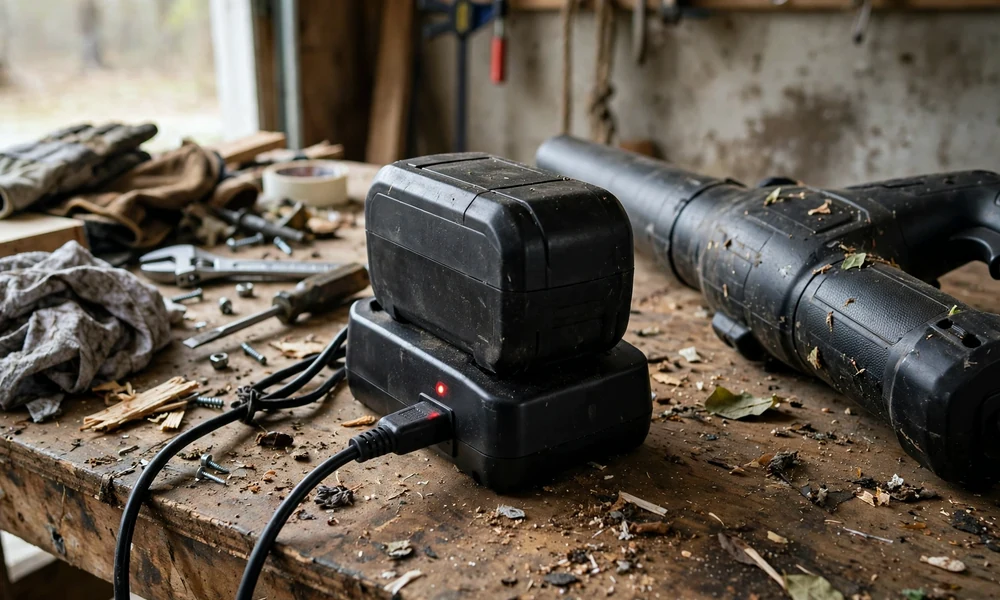
A cordless leaf blower is a simple tool, and a little care keeps it working well for years. Clean the air intake after every session, because leaves and dust clog it quickly and a starved motor works harder and wears faster. Store the battery indoors, in a cool dry place, and never leave it flat for months over winter; a battery stored at around half charge lasts far longer than one left empty in a cold shed. The same care applies to the best pressure washers of 2026 too.
The most common mistake is buying on speed alone, and ending up with a fast, narrow jet that cannot clear a lawn. The second is ignoring runtime. The third is blowing leaves into the wind, which is a losing battle, and the fourth is pointing the nozzle straight down at the ground, which scatters leaves in every direction instead of rolling them forward in a wave. Hold the nozzle at a shallow angle, work with the wind, and gather the leaves into one pile before you collect them. Finally, do not blow leaves into the street or a neighbour’s garden; gather them onto a tarp in your own garden.
A good cordless leaf blower earns its place in the shed by turning the dullest job of autumn into a short walk around the garden. Choose by air volume first, check the real runtime on full power, pick a weight you can carry comfortably, and keep a spare battery charged. Do that, and the leaves will not stand a chance.