A Guide to Humidifier Filters for Cleaner Air in 2026
Humidifier filters are the parts that decide whether your humidifier fills the room with clean, comfortable moisture or quietly spreads mineral dust and stale smells through the air. A fresh wick filter soaks up water evenly and releases it as clean vapour, while a clogged or crusty one struggles to draw water at all, so the machine runs for hours and the room stays dry.
This guide covers the humidifier filters worth buying in 2026: the main types, how to tell when one is finished, and how to match a filter to your machine. It is about filters only, not whole humidifiers. If you are choosing the machine itself, our guide to the best humidifiers of 2026 compares the leading models by room size and type. Here the focus is narrower: the part inside the machine that controls how clean the moisture in your air really is.
Key Takeaways
- A wick filter is the working heart of an evaporative humidifier, and when it crusts over with minerals it stops drawing water and the room stays dry.
- Demineralisation cartridges trap the minerals in hard tap water, which stops the fine white dust that settles on furniture.
- Never run an evaporative humidifier with a dry or missing wick, because the fan then blows dry air and the motor works for nothing.
- A filter that smells musty or stays grey after rinsing is finished, even if the calendar says it has weeks left.
- Match the filter to your exact humidifier model, since a wick that does not fit properly will not draw water evenly.
What a Humidifier Filter Actually Does
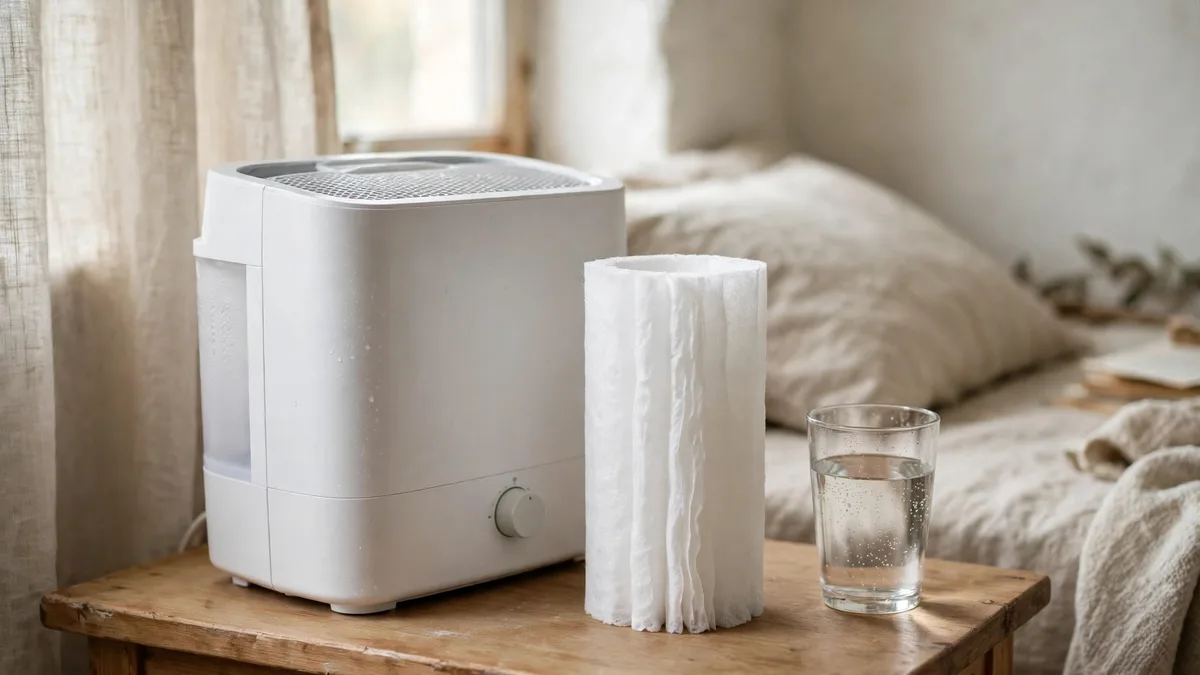
A humidifier filter has a different job from most filters, because it does not just trap things: it carries water. In an evaporative humidifier, the wick filter sits with its base in the water tank and draws water upwards like a candle wick, spreading it across a large surface so the fan can blow air through it and carry the moisture into the room.
The filter also traps things it should not be spreading. Tap water carries minerals, and when that water evaporates, the minerals stay behind in the wick, which is why a used filter turns crusty and stiff at the base. Ultrasonic humidifiers work differently: they turn water into mist with a vibrating plate, so they have no wick at all, and instead they may use a small demineralisation cartridge in the tank. Know which type of machine you own before you buy anything, because the two systems share almost no parts.
The Main Types of Humidifier Filter Compared
Humidifier filters come in three main kinds, and each one suits a different type of machine and a different kind of water. Knowing which is which stops you buying a filter that does not fit.

| Filter type | What it does | Fits which machine | Typical life | Best for |
|---|---|---|---|---|
| Wick filter | Draws water up for evaporation | Evaporative | 1–3 months | Large rooms |
| Demineralisation cartridge | Traps minerals in tap water | Ultrasonic and evaporative | 1–3 months | Hard water areas |
| Antimicrobial wick | Wick with mould-resistant treatment | Evaporative | 2–3 months | Bedrooms and nurseries |
| Activated carbon pad | Absorbs smells from the water | Some evaporative models | 1–2 months | Stale-smelling tanks |
Wick Filters
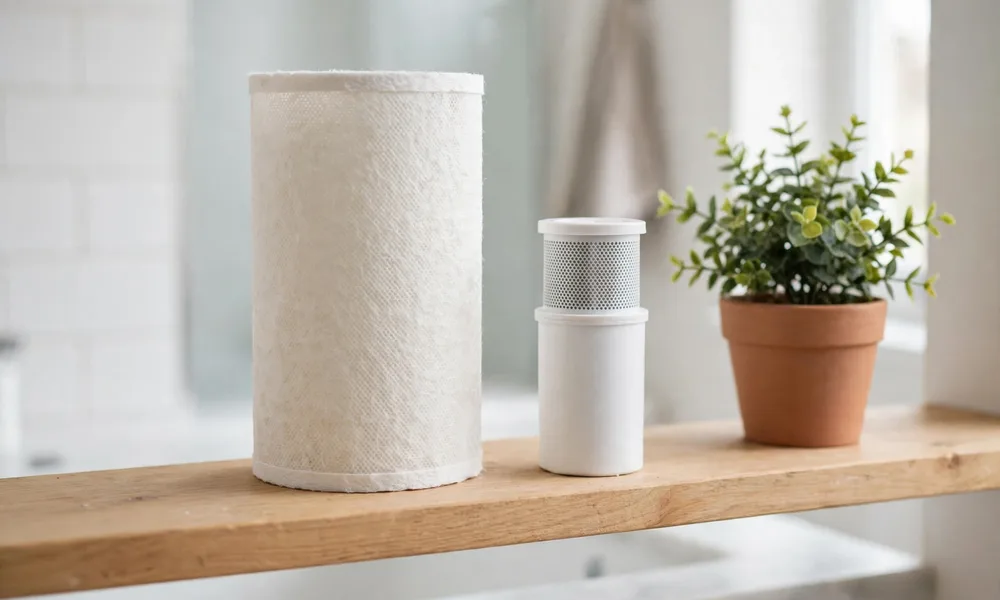
A wick filter is a thick pad of paper or fabric, shaped to fit the tank of an evaporative humidifier, and it is the part that does the real work. Water climbs through its fibres by capillary action, and the fan blows room air across the wet surface, adding moisture naturally. The weakness is mineral build-up: hard water leaves a crust in the fibres that blocks the capillary action, so the top of the wick dries out and output falls away.
Demineralisation Cartridges
A demineralisation cartridge is a small cylinder of resin beads that sits in the water tank and swaps the minerals in tap water for harmless ions before the water reaches the wick or the misting plate. It is the part that stops the fine white dust that settles on bedside tables and television screens in hard-water homes, because that dust is simply the minerals from the water, left behind when the water evaporates. If white dust returns, the cartridge is finished.
Antimicrobial Wicks
An antimicrobial wick is a standard wick treated with a substance that slows the growth of mould and bacteria in the damp fibres. It does not make the filter self-cleaning, and it does not remove the need to rinse the tank and change the water regularly, but it does buy time in the rooms where hygiene matters most, such as bedrooms and nurseries.
Carbon Pads
A carbon pad is a thin layer of activated carbon that sits in some evaporative machines to absorb smells from the water before they reach the room. It is a small part with a short life, usually one to two months, and it is easy to forget, because the machine works perfectly well without it. The sign it has failed is a stale or earthy smell in the mist, which appears even when the tank and the wick are clean.
How to Tell a Filter Is Failing
A failing humidifier filter gives itself away in a few quiet ways. The most obvious is output that fades: the machine runs all night, the tank level barely drops, and the room still feels dry in the morning. That pattern points straight at the wick, because a crusty filter cannot draw water up to where the fan can reach it, so the machine works hard and humidifies nothing.
The second sign is the white dust. A fine white film on furniture near the humidifier means minerals are getting through, which happens when the demineralisation cartridge is exhausted. The simplest test is to look at the wick itself. A finished one is stiff, crusty and brown at the base, and dry at the top. Our guide to the best vs worst humidifiers shows how much of a humidifier’s real-world performance comes down to the parts you can replace, like the filter and the tank design, rather than the features on the box.
How Often to Replace Each Type
Replacement schedules depend on how often the machine runs and how hard your water is, but a few rules hold for most homes. A wick filter lasts one to three months with nightly use, and the shorter end applies in hard-water areas, where mineral crust builds up fast. A demineralisation cartridge lasts one to three months as well, and it is exhausted sooner in very hard water. An antimicrobial wick lasts two to three months, and a carbon pad one to two months.
Judge by the filter itself rather than the calendar. If the wick is stiff or crusty, if the top stays dry while the base sits in water, if white dust has returned, or if the machine smells musty, the filter is finished, even if the box said it had weeks left.
Choosing the Right Filter for Your Humidifier
Choosing a humidifier filter starts with the model number, not the shape. Wicks that look identical can differ by a few millimetres, and a wick that does not sit properly in the tank will not draw water evenly, so one side stays dry while the other soaks. Find the model number on the machine, usually on a label underneath or at the back, and match the replacement to that number exactly. If a listing says it fits several models, check that yours is on the list rather than assuming it is.
Genuine filters and good third-party filters both work, but the difference is usually in the material and the fit. A genuine wick is cut to the exact size of the tank and made from fibres that draw water at the right rate, while a cheap copy can be too loose, too dense or made from material that crusts faster. A hard-water home should prioritise a demineralisation cartridge, and a bedroom or nursery should prioritise an antimicrobial wick. If your home is damp rather than dry for part of the year, our guide to the best dehumidifiers of 2026 covers machines that take moisture out of the air instead.
Cleaning and Caring for a Wick Filter
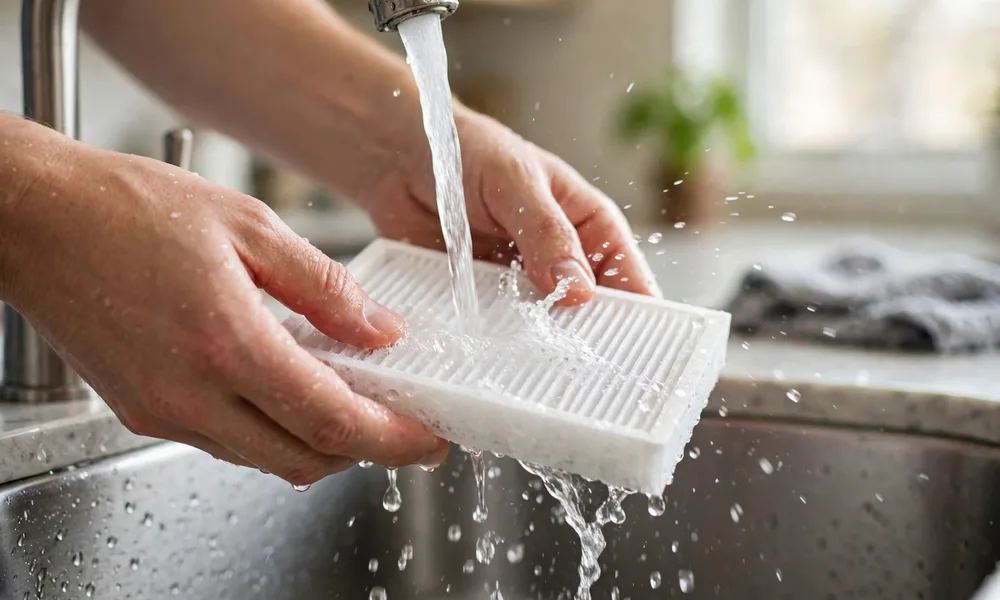
A wick filter can be rinsed, but it cannot really be washed clean, and understanding that limit saves a lot of effort. Rinse the wick gently under a cold tap, letting the water run through the fibres until it runs clear, and never use soap or detergent, because the residue stays in the fibres and blocks the capillary action that draws water upwards. Do not scrub the wick with a brush, which tears the fibres, and do not twist it, which distorts the shape.
If the wick is stiff, brown at the base or musty after a rinse, it is finished, and no amount of soaking will bring it back. The best care is preventive: change the water daily, rinse the tank every few days, and use distilled or demineralised water if your tap water is very hard, because the filter then has far less mineral to trap in the first place.
The Buying Checklist
- Match the filter to your exact humidifier model number, not just to the brand or the shape.
- Work out whether your machine is evaporative or ultrasonic before buying, since the two use different filters.
- Check your water hardness: hard water needs a demineralisation cartridge as well as a wick.
- Look at the old wick before ordering: if the top is dry while the base is wet, the capillary action has failed.
- Buy a spare wick in winter so a failed filter never means a dry bedroom while you wait for delivery.
- Keep the receipt and the box, so you know the date fitted and the exact part number next time.
Frequently Asked Questions
How do I know which filter my humidifier needs?
Find the model number on a label on the machine, usually underneath or at the back, and match the replacement filter to that exact number.
Can I wash a humidifier wick filter?
You can rinse it gently under a cold tap, but you cannot wash it clean the way you would wash a cloth.
Why is there white dust on my furniture?
The white dust is the minerals from your tap water, left behind when the water evaporates. It means the demineralisation cartridge is exhausted, or your machine has no cartridge and the minerals are passing straight through.
How long does a humidifier filter last?
A wick filter lasts one to three months with nightly use, a demineralisation cartridge one to three months, and a carbon pad one to two months.
Can I run my humidifier without a filter?
An evaporative humidifier should never be run without its wick, because the fan then blows dry air and the machine humidifies nothing while the motor works for nothing.
Why does my humidifier smell musty?
A musty smell usually means microbes are growing in the wick or in a tank that has not been rinsed for days.
The Bottom Line
Humidifier filters are small, cheap and easy to forget, and that is exactly why they cause so many problems. A fresh wick draws water evenly, a fresh cartridge keeps mineral dust off your furniture, and a clean tank keeps the air smelling fresh instead of musty. The best filter for your humidifier is the one that fits your exact model, suits your water and gets changed before it fails.