
Why a Good Recliner Is Worth the Floor Space in 2026
A good recliner asks for something no other chair asks for: floor space. It needs room behind it to lean back, room in front of it for the footrest, and room around it so you can actually get in and out. That is a real cost in a small living room, and it is why so many people hesitate before buying one. But a good recliner earns that space back every single evening, in a way few pieces of furniture can. It holds you properly after a long day, lifts your feet and supports your back. The best recliners of 2026 do that job so well that the floor space stops feeling like a sacrifice and starts feeling like the best-spent square metres in the room.
This guide judges recliners the way a real household would: by how they feel after an hour, how the mechanism holds up after a year, and how much room they truly need. It covers manual and power recliners, wall-huggers and full recliners, and the mistakes that turn a good chair into an expensive regret.
Key Takeaways
- A recliner earns its floor space when it supports your whole body: feet up, back supported, head rested, with no pressure points after an hour.
- Wall-hugger recliners need only 10 to 15 centimetres behind them, while full recliners need 45 to 60 centimetres of clearance.
- Power recliners offer precise positions and a smoother motion, while manual recliners are simpler, cheaper and never need a socket.
- Seat height of 45 to 48 centimetres and seat depth of 55 to 60 centimetres suit most adults for sitting down and standing up easily.
- Test the mechanism in the shop: it should move smoothly, lock firmly, and close without slamming.
What Makes a Recliner Different From an Armchair
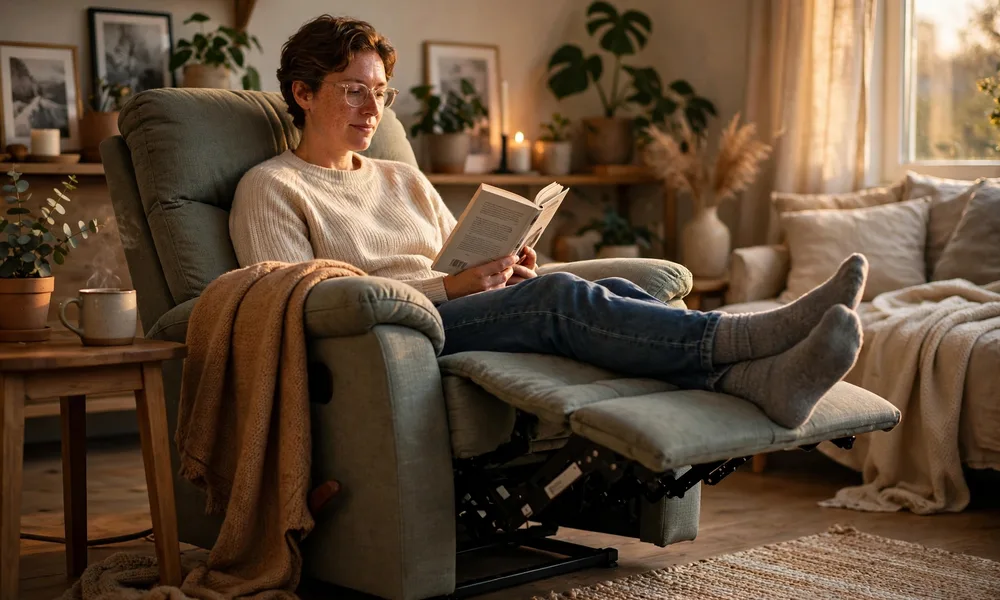
A recliner is an armchair with a moving part, and that moving part changes everything about how it is used. A normal armchair holds you in one position: upright, with your feet on the floor or tucked underneath you. A recliner changes position with you, tilting the backrest down while the footrest rises, until your body is supported along its full length and your weight is spread across the seat, the back and the raised footrest. Instead of your lower back carrying the load, the chair carries it, and your feet are lifted to heart level.
The difference shows up in how long you can sit comfortably. Most people can sit in a standard armchair for an hour before they start shifting, stretching or standing up to ease their back. The mechanism is not a gimmick; it is the whole point of the chair.
Recliner Types at a Glance
| Type | Best for | Clearance needed | Watch out for |
|---|---|---|---|
| Manual recliner | Simple use, no power | 45 to 60 cm behind | Stiff handle, few positions |
| Power recliner | Precise comfort, bad backs | 45 to 60 cm behind | Needs a socket, motor can fail |
| Wall-hugger | Small rooms, against a wall | 10 to 15 cm behind | Less deep recline |
| Rocker recliner | Gentle motion, nurseries | 45 to 60 cm behind | Rocks when you do not want it to |
| Lift recliner | Mobility help, older sitters | 45 to 60 cm behind | Bulky, medical look |
| Push-back recliner | Clean look, no handle | 45 to 60 cm behind | Needs body weight to recline |
The table makes the central trade-off clear: the deeper the recline, the more room the chair needs behind it, and the only way around that is the wall-hugger, which slides forward as it reclines instead of tipping backwards. That single design difference decides whether a recliner can live in a small room at all. That is why the wall-hugger is the type most small-room buyers should look at first.
Manual vs Power: Which Mechanism Suits You?
Manual recliners use a handle or a lever on the side of the chair, or a push-back motion where you lean into the backrest and your body weight opens the footrest. They are simpler, cheaper, lighter and completely free of power sockets, which means they can sit anywhere in the room and they never stop working because of a dead motor or a tripped fuse. The trade-off is control: a manual recliner usually offers two or three fixed positions, and moving between them takes a firm pull or push. For most healthy adults, that is more than enough.
Power recliners use a small electric motor, controlled by buttons on the side of the chair or a wired remote, to move the backrest and footrest independently. That independence is the real benefit: you can raise the footrest without leaning back, or lean back without raising your feet, and you can stop at any angle in between. For people with back pain, limited strength or mobility problems, that precision is not a luxury, it is the reason to buy the chair. The trade-offs are a power cable, a higher price, and a motor that will eventually need repair. Test both types in the shop, and listen: a good mechanism moves quietly, while a cheap one grinds or clicks.
How Much Floor Space Does a Recliner Really Need?
Floor space is the honest cost of a recliner, and it is worth measuring properly before you fall in love with a chair in the showroom. A typical recliner is 85 to 100 centimetres wide and 90 to 105 centimetres deep when closed. When it reclines, it needs 45 to 60 centimetres behind it plus the footrest extending 50 to 60 centimetres in front, so the chair can occupy up to 170 centimetres from wall to footrest when fully open. Tape that full footprint on the floor before you buy, not just the closed size.
Wall-huggers change the maths. Because the seat slides forward as the back tilts, a wall-hugger needs only 10 to 15 centimetres behind it, and the total open depth is closer to 140 centimetres. That saving of 30 centimetres or more is often the difference between a recliner fitting in the room and not fitting at all. If your room is tight, the wall-hugger is the answer, and the worst furniture buys for small spaces show what happens when a piece is bought without this kind of measurement: one oversized item can decide whether a room feels calm or constantly in the way.
Comfort, Support and Your Back
A recliner is often bought for a bad back, and it can genuinely help, but only if the support is in the right places. The lumbar region, the curve at the base of your spine, needs firm support when you sit and when you recline, and a chair that lets your lower back sag will make a bad back worse, however soft the cushions feel at first. Sit in the chair for ten minutes in the shop and check your lower back feels held, not hollow, and your head rests comfortably when fully reclined.
Seat height and depth decide whether the chair is easy to live with day to day. A seat height of 45 to 48 centimetres lets most adults sit down and stand up without a struggle, while a lower seat can trap older sitters and a higher one leaves shorter legs dangling. Seat depth of 55 to 60 centimetres suits most bodies for upright sitting, and the recline takes over from there. And the footrest should support your legs along their full length, from knee to heel, because a footrest that ends at your calves leaves your feet hanging. The best vs worst armchairs of 2026 are judged on the same qualities.
Fabric, Leather and Durability
A recliner is a mechanical piece of furniture, and the moving parts are where durability is decided. The frame should be solid hardwood or heavy plywood, joined properly, because the mechanism puts repeated stress on the frame every time the chair opens and closes. The mechanism itself should feel solid and smooth, with no wobble in the footrest when it is extended and no creak when you shift your weight. A good warranty on the mechanism, ideally five years or more, is a sign the manufacturer trusts its own engineering.
Fabric and leather are the other half of the decision. Leather wipes clean and ages well, but it can feel cold in winter and shows scratches from pets. Tight-weave fabric is the most forgiving all-round choice: it breathes, it resists stains better than loose weaves, and it does not show every mark. The armchairs that make any corner feel like home face the same test, and the chairs that pass it are the ones with solid frames and honest fabric, not the ones that merely photograph well.
Where a Recliner Works Best, and the Mistakes to Avoid
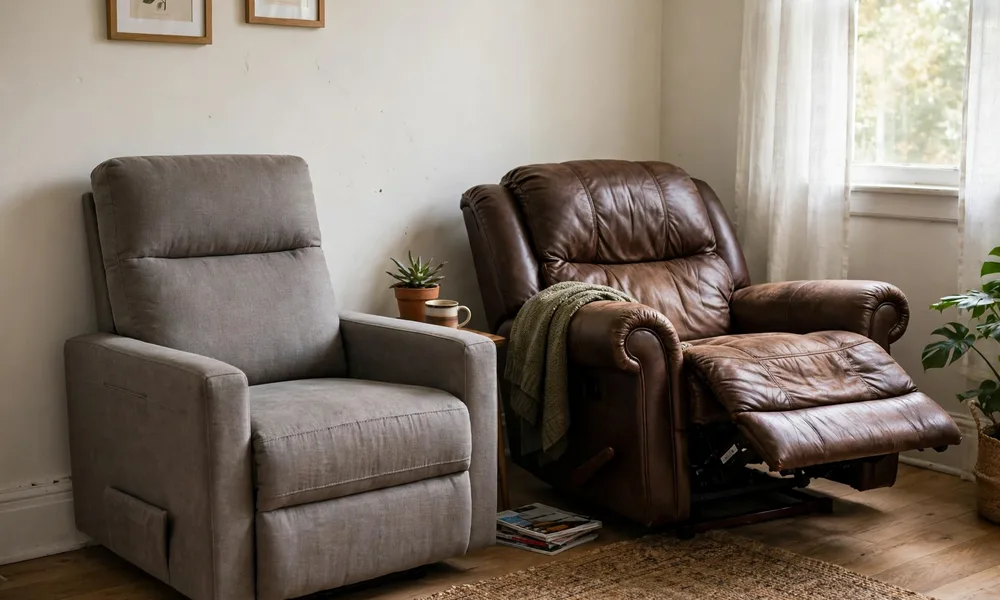
The best spot is usually a corner with a lamp and a side table, where the chair becomes a destination rather than an obstacle. A small table within reach holds the book, the glasses and the mug. That corner needs a power socket nearby if the chair is a power model, and the cable should run neatly along the wall rather than across the walkway, where it becomes a trip hazard.
The most expensive mistake is buying the wrong size for the room. The second mistake is buying the cheapest mechanism: a handle that sticks, a footrest that slams shut, or a motor that grinds will turn a daily pleasure into a daily irritation, and the repair bill will erase the saving within a year. The third is buying for looks alone, and the fourth is skipping the sit test. Buy slowly: measure, sit, and test before you spend.

Recliner Buying Checklist
- Tape the full open footprint on the floor, including clearance behind and the extended footrest in front.
- Sit in the chair for at least ten minutes, upright and fully reclined, and check your lower back and neck feel supported.
- Open and close the mechanism three times and listen for grinding, clicking or slamming.
- Check the seat height is 45 to 48 centimetres and the seat depth is 55 to 60 centimetres for your body.
- Confirm the weight rating, the mechanism warranty, and whether a power model has a battery backup.
- Make sure there is a power socket nearby for a power recliner, with the cable routed safely along the wall.
Frequently Asked Questions
How much space do I need behind a recliner?
A full recliner needs 45 to 60 centimetres of clear space behind it. A wall-hugger needs only 10 to 15 centimetres, because the seat slides forward as it reclines.
Are power recliners better than manual recliners?
Power recliners offer more precise positions, because the backrest and footrest move independently. Manual recliners are simpler, cheaper, lighter and never need a socket.
Can a recliner fit in a small living room?
Yes, if you choose a wall-hugger and measure the open footprint first. Tape the footprint on the floor and live with it for a day before you buy.
Is a recliner good for a bad back?
A good recliner can help, because it supports your back and lifts your feet. Sit in it for ten minutes before buying.
How long should a recliner last?
A well-made recliner should last ten to fifteen years with daily use.
What is the best fabric for a recliner?
Tight-weave or performance fabric is the most forgiving choice, because it breathes and resists stains. Leather wipes clean but shows scratches from pets.
The Bottom Line
A good recliner is worth the floor space because it is the one chair in the house that works as hard as you do: it holds your back, lifts your feet, and gives you a place to properly rest at the end of the day. Measure the open footprint, test the mechanism, choose a wall-hugger if the room is tight, and buy the chair your back wants rather than the one that photographs best.


