A capo has one job: to clamp across the strings at a chosen fret, so a guitarist can play in a different key with familiar chord shapes, without buzzing, without pulling the guitar sharp, and without slipping. The worst capos of 2026 fail at it in ways that leave a player with buzzing strings, a guitar that sounds out of tune, or a capo that slides off mid-song. They press too hard on some strings and too little on others, they pull the guitar sharp, or they will not fit the neck at all. Players buy them hoping for a simple tool that just works. What they get is a capo that buzzes, a capo that slips, or a capo that damages the very neck it clamps.

Uneven Pressure and Buzzing Strings
A capo must press all six strings evenly, and the worst ones cannot. A capo with a flat bar on a curved fretboard presses the middle strings hard and leaves the outer strings loose, so the outer strings buzz. A capo with a curved bar on a flat fretboard does the opposite, pressing the edges and leaving the middle to buzz. The buzz is worst on the high E string, which is thin and needs little pressure to ring, and on the low E, which is thick and needs more. A capo that buzzes is a capo that makes every chord sound wrong, however well the player plays, because the buzz is in the tool, not the hands.
Look for a capo with a bar that matches the curve of your fretboard, and check it by playing every string at the capoed fret, slowly, and listening for buzz. A capo with an adjustable tension lets you dial in just enough pressure to stop the buzz without pulling the guitar sharp, while a fixed-spring capo gives you whatever pressure the maker chose. Test the capo at several frets, because the curve of the neck changes as you go up, and a capo that works at the second fret may buzz at the fifth. A capo that holds every string evenly is a capo that works, and a capo that buzzes is a capo that should go back.
Capos That Pull the Guitar Sharp
A capo presses the strings down to the fret, and the worst ones press too hard, pulling the guitar sharp. A string that is pressed hard stretches slightly, and a stretched string sounds sharp, so a guitar that was in tune before the capo goes on is out of tune after it. The problem is worst with strong spring capos, which press far harder than they need to, and on light-gauge strings, which stretch more easily. A player who has to retune after fitting a capo is a player whose capo is fighting the guitar, and a capo that pulls the guitar sharp is a capo that makes the player sound out of tune, however well they play.
Use as little pressure as you can: fit the capo just behind the fret, not in the middle of the fret space, and tighten it only until the buzz stops. A capo with adjustable tension is worth paying for, because it lets you use the minimum pressure for your strings. Check the tuning after fitting the capo, and retune if needed, because even a good capo will pull the guitar slightly sharp. A capo that needs only light pressure is a capo that works, and a capo that needs a death grip is a capo that will pull the guitar sharp every time. Our guide to the best guitar cases of 2026 covers the cases that protect a capo and the guitar it belongs to, because a capo rattling loose in a bag is a capo that will break.
Capos That Slip and Move
A capo must stay where it is put, and the worst ones slip. A capo with a weak spring slides down the neck when the player strums hard, and a capo with a smooth bar slides sideways, so the strings are no longer covered evenly. The slip is worst during a lively song, when the player is strumming hard and cannot stop to fix it, and a capo that moves mid-song is a capo that ruins the song. Some capos slip because their rubber pad is worn or hard, and some slip because the spring was weak from the start. A capo that cannot stay put is a capo that cannot be trusted, because the player never knows when it will move.
Check the spring before you buy by fitting the capo and strumming hard, and watching whether it moves. The rubber pad should be soft and grippy, not hard and shiny, because a hard pad slides and a soft pad grips. A capo with a strong, even spring and a fresh rubber pad will stay put through a whole set, while a capo with a weak spring will slip on the first loud chorus. Replace the rubber pad when it wears, because a worn pad is the most common reason a good capo starts to slip. A capo that stays put is a capo that can be trusted, and a capo that slips is a capo that will be lost mid-song.
Damage to Necks and Finishes
A capo clamps onto the neck, and the worst ones damage it. A capo with a hard metal bar and no padding scratches the finish, and a capo left on the neck for days leaves a mark where the pressure was. The damage is worst on guitars with a soft finish, where a capo can leave a dent in the lacquer, and on vintage guitars, where the finish is thin and fragile. A capo that damages the neck is a capo that costs more than its price, because the repair costs more than the capo ever did. A player who finds a mark on their guitar after using a capo is a player whose capo has failed at the most basic courtesy: to hold the strings without harming the instrument.
Look for a capo with a soft rubber pad that covers the whole bar, and never leave a capo on the guitar when it is not in use. Take the capo off after every session, and store it in the case, not on the neck, because a capo left on the neck for a week will leave a mark. Check the pad regularly, and replace it when it wears thin, because a worn pad lets the metal touch the wood. A capo with a good pad is a capo that protects the guitar, and a capo with a hard bar is a capo that will scratch it. If the practice routine needs a steady pulse too, our guide to the best metronomes of 2026 covers the metronomes that keep time without getting in the way.
Capos That Will Not Fit the Neck
Guitar necks come in many shapes and widths, and the worst capos fit only one of them. A capo made for a narrow electric neck will not span a wide classical neck, and a capo made for a flat fretboard will not sit properly on a curved one. A capo that is too short leaves the outer strings uncovered, so they ring open while the others are capoed, and a capo that is too long overhangs the neck and catches on the player’s hand. A capo that does not fit the neck is a capo that was bought for the wrong guitar, however good the capo itself is, and a player who has to force a capo on is a player who will damage the guitar.
Measure your neck before you buy, and check the width at the fret where you use the capo most, because the neck gets wider as you go up. Look for a capo made for your type of guitar: classical, steel-string acoustic, or electric, because each has a different width and curve. Test the capo on your own guitar, at several frets, and check that it covers all six strings evenly without overhanging. A capo that fits your neck is a capo that works, and a capo that does not fit is a capo that will be returned. A capo that fits is worth paying for, because a capo that almost fits is a capo that buzzes.
Springs Too Strong to Move
A spring capo must be easy to move, and the worst ones need two hands and a struggle. A spring that is too strong makes the capo hard to open, so the player cannot move it quickly between songs, and a capo that needs both hands to move is a capo that cannot be used on stage. The strong spring also presses too hard, pulling the guitar sharp, and it tires the hand, so a player who moves the capo often ends the night with a sore hand. A capo that is hard to move is a capo that fights the player, and a player who fights their capo is a player who will stop using it, which defeats the purpose of owning one.
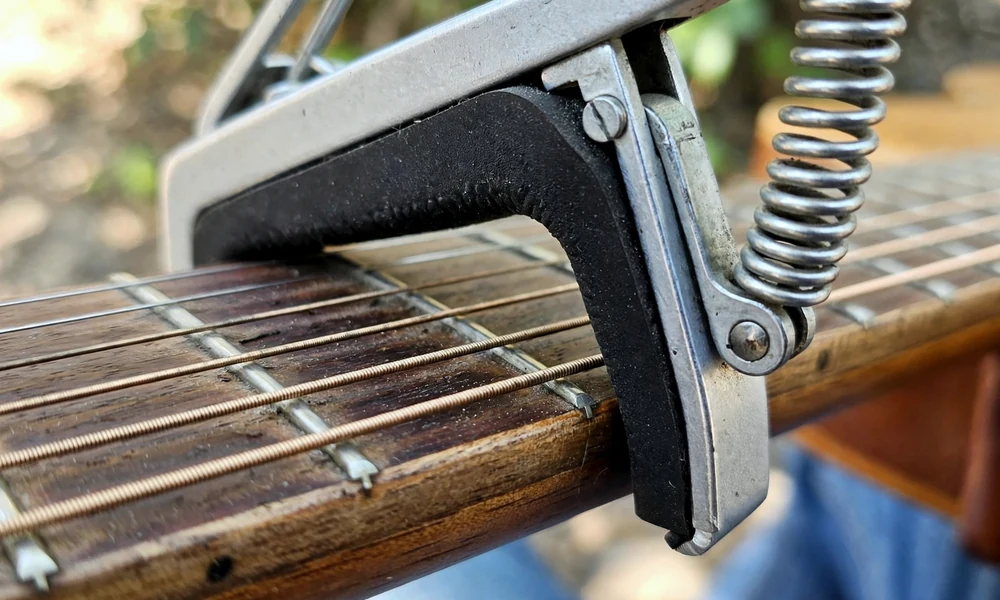
Test the spring before you buy by opening and closing the capo with one hand, several times, and feeling whether it is easy or a struggle. A good spring capo opens smoothly with one hand and closes with just enough pressure to stop the buzz. A capo with adjustable tension is better still, because it lets you set the pressure for your strings and your guitar. A capo that moves easily is a capo that gets used, and a capo that needs a struggle is a capo that will be left in the case. Our guide to the best banjos of 2026 covers another instrument where a capo that fits badly causes the same trouble.

What to Buy Instead
The capos worth buying share a short list of features, and none of them is expensive on its own. A bar that matches the curve of your fretboard, with a soft rubber pad that covers the whole bar, and adjustable tension so you use only the pressure you need. A spring that opens easily with one hand, a size that spans your neck without overhanging, and a pad that grips without slipping. If a capo fails any one of those checks, keep looking.
Fit matters as much as build, and the capo should suit the guitar in front of you rather than the guitar in the photograph. Measure your neck, check the curve of the fretboard, and test the capo at several frets before you buy. A capo that fits your guitar is a capo that disappears into the playing, and a capo that fights it is a capo that will be left in the case. Buy the capo for the guitar you own, and take it off after every session.
The Bottom Line
The worst capos of 2026 share a pattern: uneven pressure and buzzing strings, capos that pull the guitar sharp, capos that slip and move, damage to necks and finishes, capos that will not fit the neck, and springs too strong to move. Avoid those six failures and you avoid almost every capo regret. Match the bar to your fretboard, use the minimum pressure, and test it on your own guitar. Do that, and the capo you buy will be the one that lets you change key without a second thought, not the one that buzzes, slips, or scratches the neck.